
Vinicius Júnior celebrates Real Madrid’s Champions League qualification

The decisive clash between Champions League culminated in Real Madrid progressing to the round of 16 after an essential victory over Benfica. The result, which confirmed the favoritism of the Spanish team, was marked by yet another outstanding performance from striker Vinicius Júnior, whose goal celebration once again captured attention and reignited important discussions on the international sporting scene. The young talent, known for his vibrant style on the field, reiterated his characteristic gesture, transforming a moment of joy into a statement against prejudice.
In the match played this Wednesday, February 25, 2026, at the legendary Santiago Bernabéu, Real Madrid secured a fundamental triumph that sealed their early classification for the next phase of the most prestigious European competition. The victory was built with tactical intelligence and the individual contribution of its athletes.
Vinicius Júnior’s decisive goal, the team’s second of the night, was one of the highlights of the game, demonstrating his growing influence and lethality in the Merengue attack. Após the final whistle, number 7 used his social networks to share the joy of classification and the importance of his message, showing photographs of his celebration flanked by an anti-racist banner held up by the fans.
Celebration in focus: the dance that sparked debate
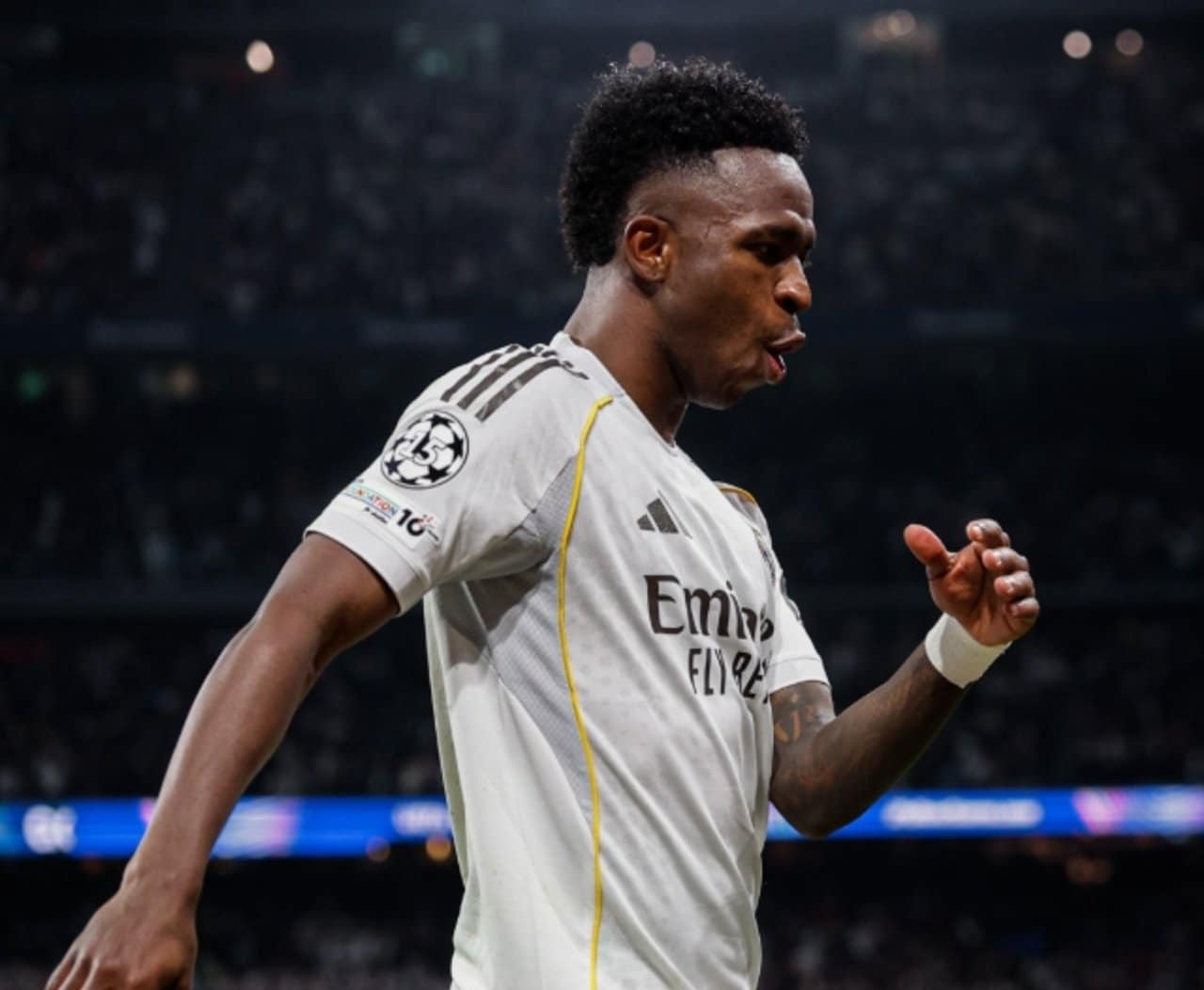
The Vinicius Júnior dance, often performed in front of the corner flag, became the striker’s signature, a symbol of his irreverence and joy in football. Mais than a simple celebration, the gesture became a cultural manifestation and, in the face of recent episodes of racist attacks, a flag of resistance.
This exuberant way of celebrating goals, however, is not universally accepted and was the trigger for a significant controversy during the first leg between Real Madrid and Benfica. Naquele previous game, the Brazilian’s celebration generated intense friction with players and part of the Portuguese team’s fans, highlighting the different interpretations of the same act on the professional field.
The decisive match and confirmation of the place
The return duel for Champions League represented a crucial milestone for both teams, with Real Madrid looking to consolidate their position and Benfica fighting to reverse an unfavorable score. The atmosphere at Santiago Bernabéu was one of great anticipation, with fans eager for a victory that would ensure progression into the most watched club competition on the planet.
Real Madrid’s performance was solid, with the team controlling the actions and creating the best opportunities throughout the ninety minutes. Vinicius Júnior’s goal was a moment of clarity in the match, not only extending the lead, but also reaffirming the home team’s technical and tactical dominance in the competition.
With the positive result, the Spanish giant confirmed its presence among the 16 best clubs in the Europa, keeping alive its dream of winning another cup in the Liga of the Campeões. The victory, built on the intelligence and skill of the squad, demonstrated the team’s strength and ability to overcome pressure in moments of pressure on the European stage.
Reactions after the final whistle
Real Madrid’s goalkeeper, Thibaut Courtois, expressed his unrestricted support for Vinicius Júnior, encouraging his teammate to continue with his authentic and personality-filled celebrations. In a statement to Movistar after the game at Santiago Bernabéu, Courtois stated that Vini’s dance not only expresses the player’s personality, but is also a positive indication that he is scoring goals and contributing decisively to the team’s success.
Freedom of expression and the individuality of athletes on the field are recurring themes in modern football, generating constant debates about their limits and interpretations. Enquanto Some see celebrations as a legitimate way of expressing joy and passion for sport, others interpret them as unnecessary provocations. Vinicius Júnior’s dance fits into this context, becoming a symbol of boldness and joy, elements that, for many, enrich global football culture.
The controversy of the first clash
The first leg between Real Madrid and Benfica was the scene of a controversy that dragged on until the return game, intensifying the debate about behavior on the field and respect. Vinicius Júnior’s celebration at the corner flag, seen by some as a provocation, generated a widespread uproar, with players and part of the Benfica fans reacting vehemently. In the heat of the discussion, the Brazilian striker claimed to have been the target of a racist insult, claiming to have heard Gianluca Prestianni, a player from the Portuguese team, utter the term “monkey”. Este incident, which quickly gained international repercussion, highlighted the persistence of racism in football and the vulnerability of black athletes in the face of such offenses, even on highly visible stages like Champions League.
José Mourinho’s view of what happened
After the incident in the first leg in Portugal, coach José Mourinho, then in charge of Benfica, publicly expressed his view on the confusion. Ele attributed the responsibility for the escalation of tempers to Vinicius Júnior’s celebration, arguing that the Brazilian’s gesture would have been the turning point that destabilized the game’s atmosphere.



Mourinho did not hesitate to blame Vinicius, stating that the striker “ended the game” by provoking the opposing stadium with his celebration. The Portuguese coach’s statement raised questions about the interpretation of the players’ actions and the fine line between personal celebration and provocation in a high-tension environment.
The perspective of Mourinho, who defended his player and his team, was that such a significant goal should be celebrated in a more restrained way, without “stirring the hearts of the opposing stadium”. Ele suggested that the Brazilian’s attitude would have diverted the focus of the match to the controversy.
This interpretation, however, is often contested by defenders of players’ freedom of expression and by those who see accusations of provocation as an attempt to divert focus from possible racist acts. The debate highlights the complexity of managing emotions and behaviors in major sporting competitions.
Paths of real madrid in the Champions League
Qualifying for the round of 16 is a crucial step in Real Madrid’s journey towards glory in the Champions League, a competition that the club has historically dominated. The team is now preparing for an even more challenging knockout phase, where every tactical detail and individual performance will be decisive for advancing towards the cup.
With the place secured, the focus turns to analyzing possible opponents. The draw will decide whether Real Madrid will face the powerful Manchester City, from Inglaterra, or Sporting, from
The draw and next steps
The long-awaited draw that will define the round of 16 clashes of the Liga of the Campeões is scheduled for next Friday, February 27, 2026, starting at 8 am, Brasília time. Este event will be crucial for the future strategies of the classified clubs.
Vini Jr. and its role in modern football
Vinicius Sua speed, dribbling and decision-making are fundamental pillars for Real Madrid’s attack, making him an irreplaceable part of the team. Além of his technical prowess, Vini Jr. has emerged as a global spokesperson in the fight against racism in sports, using his platform to call out injustices and inspire millions of young athletes and fans around the world.
Its influence manifests itself in several aspects:
– Raising awareness about racism, by transforming offenses into opportunities for debate and change.
– Representing a new generation of athletes who combine sporting excellence with social engagement.
– In redefining how goal celebrations can be seen, as authentic expressions of joy and culture.
Vinicius Júnior’s resilience in the face of prejudiced attacks and his courage in maintaining his celebrations, despite criticism and controversy, established him as an icon that goes beyond the four lines. Ele represents the hope of a more inclusive and respectful football for future generations, a sport where passion and joy prevail over hatred and intolerance.
Veja Tambem em News (EN)

Research reveals that parents are unaware of how their children use artificial intelligence

Samsung releases new system update with new features for Galaxy Watch 4 users

Digital retail reduces the value of the Galaxy S25 5G smartphone with bank bonuses and device exchange

Amazon’s wireless CarPlay adapter has a 50% discount and high approval ratings from drivers

Zach Cregger’s new Resident Evil ignores games and focuses on an unprecedented story with new characters

Rumor suggests that Nintendo is preparing a special edition of the Switch 2 with a remake of Ocarina of Time

Apple accelerates production of the iPhone 17e and develops new Air model with dual camera system

Epic Games platform releases twelve high-budget games at no permanent cost for PC users

PlayStation 5 Pro price drop accelerates digital retail sales and eliminates global stocks

New Galaxy Watch 9 firmware appears on server and confirms progress in software development

Apple’s commemorative project tests cell phone with 1.1 millimeter edge and curved screen for 2027
