
Alignment of stars allows the Moon and four planets to be seen with the naked eye across the country this week


Observers from all regions of Brasil have a unique opportunity to follow a celestial phenomenon that brings together five bodies of Sistema Solar in the same visual range. The event, which remains visible until next Saturday, February 28th, highlights the simultaneous presence of Lua alongside Vênus, Mercúrio, Saturno and Júpiter. Especialistas of Observatório Nacional indicate that the spectacle can be enjoyed without the need for advanced equipment, simply by looking at the western horizon.
The current configuration of the stars is the result of their orbits around Sol, creating a perspective of proximity when seen from Terra. The best time for viewing occurs during twilight, just after sunset, when the gradual darkening of the sky allows the planets’ brightness to shine. Embora Urano and Netuno are also in the region, observation of these requires the use of telescopes due to the low luminosity.
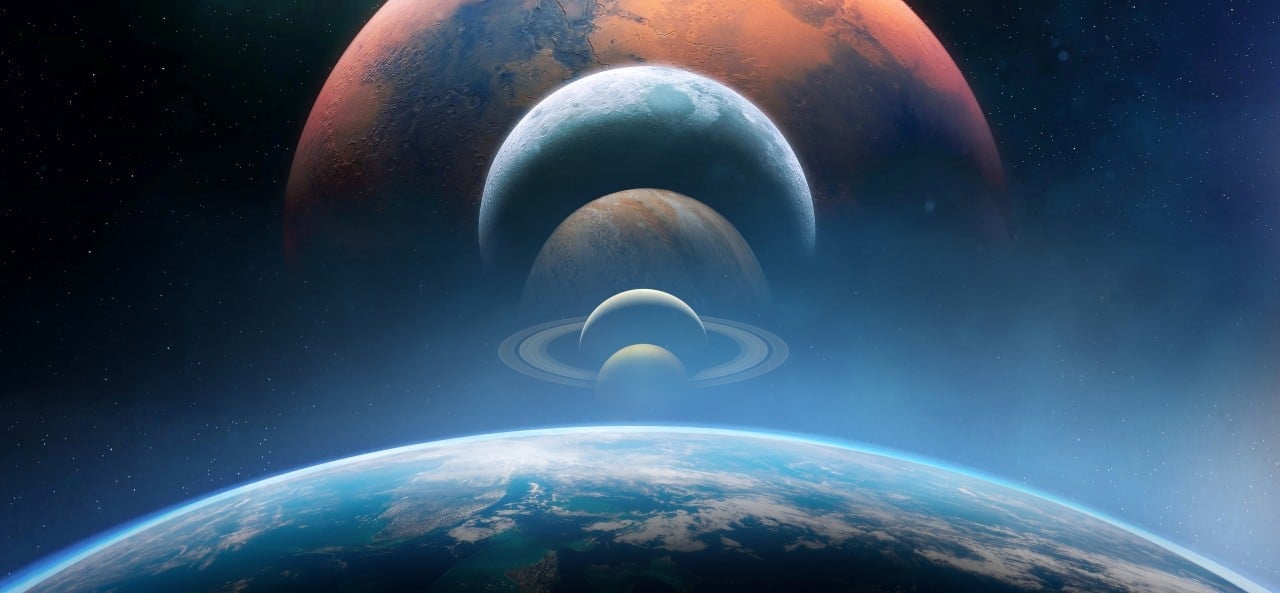
Identification of planets on the horizon
For those who want to identify each luminous point, Vênus appears as the brightest and easiest star to locate as soon as the sun sets. Júpiter, in turn, is in a higher position in the firmament, close to the constellation of Gêmeos, maintaining a constant and intense brightness. Já Saturno and Mercúrio require a little more attention, as they are positioned lower, close to the horizon line.
The Lua plays a fundamental role in the composition of the scenario, presenting itself in a growing phase and heading towards flooding. Sua dynamic position changes slightly each night, reaching a few degrees away from Júpiter at specific times this week, which makes it easier for beginner observers to locate other celestial bodies.
Orbital dynamics and terrestrial perspective
The phenomenon, popularly called planetary alignment, is actually an optical illusion caused by the relative position of Terra. The planets are not physically aligned in a straight line in space, but their elliptical orbits and distinct speeds make them periodically appear to cluster together in a specific sector of the night sky.
Astronomers compare the situation to observing a line of people while standing inside it. Essa terrestrial perspective creates the impression of proximity between stars that, in reality, are millions of kilometers apart. The event serves as a practical tool for studying orbital movements and refining astronomical models.
Best Practices for Observation
To ensure the best viewing experience, it is recommended to begin observation between 30 and 60 minutes after local sunset. Locais with little light pollution, away from large urban centers, they offer greater contrast and sharpness. Além Furthermore, it is essential to look for a point with the western horizon free of obstacles, such as tall buildings or mountains, especially to see Mercúrio before it disappears.
The planetary grouping is accessible throughout the national territory and does not pose any risk to vision. Aplicativos astronomy charts for smartphones can be used as auxiliary tools to pinpoint the exact location of each planet in real time, making identification easier for the lay public.



