
Alma telescope captures cosmic gas network at the heart of the galaxy revealing unprecedented chemical details

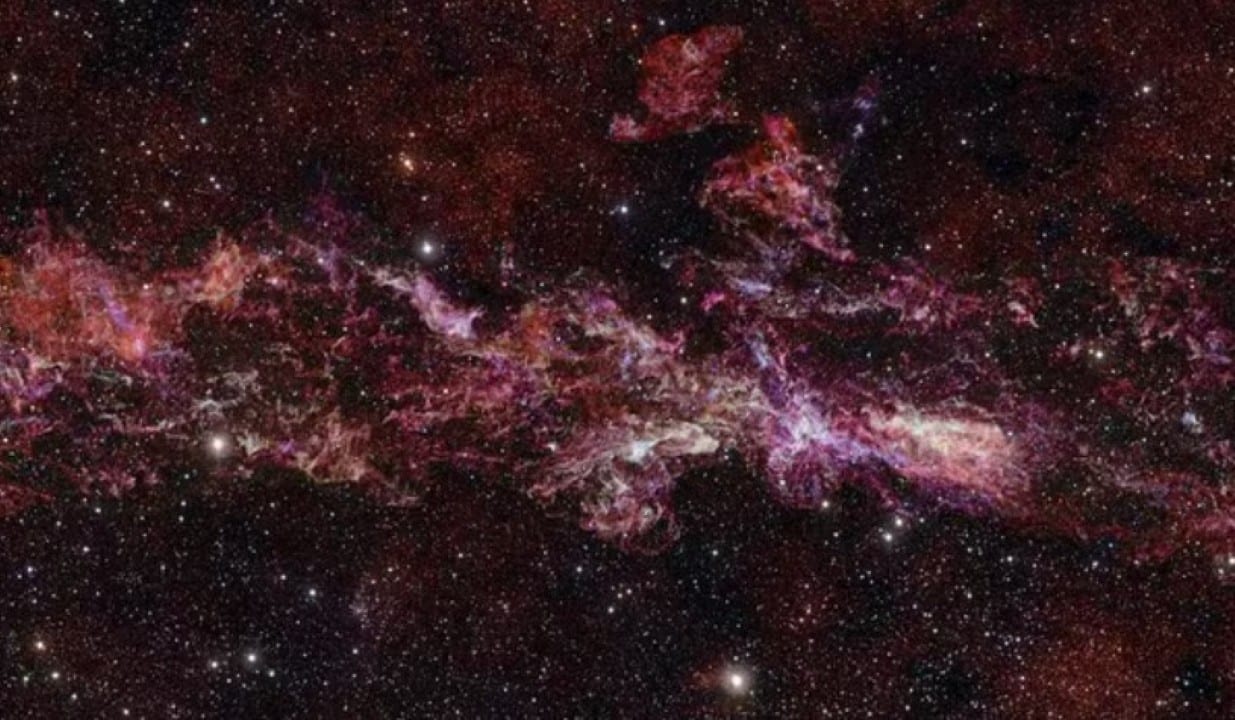
Astronomers from Observatório Europeu of Sul have released a new image captured by the Alma telescope, revealing a complex network of cosmic gas filaments at the center of Via Láctea. Essa observation, carried out in the Atacama desert, at Chile, at 10 am local time on February 25, 2026, marks the largest mosaic ever produced from this galactic region.
The image covers an area of more than 650 light-years and highlights Zona Molecular Central, a dense area of gas and dust around the supermassive black hole Sagittarius A*. The data allows for an in-depth analysis of the raw material for star formation, with the detection of several molecules that range from simple to complex.
The results were presented in five scientific papers accepted for publication, providing insights into extreme environments similar to early galaxies. Essa discovery improves understanding of how stars are born in chaotic conditions, influenced by the proximity of the central black hole.
Observation details by Alma
The Alma telescope, made up of 66 antennas, captured millimeter waves that penetrate dense dust clouds, invisible to optical light. Essa technique has revealed filaments of cold molecular gas stretching tens of light years, fueling clusters where new stars can form. The image resolution makes it possible to identify structures ranging from large clouds to small concentrations around individual stars.
Furthermore, the observation detected molecules such as silicon monoxide, methanol, acetone and ethanol, indicating a rich and varied chemistry in the region. Esses organic compounds suggest processes similar to those occurring in other active galaxies, where star formation is intense. Astronomers highlight that this detailed view is crucial for modeling galactic evolution.
Chemical composition revealed
The analysis identified dozens of different molecules in Zona Molecular Central, highlighting the chemical diversity in an extreme environment. For example, cold gas flows along filaments that connect high-density regions, facilitating the gravitational collapse necessary for star birth. Essa dynamics are influenced by the gravity of the supermassive black hole, which distorts the flow of matter.
The data also shows variations in the distribution of molecules, with higher concentrations in certain clouds. Isso indicates chemical reactions driven by shocks and radiation, common in galactic central zones. The research compares this region with older galaxies, where similar conditions promoted bursts of star formation.
Researchers noted that the chemistry detected includes prebiotic compounds, potentially relevant to studies on the origins of life in other systems. However, the focus remains on understanding stellar physics, without speculation beyond observed facts.
Impact on modern astrophysics
The ACES project, responsible for the survey, combined hundreds of observations to create the complete mosaic. Essa approach allowed us to map cold molecular gas across the entire extent of the central zone, revealing flow patterns that were previously unknown. Astronomers use this data to simulate computer models of galactic evolution.
Additionally, the image assists in the investigation of supermassive black holes and their role in regulating star formation. In regions like this, black hole activity can suppress or encourage star birth, depending on local conditions. Essa duality is essential for understanding galaxies at different evolutionary stages.
International collaboration, involving institutions like Liverpool John Moores University, reinforces the importance of observatories like Alma for advances in science. The results open avenues for future observations with complementary telescopes, such as the James Webb.
Comparisons with previous data show a significant improvement in resolution, allowing more accurate analysis of gas velocities and densities.
Exploration of gaseous filaments
Filaments of cold molecular gas represent the fundamental raw material for star formation in Zona Molecular Central and Via Láctea, where extreme conditions such as high density and intense radiation shape the cosmic environment. X__NM2____ Furthermore, the presence of the supermassive black hole at the center influences these flows, creating turbulence that can accelerate or inhibit the formation of new stars, as observed in recent data from the Alma telescope. The detection of complex organic molecules, such as ethanol and acetone, suggests chemical reactions driven by interstellar shocks, which enrich the gas with heavy elements released by previous stars, contributing to the region’s chemical diversity; This enrichment cycle is crucial for understanding how galaxies evolve over billions of years, comparing Via Láctea with more primitive galaxies where bursts of star formation were common. Astronomers use these insights to refine theoretical models, incorporating gas velocity data that reveal patterns of rotation and expansion around the black hole, helping to map the distribution of dark mass in the central zone; Furthermore, the observations highlight variations in the temperature of the gas, with colder areas prone to condensation and the formation of dense molecular clouds. Essa In-depth understanding allows us to predict future scenarios for the evolution of our galaxy, integrating multimodal observations from other telescopes for a holistic view of the galactic center.
Technological advances in mapping
The use of interferometry on the Alma telescope allowed the creation of a mosaic that unites multiple observations into a cohesive image. Essa technique improves spatial resolution, capturing fine details that optical telescopes cannot detect due to obstruction by dust.
The processed data involves advanced algorithms to correct atmospheric distortions, ensuring precision in molecule measurements. Essa technological innovation sets precedents for similar studies in other galaxies.
Context of Zona Molecular Central
Zona Molecular Central covers an area rich in gas and dust, essential for galactic dynamics. Nessa region, the supermassive black hole acts as a regulator, influencing the movement of gas through its immense gravity.
Previous studies indicated the presence of filaments, but the new image provides quantitative evidence of their role in star formation. High density creates conditions for massive stars, which live briefly and enrich the interstellar medium.
Complementary observations at other wavelengths corroborate the findings, showing consistency in the chemical patterns detected.
Comparison with active galaxies reveals similarities, suggesting that Via Láctea went through similar phases in its past.
Specific molecular discoveries
Among the molecules detected, silicon monoxide indicates shock processes in gas clouds. Essa detection helps trace the history of dynamic interactions in the central region.
Organic molecules like methanol point to complex pre-stellar chemistry, where compounds form before stars. Isso enriches the understanding of environments conducive to chemical complexity.
The uneven distribution of molecules reflects temperature and density gradients, influenced by the black hole. Áreas closer together show greater molecular agitation.
These findings encourage searches for similar signatures on exoplanets, expanding the scope of astrochemistry.
Global scientific collaboration
The project involved teams from multiple countries, coordinated by ESO, highlighting the importance of cooperation in astronomy. Recursos shared like Alma facilitates large-scale discoveries.
The published articles detail methodologies, allowing replication and advancement by other researchers. Essa transparency strengthens scientific credibility.
Perspectives for future studies
Observations planned with Alma aim to monitor temporal variations in the gas filaments. Isso can reveal star formation cycles in real time.
Integration with James Webb data will enhance infrared analysis, complementing millimeter observations. Essa synergy promises revelations about hot dust and gas.
Computational models based on this data will simulate galactic evolutions, testing theories about black holes.
Expanding the survey to peripheral regions will compare contrasts with the extreme center.




