
Volkswagen’s unprecedented Tukan pickup truck will be produced in Paraná and feature a hybrid system to face rivals

The national automotive industry is preparing to welcome a new major player in the commercial vehicle segment, with the official confirmation of the production of a new model by the German automaker. Volkswagen defined the strategy to fill an important gap in its portfolio, positioning the new vehicle as a direct response to the consolidated leadership of competitors such as Fiat Toro and Chevrolet Montana. The project, which had been speculated under various codenames, finally gained a defined identity and schedule, promising to shake up the market with electrification technologies.
The official announcement took place at a strategic event held at the headquarters of Confederação Brasileira of Futebol (CBF), at Rio of Durante the presentation, the manufacturer revealed not only the definitive name of the model, but also the first official images that highlight exclusive visual elements and the vehicle’s aesthetic proposal. Production will be concentrated in the industrial unit of São José of Pinhais, in Paraná, reinforcing the importance of the factory complex for the company’s operation in América of
This movement is part of a robust cycle of investments planned for the region, which total R$16 billion specifically allocated to Brazilian operations until 2028. The new pickup truck is considered the centerpiece of this offensive, symbolizing the brand’s transition to more technological and sustainable products. The choice to manufacture the model in the same plant responsible for the T-Cross SUV indicates logistical and technical use, sharing modern assembly processes.
To ensure competitiveness in an increasingly demanding niche, the automaker is investing in a technological package that includes:
- Adoption of the MQB A0 modular platform, recognized for its rigidity and safety;
- Hybrid motorization systems for greater energy efficiency;
- Design adapted from the Tarok concept, focusing on urban functionality;
- Inclusion of advanced driving assistants (ADAS) as standard.
Details of the revelation and origin of the name
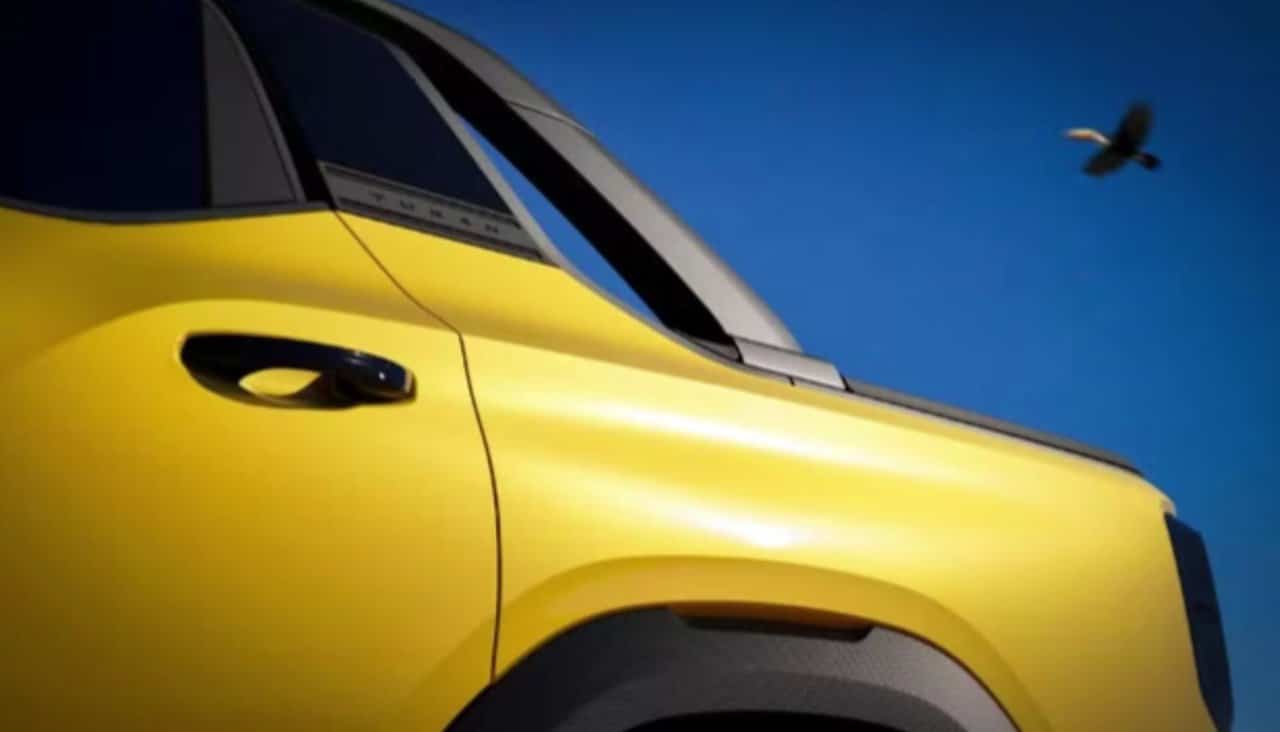
The choice of the name “Tukan” was not random, seeking a direct connection with South American biodiversity and a strong sound identity for the local public. The reference to the toucan bird, a symbol of tropical fauna, aligns with the company’s marketing strategy of creating products with a “Brazilian soul”. The launch color presented, called Amarelo Canário, reinforces this nationalist narrative, creating an immediate and differentiated visual appeal in dealerships.
In the released teaser, it was possible to observe specific details of the body, such as the C column adorned with a gray stripe containing the inscription of the model name. The rear design features a striking crease on the tailgate, which surrounds the handle and extends to the edges, giving the look robustness. Acabamentos in glossy black and a matte textured finish complete the aesthetic package revealed, suggesting a top-of-the-line version with a sporty and adventurous appeal.
The presentation at Rio of Janeiro also served to calm the spirits of investors and dealers, who had been waiting for years for a worthy replacement for the veteran Saveiro or a product capable of fighting upstairs. The confirmation that the model will hit the streets in 2027 sets a clear horizon for the chain’s commercial planning, which will now feature a product with greater added value and a higher profit margin.
Platform and mechanical assembly specifications
The technical basis of the Tukan will be the MQB A0 architecture, the same one used in successful models such as the Polo, Virtus and T-Cross. Essa strategic choice allows the pickup to offer dynamic behavior closer to that of a passenger car or SUV, avoiding the rustic handling of traditional pickups mounted on a chassis. The internal space promises to be optimized, taking advantage of the versatility of the platform to offer comfort to rear seat occupants, a critical point in this segment.
The model’s greatest competitive advantage will lie in its engine, designed to meet new emissions standards and the demand for fuel economy. Volkswagen confirmed that the pickup will feature hybrid systems, including 48V mild-hybrid options. Essa technology uses a small electrical generator to assist the combustion engine in stressful situations, reducing consumption and improving responses during urban acceleration.
In addition to mild hybridization, there is strong speculation about plug-in hybrid versions, which would allow short distances to be driven in 100% electric mode, with recharging using conventional sockets. The expected combustion engines are evolutions of the TSI family:
- 1.0 TSI Turbo Flex engine updated for the 48V electrical system;
- 1.5 TSI Evo2 engine for the most expensive versions, offering greater torque and power;
- Six-speed automatic transmission calibrated for utility use.
These configurations put the Tukan at a technological advantage over competitors who still rely largely on exclusively combustion or diesel engines without electrification.
Inspired design and adaptations for the market
The look of the new pickup is a direct evolution of the Tarok concept, presented worldwide in the Salão of the Automóvel of One of the most notable changes is the absence of the complex cabin folding system that integrated the cargo space into the cabin, an innovative feature of the concept that proved costly for mass production.
Despite the adaptations, the Tukan maintains the modern and aggressive silhouette that attracted attention in the past. The front headlights and taillights adopt contemporary LED signatures, in line with the brand’s new global visual language. The front grille should follow the illuminated pattern seen in recent launches on the Europa, giving the model sophistication.
The double cabin configuration will be the main bet, serving both family and light professional use. The bucket, although not integrated into the cabin as in the concept, promises competitive volume for transporting urban cargo and leisure equipment, the main focus of the target audience in this segment.
Market strategy and investments in Brasil
The arrival of Tukan represents a milestone in the renewal of Volkswagen into América from Sul. With the Saveiro already showing signs of age and without major structural updates for years, the brand needed a product capable of competing in the mid-range segment, which has become one of the Brasil’s most profitable. The new pickup not only replaces the Saveiro in higher price ranges, but expands the brand’s operations to where the Toro and Montana currently reign supreme.
The billion-dollar investment in the Paraná factory includes the modernization of assembly lines, the implementation of new welding and painting robots, and the training of the workforce to deal with high-voltage systems in hybrid vehicles. The financial contribution is supported by BNDES credit lines, highlighting the strategic nature of the project for the national industry.
The automaker plans to launch 21 new products in the region by 2028, and the Tukan is seen as the “flagship” of this new phase. Local production is essential to guarantee delivery volume and affordable spare parts, in addition to shielding the operation against excessive exchange rate fluctuations that would affect an imported model.
With electrification as a central pillar, Volkswagen hopes that the Tukan will attract a consumer who seeks the robustness of a pickup truck, but does not give up the energy efficiency and onboard technology of a modern SUV. The fight for leadership in medium-compact pickup trucks promises to intensify from 2027 onwards, with the Brazilian consumer being the main beneficiary of this technological dispute.




