
Interstellar visitor 3I/ATLAS challenges astronomy with giant particle tail aimed at the Sun


The global scientific community turns its attention to an intriguing phenomenon in the vicinity of Terra, led by the third interstellar visitor confirmed in the history of astronomy. Após its passage through the point of closest approach to our planet in mid-December 2025, the object called 3I/ATLAS revealed physical characteristics that defy conventional comet models. The most recent analysis, led by physicist Avi Loeb, of Universidade of Harvard, points to the existence of an anomalous structure composed of particles of unexpected dimensions.
Unlike comets formed in Sistema Solar, which typically display tails of fine dust driven by the solar wind away from the star, 3I/ATLAS features a prominent “anti-tail.” Esta’s peculiar structure extends toward Sol, creating a visible, highly directed jet that has intrigued professional and amateur observers. The persistence of this formation, even after the object has surpassed its perihelion, suggests a complex and distinct internal dynamic of local celestial bodies.
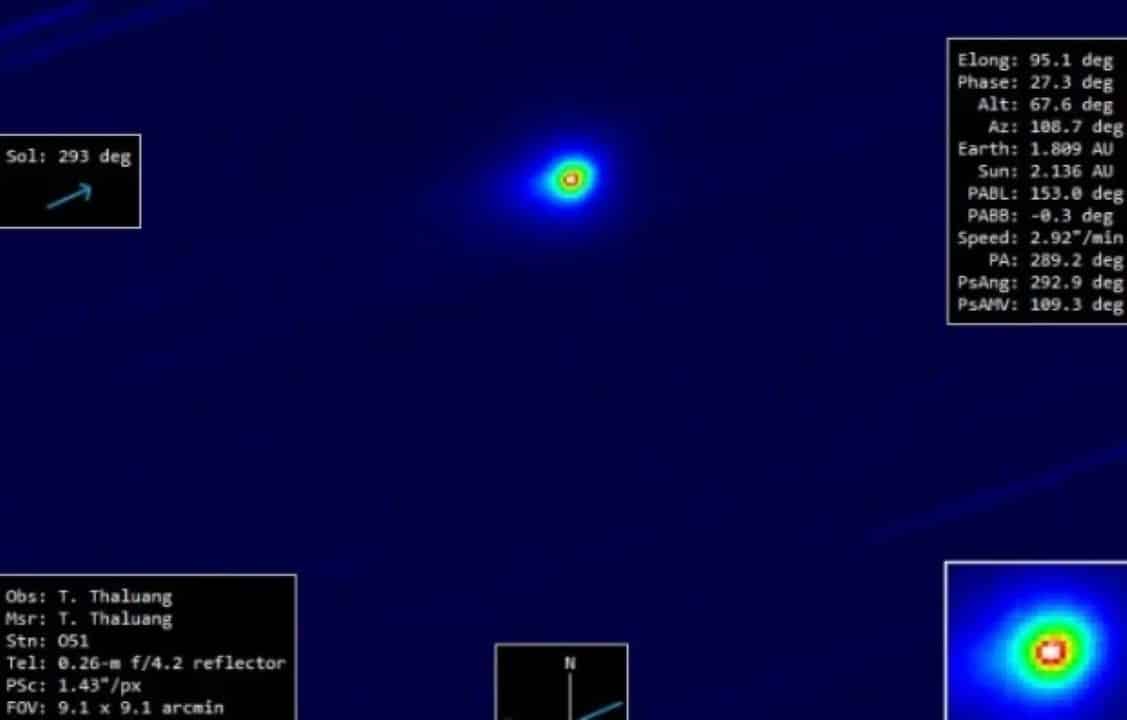
- The object was originally discovered on July 1, 2025 by the ATLAS monitoring system, located at Chile.
- Its closest approach to Terra occurred on December 19, 2025, at a safe distance of 269 million kilometers.
- The observed anti-tail has an impressive length of at least 400 thousand kilometers.
- Analysis indicates that the tail’s glow is dominated by solid particles, not just gases.
The implications of this discovery are vast for the study of matter outside our planetary system. Segundo the data collected, the physics behind this solar jet suggests that the object is ejecting material in a very specific way, possibly from a restricted region of its nuclear surface. The stability and length of the jet offer a unique opportunity to understand the chemical composition and physical structure of bodies traveling through interstellar space before they cross our path.
Trajectory and confirmation of origin
Since its initial identification by the ATLAS telescope, 3I/ATLAS has demonstrated that it is a celestial body of hyperbolic nature, which almost immediately confirmed its interstellar origin. The Sua orbit, which is not gravitationally bound to the Sol, has an inclination and speed that indicate a journey of long galactic distances before entering our cosmic neighborhood. The object reached its perihelion, the closest point to Sol, on October 29, 2025, passing about 1.4 astronomical units from the star, at which point the thermal activity on its surface intensified considerably.
The movement of the celestial body is classified as retrograde and maintains a curious alignment with the ecliptic plane, facilitating monitoring by terrestrial and space observatories during its exit phase from the system. Observations carried out between November and December were crucial in mapping not only its route, but also the morphological changes in its coma and tail. Unlike other objects that quickly lose activity after moving away from Sol, 3I/ATLAS maintained the emission of visible material, allowing a detailed study of its orbital dynamics in conjunction with its mass ejections.
Dynamics of the solar anti-tail
The most fascinating aspect of 3I/ATLAS lies in the physics of its anti-tail, which projects defiantly towards Sol, a behavior that requires very specific conditions to occur in a real way and not just as an optical illusion caused by the observation perspective of Terra. Imagens processed with high-precision filters reveal that this jet is extremely narrow and long, exceeding the distance between Terra and Lua, and maintains a collimation — that is, a parallel alignment of the particles — that is difficult to explain with traditional dirty ice sublimation models. Solar radiation pressure exerts a constant force that would normally push light particles away, dispersing the tail; however, the structure observed in 3I/ATLAS remains cohesive and linear. Isso indicates that the ejected particles have sufficient inertia to partially resist this radiative pressure, maintaining their trajectory towards the star while being released by the object’s core, suggesting a violent and focused launch mechanism, possibly originating from vents or active geological faults on the surface of the interstellar visitor.
Granulometric analysis of particles
The key to understanding the resistance of this anti-tail to solar pressure lies in the size of the grains that compose it. Segundo astrophysicist Avi Loeb’s analysis, common dust particles, with diameters around 0.5 microns, would be quickly slowed down and dispersed by sunlight.
For the jet to maintain its elongated shape and sunward direction (facing Sol), the grains must be significantly larger. Calculations indicate that these particles must have a radius greater than 1 micron, and can reach up to 100 microns.
These dimensions are atypical for Sistema Solar comets, where submicron dust often dominates the brightness of the tails. The presence of larger grains suggests a less processed surface composition or an agglutination of materials different from that seen in local bodies.
Furthermore, to reach the observed speeds and form such a long jet, these heavy particles need to be swept along by a vigorous gas flow. Isso implies that 3I/ATLAS has reserves of volatiles capable of generating enough thrust to carry massive solids into space.
Comparisons with previous visitors
The arrival of the 3I/ATLAS inevitably evokes comparisons with its predecessors, the 1I/’Oumuamua and the 2I/Borisov. Enquanto ‘Oumuamua did not have any visible tail or coma, behaving more like a rocky or metallic asteroid, the new visitor exhibits clear and vigorous cometary activity.
In relation to 2I/Borisov, which was indistinguishable from a typical comet in our system, 3I/ATLAS stands out due to the extreme collimation of its matter ejection. The jet observed now is about ten times longer than it is wide, a proportion that denotes a much more punctual origin on the surface of the nucleus.
These fundamental differences reinforce the thesis that the population of interstellar objects is diverse. Cada visitor brings a unique chemical and physical signature, reflecting the varied conditions of the star systems where they formed and were subsequently expelled.
Monitoring and recent data
Large telescopes, such as Gemini, have been instrumental in confirming the persistence of the post-perihelion phenomenon. Images captured in mid-December show that the linear structure remains stable even at distances of hundreds of thousands of kilometers from the nucleus, validating the heavy particle hypothesis.
Complementary spectroscopic observations detected the presence of gases such as cyanide, but confirmed that the visible glow of the jet is mostly caused by the reflection of light from the solid particles. Continuous monitoring is essential to refine models of object mass loss.
Perspectives until the final match
As 3I/ATLAS begins its definitive exit journey from Sistema Solar throughout 2026, scientists hope to collect the last crucial data on its rotation and composition. Projetos research focused on interstellar objects, like Projeto Galileo, uses this evidence to distinguish natural phenomena from other theoretical possibilities, expanding our understanding of the matter that fills the void between stars.



