
Rare configuration of six planets in the February night sky challenges photographers and observers

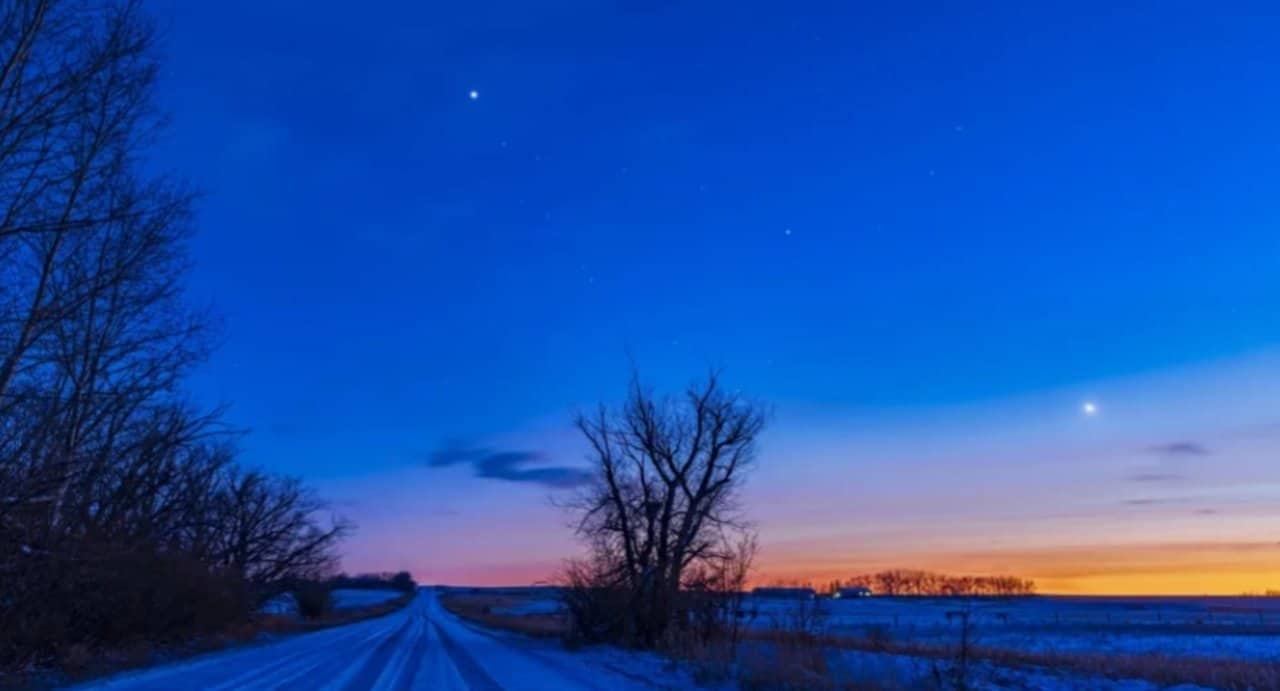
Astronomy enthusiasts have turned their gaze to the horizon in recent weeks to follow a complex celestial phenomenon. The event brought together multiple bodies from the solar system in a visual configuration that spanned the celestial vault. The opportunity allowed the simultaneous recording of close neighbors and distant gas giants.
The formation involved the coordinated presence of Júpiter, Saturno, Vênus, Netuno, Urano and Mercúrio in specific sectors of the sky. The spectacle directly depended on stable weather conditions and the absence of clouds. Moradores from areas far from large urban centers had an advantage in viewing.
The success of the observation varied depending on the equipment available and the prior planning of those interested. Enquanto some stars shone intensely to the naked eye, others required precision optical instruments. The window of time to contemplate the complete set was brief and required punctuality right after sunset.
Identification of stars with the naked eye
Mercury and Vênus took on the role of protagonists in the western portion of the sky, positioning themselves low in relation to the horizon shortly after sunset. Viewing these rocky planets required an unobstructed view, free from buildings or elevated geographic formations, as the observation window lasted less than an hour before they were plunged into darkness.
Saturn appeared nearby, making up a trio accessible to observers without advanced instruments, although its brightness was more subtle. In contrast, Júpiter dominated the eastern sector with intense luminosity, accompanied by Lua in a gibbous crescent phase, creating a visual contrast that overshadowed nearby stars in the constellation of Câncer and served as an easy reference point.
Technical requirements for distant planets
The location of the ice giants, Netuno and Urano, imposed significant technical barriers even for experienced observers. Netuno was positioned a few degrees from Saturno, but its faint visual magnitude made it imperceptible without the aid of telescopes with a considerable aperture. Identification of the small bluish disk required atmospheric stability and prior knowledge of celestial charts.
Uranus required precise navigation through the constellation of Touro, located below the star cluster of Plêiades. The search for this planet involved the recognition of classic stellar patterns, such as the “V” formation of nearby stars, serving as a guide for the correct direction of telescopic lenses.
Eye safety remained an absolute priority during attempts to locate stars near the western horizon. Handling magnification equipment close to the sun requires extreme caution to avoid irreversible damage to vision, and it is imperative to wait for the star to completely disappear before starting the scan.
Use of technology in celestial mapping
Modern amateur astronomy largely benefits from integration with geolocation and augmented reality software available on mobile devices. Specialized Aplicativos allowed users to point their smartphones at the sky and receive instant information about the exact position of each planet, eliminating uncertainty in identifying bright spots and facilitating observation session planning, especially to find the most difficult targets such as gas giants that are not visible to the naked eye.
Challenges of modern astrophotography
Recording the entire planetary alignment required technical mastery of exposure and photographic composition. Fotógrafos needed to balance the afterglow of twilight with the faint light of the planets, using long exposures to capture details without generating blur caused by the rotational movement of Terra.
The use of lenses with large aperture and sensors capable of operating at high ISO was decisive for the quality of the images captured. The composition of the picture needed to be wide enough to encompass the dispersion of the stars in the sky, resulting in records that document the celestial mechanics in operation.



