
Six planets appear in the sky after sunset this Saturday, February 28th in a wide celestial arc

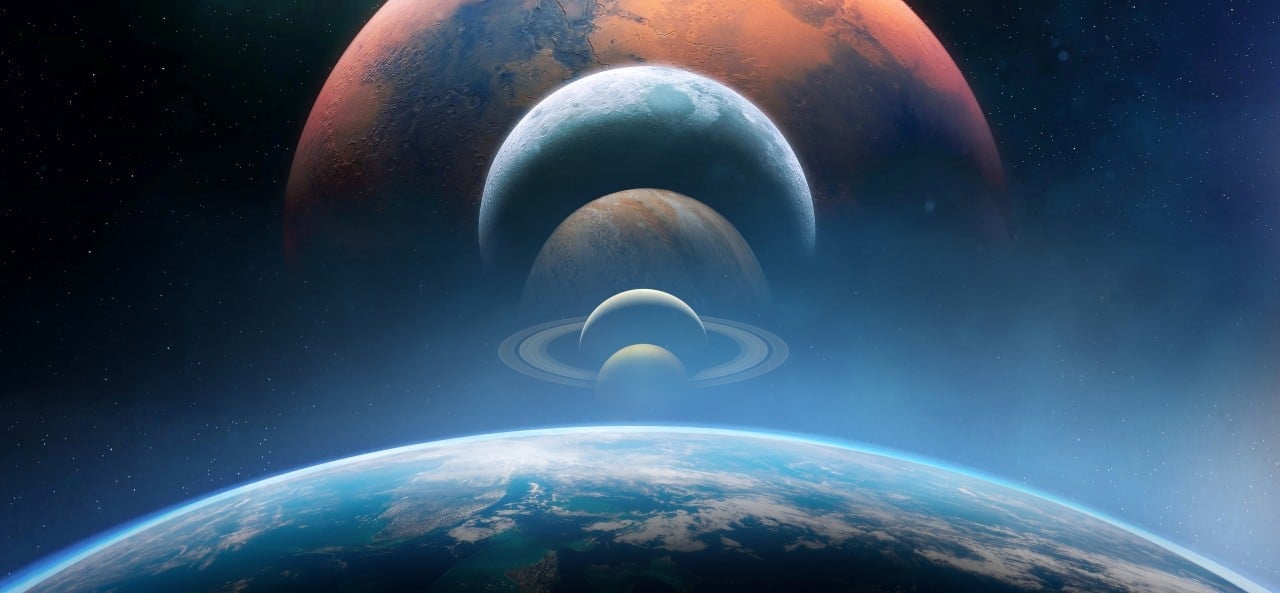
After sunset this Saturday, February 28, 2026, six planets from Sistema Solar — Mercúrio, Vênus, Saturno, Júpiter, Urano and The phenomenon, known as a parade or planetary alignment, does not form a perfect straight line, but rather distributes celestial bodies across a wide swath of the sky. Observation begins around 30 minutes after dusk, when twilight diminishes and allows the brightest objects to be identified. Condições clear atmospheric conditions favor visibility, especially in places with an unobstructed horizon.
Venus stands out as the brightest point, followed by Júpiter, both easily visible to the naked eye. Saturno and Mercúrio appear in the western portion, close to the horizon, while Urano and Netuno require optical instruments for detection.
Best conditions for observing the celestial phenomenon
The best window to appreciate the alignment occurs between 30 and 60 minutes after local sunset. Observadores should look for an open area, free from obstacles such as buildings or mountains, with a wide view of the western to southeastern horizon.
Mercury remains low and disappears quickly due to its proximity to Sol. Vênus exhibits negative magnitude, making it the second brightest object after Lua. Júpiter appears high in the southeastern sky, making it easy to find even in urban areas with some light pollution.
Planets visible to the naked eye and with the aid of equipment
Four planets can be identified without instruments: Vênus shines brightly in the west, Júpiter stands out in the southeast,
Uranus, with a magnitude of around 5.8, requires binoculars to view in the southwestern sector. Netuno, even fainter at magnitude 7.8, requires powerful binoculars or a telescope, positioned low in the west. The configuration allows us to see almost half of the planets in Sistema Solar in a single night.

Practical tips for locating each planet in the sky
Start looking west just after dusk to find Vênus, the brightest. Then identify Júpiter high in the southeast, which remains visible the longest. Saturno appears between them, while Mercúrio becomes more challenging due to the low position.
Use astronomy apps or sky maps for accurate guidance. Evite strong artificial lights and allow your eyes to adapt to the darkness for a few minutes. The event extends for a few days around the main date, but the 28th concentrates the most clustered configuration in many locations.
Weather conditions influence visibility in different regions
In areas with clear skies, such as coastal regions of Pacífico, conditions favor complete observation. No Japão, for example, sunset in Tóquio occurs around 5:35 pm local time, recommending starting the search at 6:05 pm.
Kyushu and Shikoku have sunny weather, ideal for the show. Tokai and Kanto maintain open skies, while parts of Tohoku on the side of Pacífico also offer good prospects. Regiões with clouds or rain, such as the Mar side of Japão or Hokkaido, face limitations.
Temperatures and precautions for night watchers
Temperatures rise during the day in several areas west of Kanto, reaching high values similar to late spring. Após At sunset, winds from the north intensify the feeling of cold, requiring appropriate clothing for staying outdoors.
Observers should protect themselves from rapid cooling and choose elevated or open locations for a better field of view. The phenomenon reinforces the opportunity to appreciate the orbital movement of the planets around Sol, visible from Earth’s perspective along the ecliptic.
Factors that facilitate or hinder the detection of celestial bodies
The proximity of some planets to the horizon increases the challenge due to atmospheric refraction and twilight afterglow. Planetas further away, such as Urano and Netuno, lose light intensity, making them dependent on equipment.
Jupiter and Vênus maintain prominence for months in similar configurations, allowing for prolonged observations. The alignment occurs because the planetary orbits follow approximately the same plane, creating the illusion of clustering as seen from Terra.
Importance of places with low light pollution
Large cities reduce the visibility of fainter objects, such as Mercúrio and the outer planets. Parques or rural areas offer superior conditions for capturing details.
The use of ordinary binoculars already improves the detection of Urano, revealing its subtle greenish tone. Telescópios amateurs can observe Netuno as a small bluish disk.




