
Telescopes detect X-ray halo on comet coming from another star system after visiting Earth


Astronomers from several space agencies confirmed the detection of unprecedented energetic phenomena in the object 3I/ATLAS, the third interstellar celestial body identified crossing our planetary system. Dados collected during its closest approach at the end of 2025 indicate that the comet’s nucleus interacts in a complex way with the space environment, generating a diffuse halo of X-rays. The discovery was made possible by joint monitoring of terrestrial and space observatories, which track the object as it begins its definitive exit trajectory from our cosmic neighborhood.
Analysis of the hyperbolic trajectory of 3I/ATLAS revealed a speed exceeding 200,000 kilometers per hour, a parameter that attests to its external origin, possibly ejected from another stellar system billions of years ago. Diferente of the local comets, which orbit Sol periodically, this visitor has a unique passage route, coming from the direction of the constellation of Sagitário and now heading towards deep space with no possibility of return.
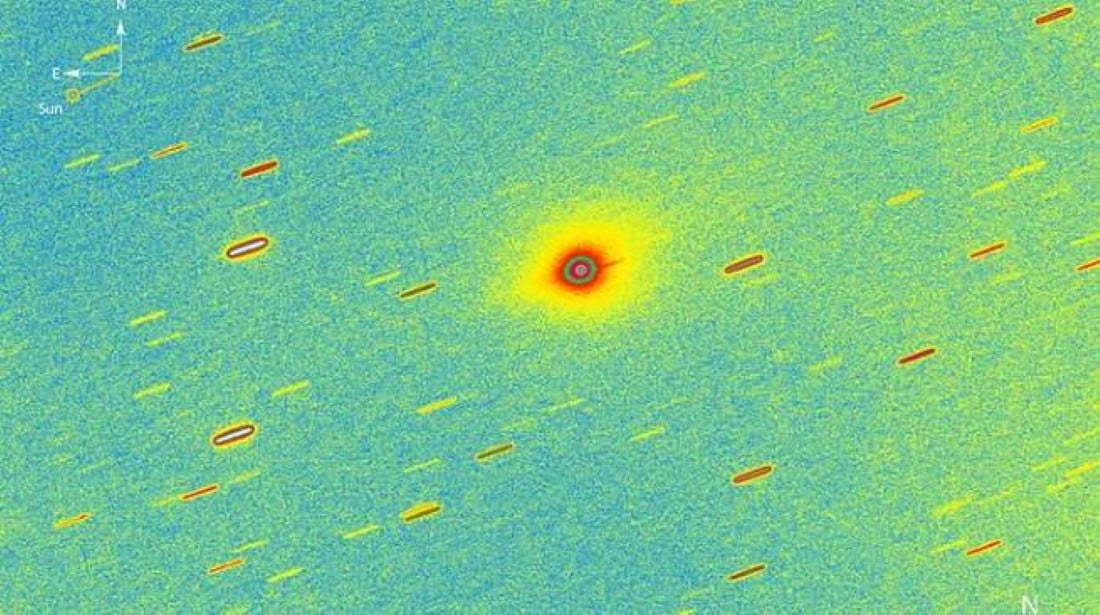
Intensive monitoring carried out in recent weeks has allowed scientists to map the object’s chemical composition and physical behavior with unprecedented precision.
High energy emissions
Observations conducted by the XMM-Newton telescope identified a diffuse emission of X-rays around the comet’s nucleus, a behavior never before recorded in objects of this category. The phenomenon occurs due to the interaction between charged particles from the solar wind and neutral gases released by the 3I/ATLAS coma, resulting in charge exchanges that release energy at specific wavelengths.
This energetic signature provides crucial clues about the density and composition of the gas cloud surrounding the core, suggesting the abundant presence of oxygen and carbon. The detection validates theoretical models about how icy bodies from other systems react to radiation from stars different from their original hosts, expanding understanding of the physics of interstellar objects.
Distinctive chemical composition
Spectroscopic studies indicate that the chemistry of 3I/ATLAS differs substantially from the patterns observed in comets formed in our Sistema Solar. The proportion of carbon dioxide in relation to water is significantly high, indicating that the object formed in a region where sublimation occurred at greater distances from its parent star. Além Furthermore, the marked presence of nickel and methanol suggests a formation environment with specific metallicity and volatile conditions.
- Excess carbon dioxide points to sublimation processes distinct from local comets.
- High levels of nickel contrast with the abundance of iron typical of bodies in our system.
- The low relative water concentration indicates a primarily drier structure.
- Traces of cyanide and carbon molecules contributed to the coma’s characteristic green glow.
Dynamics and remoteness
After reaching perihelion and making its closest passage to Terra in December, around 270 million kilometers away, the comet is now on its way out. Cálculos orbitals show that solar gravity altered its trajectory by just 16 degrees, a minimal deflection given the object’s high kinetic speed, which reached 246,000 km/h at the point of greatest acceleration.
The object is expected to cross the orbit of Júpiter throughout 2026, progressively losing brightness as it moves away from the solar heat source. Large Telescópios continue to track the celestial body, whose current magnitude requires professional equipment for visualization, aiming to extract the last possible data before it becomes undetectable.
The passage of 3I/ATLAS represents a rare opportunity for planetary science, allowing the direct study of material from other corners of the galaxy without the need for interstellar missions. Information collected by the Hubble and James Webb telescopes, along with solar probes, is being compiled to refine models of the formation of distant planetary systems.



