
Radio signal from the center of the Milky Way reveals pulsar capable of testing theory of relativity

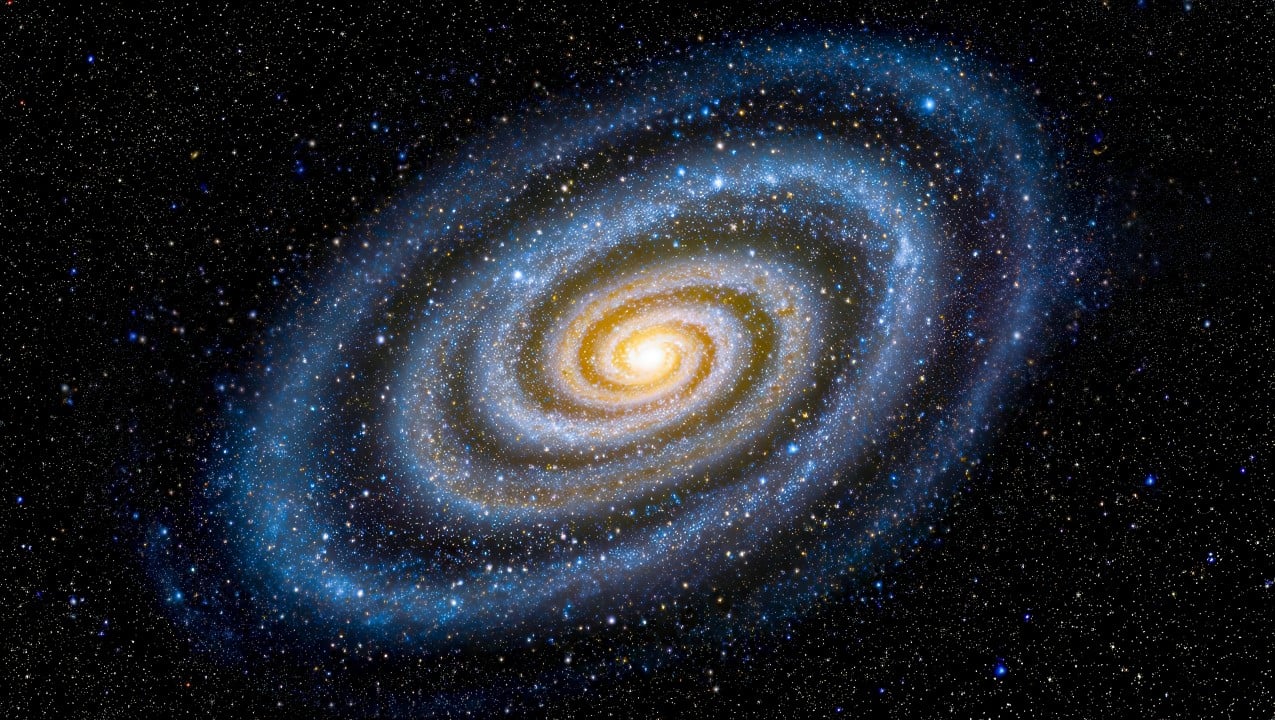
Scientists linked to the Breakthrough Listen project have revealed the detection of a peculiar radio emission originating in the depths of our galaxy. Analysis of the captured signals suggests the presence of a rare stellar body orbiting the region of Sagitário A*, the supermassive black hole that resides at the heart of Via Láctea. Evidence points to a millisecond pulsar, a type of neutron star that spins at breakneck speeds.
The monitored object demonstrated impressive regularity, completing a rotation on its own axis every 8.19 milliseconds. Essa frequency is equivalent to approximately 122 rotations per second, a characteristic that transforms the star into an extremely precise natural chronometer. The data were obtained using the Green Bank radio telescope, located at Estados Unidos, after processing information collected over two years.

Identification of this specific source represented a significant technical challenge due to the noisy environment of the galactic center. The sensitivity of current instruments was crucial to isolating the object’s rhythmic pattern amid the region’s vast electromagnetic interference. The discovery offers physicists an unprecedented opportunity to study the behavior of gravity in extreme conditions.
Challenges in observing the galactic nucleus
The central region of Via Láctea is considered one of the most hostile and complex environments for observational astronomy. Nuvens dense layers of gas and dust block most visible light, making optical telescopes ineffective for this type of research. Radio waves, however, can cross these barriers, functioning as an essential tool for mapping what happens in the vicinity of the central black hole.
Although theory predicts a large population of pulsars in this area, practical detection remains rare due to the intense radiation and turbulent magnetic fields. The success in locating this new candidate, provisionally named BLPSR, demonstrates the advancement in data filtering techniques. Confirmation of this finding could lead to a review of the methods used to track objects in areas of high stellar density.
Physical characteristics of the BLPSR system
The newly discovered object is located approximately 26 thousand light years from Terra and has properties that defy conventional understanding of matter. The temporal stability of its pulses allowed researchers to draw a preliminary profile of its composition and dynamics. The analyzes indicate a scenario of extreme forces acting on the celestial body.
– The estimated mass of the object could exceed twice the mass of Sol, concentrated in a sphere with a diameter of just 20 kilometers.
– The magnetic field generated is billions of times more powerful than that of the Terra, capable of accelerating particles to speeds close to that of light.
– Feixes radio continua are projected from the magnetic poles, creating the beacon effect detected by terrestrial instruments.
– The high rotation speed suggests that it is a recycled pulsar, which absorbed matter from a companion star in the past.
Physics testing laboratory
The privileged location of the BLPSR in the vicinity of Sagitário A* offers an ideal setting for testing the Teoria of Relatividade Geral. The intense gravitational field generated by the black hole, which has four million solar masses, must influence the propagation of the signals emitted by the pulsar. Medições’s precise changes could confirm or refute predictions made by Albert Einstein more than a century ago.
Physicists hope to observe phenomena such as time dilation and the bending of light caused by extreme gravity. Qualquer deviation in observed data in relation to theoretical models could signal the need for adjustments in modern physics. The expectation is that this system will provide one of the most robust validations ever carried out on the behavior of matter in strong gravitational fields.
Perspectives with new observatories
For the discovery to be fully accepted by the scientific community, the signal will undergo rigorous independent verification processes. Eliminating possible terrestrial interference or failures in data processing is a fundamental step before official cataloging. The raw data will be made available for other research groups to carry out cross-analysis.
The future of exploration in this region depends on the entry into operation of more powerful infrastructures, such as Square Kilometre Array (SKA). With antennas distributed across África, Sul and Austrália, the new observatory will increase the sensitivity of searches for radio signals. Espera SKA is expected to not only confirm the nature of the BLPSR, but also reveal other hidden pulsars, allowing detailed mapping of the distribution of dark matter in the center of the galaxy.




