
Astronomical research points to the existence of trillions of exotic objects on the edge of the Solar System

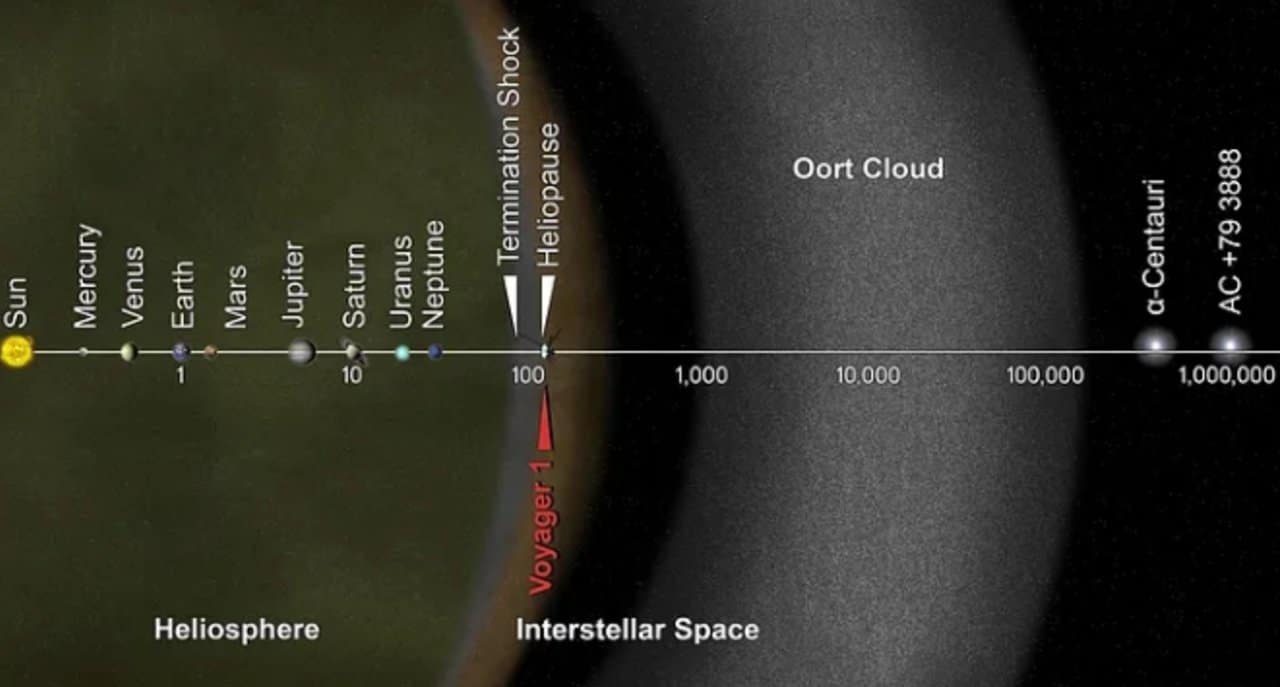
A comprehensive review of current cosmological models suggests that the space environment surrounding Sol is much more populated by visitors from other star systems than previously imagined. Estudos recent studies, based on detailed observations of celestial bodies that cross our galactic neighborhood, indicate that the region furthest from our gravitational domain can act as a vast reservoir of exotic material. Essa new perspective challenges classical theories about the density of matter in interstellar space and raises fundamental questions about the architecture of the local universe.
Scientific analysis focuses on the implications of the passage of bodies that did not originate in the formation of our own planetary system. Detecting and tracking these objects provides valuable clues about the chemical and physical composition of other stars, functioning as time capsules sent through the cosmic vacuum. The estimated presence of trillions of these natural artifacts on the periphery of Sistema Solar suggests a much more intense and dynamic exchange of galactic material over billions of years.
Experts in the international astronomical community are now debating whether these visitors are isolated anomalies or the tip of a cosmic iceberg. Confirming this population density of interstellar objects could rewrite the chapters on how stellar systems interact with each other, exchanging mass and possibly organic compounds across the vast distances that separate the stars of Via Láctea.
The revealing role of comet 3I/ATLAS
The turning point for this new understanding came with the identification and thorough analysis of comet 3I/ATLAS. Identificado formally in mid-2025, this celestial body has become a key piece for astronomers. Diferente of the periodic comets we know of, which orbit Sol on predictable trajectories, the orbital and physical characteristics of this object unequivocally indicated an extrasolar origin.
Observations carried out with high-precision instruments, including Telescópio Espacial Hubble, allowed scientists to dissect the visitor’s physical properties. The comet’s nucleus, estimated at a radius of approximately 1.3 kilometers, had an average density that intrigued researchers. Based on the data collected, the object’s total mass was calculated to be about 5 billion tons, a significant value that helped calibrate mass distribution models for similar objects.
One of the most challenging aspects of studying 3I/ATLAS was the nature of its visibility. Almost all of the light captured by the telescopes did not come from the solid surface of the nucleus, but rather from the coma — the cloud of gas and dust generated by the sublimation of its volatile components when approaching the solar heat. Este fact highlights a critical technological limitation: interstellar objects that have already lost their volatiles or that do not come close enough to a star to activate them remain dark and invisible, suggesting that the real number of visitors may be astronomically higher.
The Nuvem of Oort as a dynamic boundary
Nuvem of Localizada In the confines of the gravitational influence of Sol, this spherical structure extends to immense distances, reaching up to 100,000 astronomical units. It is in this galactic “middlefield” region that solar gravity subtly competes with the galaxy’s tidal forces and the attraction of stars passing nearby.
The gravitational dynamics in this region are extremely complex and sensitive. Pequenas disturbances can launch objects towards Sol or definitively expel them into interstellar space. The new study proposes that Nuvem of Oort not only misses objects, but also efficiently captures errant bodies roaming the galaxy. Over the course of Sistema Solar’s history, this gravitational capture would have accumulated a mixed population, made up of both remnants of our own formation and debris ejected from other planetary systems.
Mathematical and statistical projections
The estimate that there are trillions of interstellar objects orbiting within the limits of Sistema Solar is not the result of direct counting, but of sophisticated statistical extrapolations. The reasoning is based on the probability of detecting an object like 3I/ATLAS in a restricted volume of space and time. If the chance of finding a body of this size within the orbit of Júpiter is rare, but it did happen, this implies a very high background density when the total volume of the Nuvem of
Calculations indicate that, to justify current observations, the population of captured interstellar objects must be in the region of ten trillion. Essa monumental figure suggests that the total mass of these rocky and icy objects could exceed the mass of Terra by up to a hundred times. Tais numbers transform the view of interstellar space from an almost absolute void to a medium rich in solid matter in transit.
Implications for planetary formation
The amount of ejecta needed to explain this population of interstellar travelers has direct consequences for theories of planet formation. If every star in Via Láctea contributes to this galactic debris pool, planetary formation processes must be inherently “inefficient” in the sense of mass retention, expelling large amounts of material into deep space.
Some crucial points raised by the research include:
– The combined mass of the putative interstellar objects in Nuvem of Oort rivals the mass of the native comets of Sistema Solar.
– The proportion of ejected material per stellar system can reach 100 Earth masses, chemically enriching the interstellar medium.
– The exchange of material between systems suggests a possible panspermia lithopanspermia (transfer of life through rocks) that is more viable than previously assumed.
– The density of interstellar objects can influence the rate of impacts on planets over geological eons.
Future challenges and new technologies
The validation of these theories crucially depends on the advancement of observational capabilities. Distinguishing between a native comet and an interstellar visitor often requires trajectory and composition data that is at the limit of current technology. The case of 3I/ATLAS, as well as that of its predecessor `Oumuamua, illustrates the difficulty of obtaining accurate data in short time windows, as these objects cross the interior system at high speeds.
The hope of the scientific community lies with the next generation of instruments, with emphasis on the Observatório Vera C. Rubin. With its ability to repeatedly scan the sky and detect very faintly bright objects, it is expected to reveal a hidden population of celestial bodies. If detections of objects with hyperbolic features (which indicate external origin) become frequent, the “mixed Oort Cloud” theory will gain robust traction.
On the other hand, if 3I/ATLAS proves to be a statistical anomaly—an extremely rare object and not representative of a large class—models of planetary formation and galaxy dynamics will need to be readjusted to explain the uniqueness of these events. Either way, the frontier of our knowledge about Sistema Solar is being pushed out, revealing a much more complex and interconnected local universe.



