
Dollar price jumps to R$5.19 with worsening of the crisis in the Middle East and risk aversion


The North American currency ended this Monday’s session with a significant appreciation against the real, reflecting the climate of apprehension in global markets. The closing quoted at R$5.1915 marks an increase of 1.18% in relation to the previous adjustment, which had been R$5.1311. The upward movement was mainly driven by investors’ search for safe assets amid increasing international geopolitical instability.
The external scenario dominated the operating tables, with attention focused on the unfolding conflicts in Oriente Médio. The perception of risk has increased significantly, leading to a withdrawal of capital from emerging countries, such as Brasil, towards economies considered more solid. The above-average trading volume indicated a defensive stance on the part of financial agents.
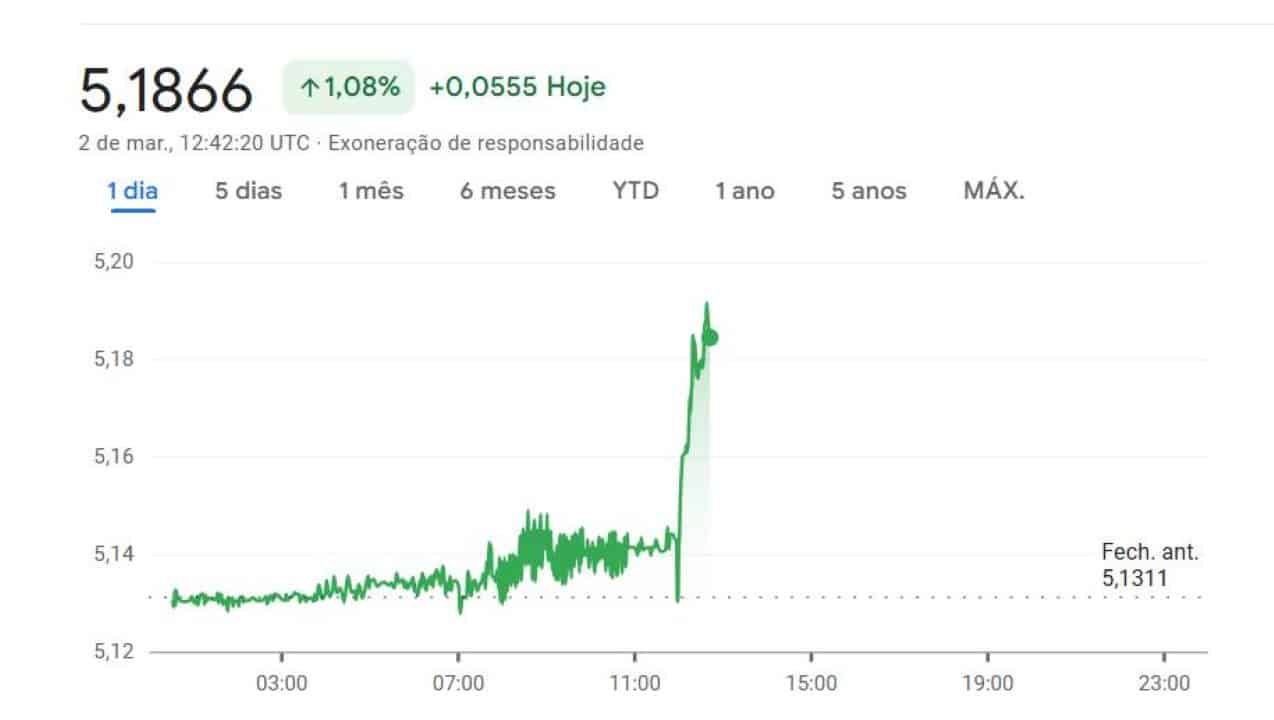
During the trading session, pressure on the exchange rate was constant, in line with the currency’s behavior abroad. Around noon, at Brasília time, the tendency for the dollar to strengthen was already clear, also influenced by expectations surrounding the monetary policy of the Estados Unidos. The Brazilian Banco Central maintained monitoring of fluctuations to ensure market functionality.
Market analysts point out that the combination of external factors and the sensitivity of the Brazilian economy to shocks in the price of energy commodities were decisive for the result. The observed volatility reinforces the need for caution in portfolio management and financial planning of companies with exchange rate exposure.
Impact of geopolitical tensions on oil
The escalation of tensions between powers in the Oriente Médio caused an immediate reaction in oil prices, with the Brent type registering an increase of more than 2% on international stock exchanges. Fears of disruptions in the global energy supply chain generated a wave of risk aversion that penalized currencies in emerging countries.
For Brasil, the correlation between the price of a barrel and the exchange rate is direct, given the weight of imports of derivatives and the structure of the trade balance. The increase in energy prices tends to put pressure on domestic inflation, creating a challenging scenario for national monetary policy. The market awaits signs of diplomatic measures that could cool sentiments in the region.
Foreign investors reacted promptly, reallocating resources to the American Tesouro and reducing exposure to riskier assets. Esse outflow of dollars from the country contributed to the depreciation of the real, requiring increased attention from local economic authorities regarding the secondary effects on the real economy.
Behavior against other global currencies
The strengthening of the dollar was not an isolated phenomenon in relation to the real, but the Brazilian currency was among the most affected in the daily comparison. The euro also advanced, registering an increase of 0.33% and being traded at R$6.0827, supported by economic data that exceeded expectations in the euro zone.
Other strong currencies followed the appreciation movement against the real. The British pound rose 0.56%, reaching R$6.9589, while the Japanese yen appreciated 0.44%. The Australian dollar, often correlated with the mineral commodities cycle, rose 0.84%, quoted at R$3.6697.
Economic scenario and projections for 2026
The financial market has adjusted its expectations for the behavior of the exchange rate throughout 2026. Recent Relatórios indicate a median of R$5.42 for the end of the year, a slight downward revision compared to previous estimates that pointed to R$5.45. The calibration reflects the analysis of expected interest cycles for the coming months.
Projections for Brazilian Produto Interno Bruto (GDP) in 2026 are around 1.89%, demonstrating moderate optimism with economic activity. Maintaining the Selic rate at high levels, close to 15%, continues to be a central instrument to anchor inflation expectations and attract speculative capital that seeks profitability in fixed income.
The trade balance and consumer price indices remain crucial variables for confirming these trends. The balance between domestic growth and monetary stability depends on the government’s ability to meet established fiscal targets, which directly influences foreign investor confidence.
Historical data from recent weeks shows that the American currency fluctuated within a band between R$5.12 and R$5.17 before the current rebound. The recent average of R$5.27 suggests that, despite the one-off increase, there is moderate volatility that can be absorbed by the market, as long as there are no new abrupt external shocks.
Action of Banco Central and internal factors
The national monetary authority remains vigilant, using instruments such as foreign exchange swap auctions to provide liquidity and avoid dysfunctionalities in the foreign exchange market. The strategy aims to smooth out sudden movements without necessarily setting a ceiling for the price, allowing the price to fluctuate according to economic fundamentals. The interest rate differential between Brasil and developed economies continues to be an attraction for financial flow, although fiscal risk remains on the radar.
Internally, controlling inflation and advancing structural reforms are seen as anchors for long-term stability of the real. The export sector, benefiting momentarily from a higher dollar, increases its revenues in local currency, which can generate positive effects on tax collection. On the other hand, companies with debts in foreign currency intensify their hedging strategies to mitigate the impact on the financial balance sheet.
Reflections on foreign trade and commodities
The agribusiness and mining sector is closely watching the appreciation of the dollar, since the rise in the American currency increases the profitability of exports of soybeans and iron ore, products that have prices set on the international market and represent a significant portion of Brazilian GDP. On the other hand, the industry that depends on imported inputs, such as electronic and chemical components, faces an immediate increase in production costs, which inevitably puts pressure on profit margins and can result in prices being passed on to the end consumer, fueling cost inflation. The trade balance surplus, supported by sales to strategic partners such as China, offers a liquidity buffer, but global price dynamics continue to be the preponderant factor for the performance of the external sector.
Future market and trends
Dollar futures contracts for March 2026 operate with an upward bias, trading at around R$5.1495. The increase in the volume of open contracts on the stock exchange signals that major players are setting up defensive positions, anticipating that external volatility may persist in the short term.



