
European space probe records images of interstellar comet at impressive speed

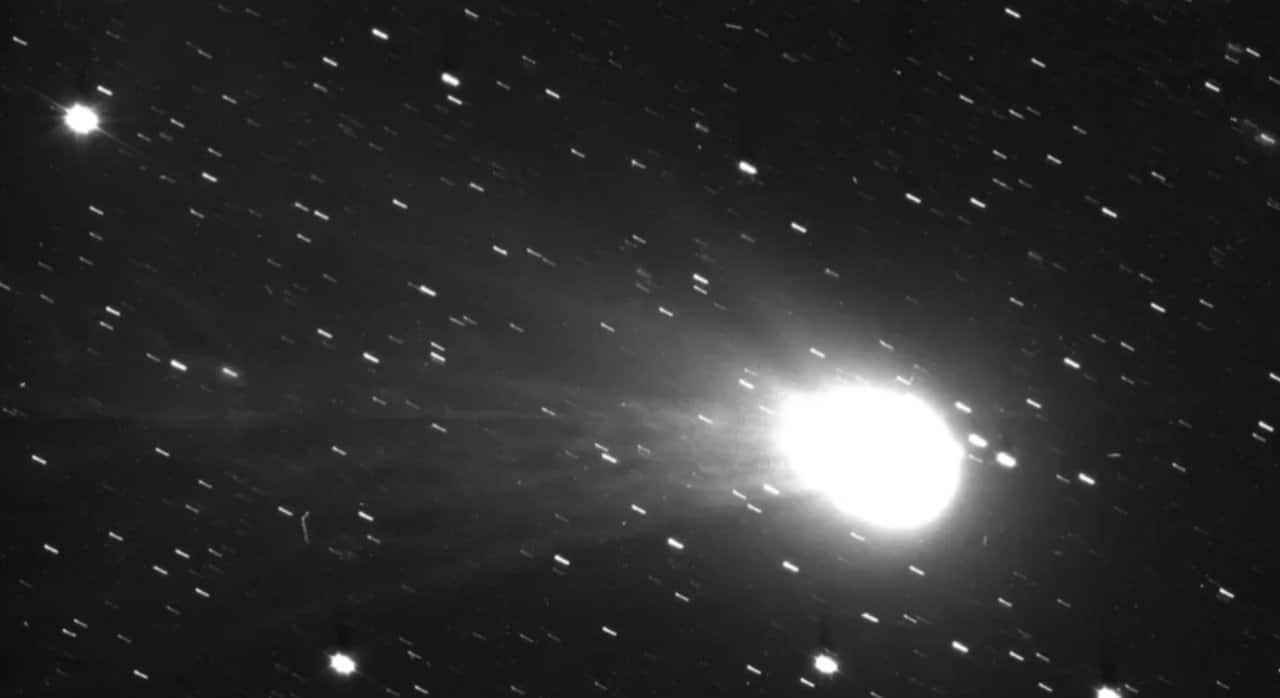
Space exploration has just gained a new chapter with the recent documentation of a rare visitor who crossed the borders of our planetary system. The Jupiter Icy Moons Explorer (JUICE) mission, operated by Agência Espacial Europeia (ESA), accomplished a remarkable feat by capturing detailed images of comet 3I/ATLAS. The recording occurred as the spacecraft continued its long journey toward the moons of Júpiter, demonstrating the adaptability of onboard scientific instruments to study targets of opportunity that arise unexpectedly in the vast cosmic theater.
The interstellar object was monitored during its passage through the neighborhood of Terra and Marte at the end of 2025, when it reached extraordinary speeds. The successful operation of the European probe not only provided crucial visual data, but also confirmed the presence of physical characteristics that differentiate this celestial body from locally formed comets. The global astronomical community celebrates obtaining this data, as it represents fundamental pieces for understanding the dynamics of objects that roam among the stars.
This event marks one of the few times in history that humanity has been able to closely observe a body from another star system. The rarity of such encounters makes each pixel of information extremely valuable to researchers, who seek to unravel the chemical composition and physical structure of these travelers. Preliminary analysis suggests that 3I/ATLAS has a complex nature, hidden beneath a cloud of gas and dust that challenges observational instruments.
Monitoring and data capture by the equipment
The JUICE probe used its high-precision scientific camera to record the comet in November last year. Originalmente designed to withstand Júpiter’s intense radiation environment and study its icy moons, the equipment proved versatile enough to track a small, fast-moving object. The images obtained revealed a predominantly oval structure, surrounded by a gaseous coma that makes direct visualization of the comet’s solid nucleus difficult.
The mission control team’s decision to redirect instruments to this secondary target was strategic. Aproveitar the probe’s trajectory to study 3I/ATLAS allowed the collection of information that ground-based telescopes would have difficulty obtaining with the same clarity, due to distance and atmospheric interference. Essa operational flexibility highlights the importance of long-duration space missions, which can serve as observation platforms for transient phenomena.
The data collected by JUICE is being processed to create more accurate models of the comet’s morphology. Analysis of reflected light and gas emissions can offer clues about the materials that make up this distant visitor. Entender the density and distribution of the cloud that surrounds it is the first step in theorizing about the spatial erosion processes that the object suffered during its interstellar journey.
Unique characteristics of speed and trajectory
One of the aspects that most caught the attention of scientists was the dizzying speed of 3I/ATLAS. At the point of closest approach to Sol, the object exceeded the 240,000 kilometers per hour mark. Essa extreme acceleration is a clear indication that the celestial body is not gravitationally bound to our star, confirming its classification as an interstellar object. Cometas natives of our solar system rarely reach such speeds without gravitational assistance from giant planets.
The trajectory drawn by the comet also deviates from the common elliptical patterns of stars that orbit Sol. Sua hyperbolic route suggests that it entered our system from deep space and, after passing through perihelion, will continue its journey never to return. Continuous monitoring of this orbit has allowed astronomers to accurately calculate its future position, although the exact point of its origin remains unknown.
Since its first detection in July 2025, when it was traveling at around 220,500 kilometers per hour, the object has been closely monitored. The variation in speed as it approached the interior of the solar system provided valuable data on how solar gravity affects bodies with such kinetic energy. Esses studies are essential to improve celestial mechanics models applied to non-native objects.
Challenges in identifying cosmic origin
Despite the wealth of data on 3I/ATLAS’s speed and direction, determining its birthplace has proven to be an impossible task to date. David Jewitt, renowned researcher and director of Instituto of Planetas and Exoplanetas of Universidade of Califórnia, highlighted the complexity of this tracking. Segundo the expert, uncertainties in long-range measurements prevent drawing a precise line back to the comet’s parent star.
It is believed that the object may have traveled through the interstellar void for billions of years before crossing our path. Durante this solitary journey, it may have undergone subtle gravitational changes as it passed close to other stars or molecular clouds, which erases traces of its original trajectory. Essa “Cosmic amnesia” is common in wandering objects, making each of them a mystery isolated in time and space.
The impossibility of pointing to a specific star system as its origin does not diminish the scientific fascination with the object; on the contrary, it expands questions about how often our solar system is visited by such bodies. NASA and other agencies continue to refine their detection methods to try to find patterns that could, in the future, link these travelers to specific regions of Via Láctea.
Scientific relevance of interstellar visitors
The 3I/ATLAS flyby represents only the fourth time in the history of modern astronomy that an interstellar object has been confirmed within our system. A escassez desses eventos torna a observação realizada pela sonda JUICE um marco na ciência planetária. Antes Of this, few bodies, like the famous ‘Oumuamua, have offered similar opportunities for study, and each new visitor brings unique features that challenge existing theories.
These objects function as time capsules, transporting matter from distant star systems directly to our “doorstep”. Analysis of its chemical composition could reveal whether the building blocks of life and planets are common elsewhere in the galaxy or whether our solar system has a unique chemistry. The comparison between the isotopes found in these comets and those in Terra is one of the most promising frontiers in current astrophysics.
In addition to the intrinsic value of data, the detection of these bodies drives the development of new technologies. The need to quickly identify and react to the presence of fast, dim objects requires constant improvements in tracking telescopes and orbit prediction software. ESA’s success in using an ongoing mission to study the comet demonstrates a significant advance in the response capacity of space agencies.
Ejection mechanisms and galactic dynamics
The existence of interstellar comets raises fundamental questions about how forming planetary systems expel matter into deep space. Current theories suggest that the violent gravitational interaction between gas giant planets and small icy bodies results in the ejection of trillions of objects out of their home systems. 3I/ATLAS would therefore be a remnant of a chaotic process that occurred a long time ago around another star.
Studying the physics behind these ejections helps scientists better understand the history of our own solar system. Acredita It is believed that, in its infancy, Sol and its planets also released an immense amount of material into the interstellar medium. Validar these theories through observation of objects that reach us is crucial to putting together the puzzle of galactic evolution.
The exchange of matter between stars, mediated by these solitary travelers, suggests a galaxy much more dynamically connected than previously thought. The possibility that organic materials or water are transported across light years via these comets adds a layer of complexity to discussions about the habitability of other worlds and the distribution of elements in the universe.



