
Hubble records triple jets in an interstellar object and reveals unprecedented rotation pattern after perihelion

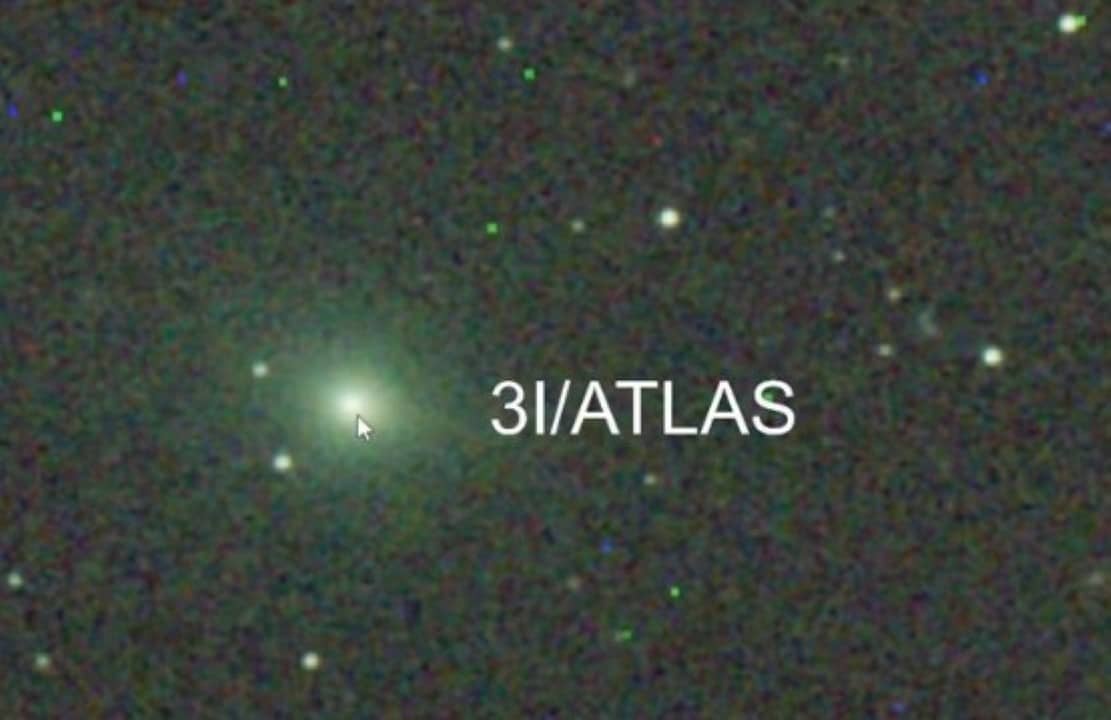
Images captured by Telescópio Espacial Hubble revealed a complex behavior in the interstellar object 3I/ATLAS, highlighting a structure composed of three distinct jets that operate in synchrony. The observations, carried out between the end of November and December 2025, indicate that the celestial body presents a consistent periodic oscillation after its passage through perihelion. The most prominent jet, directed in the opposite direction to Sol, exhibits an angular variation of approximately 20 degrees, suggesting active internal dynamics influenced by solar proximity.
Analysis of the data points to a rotation cycle of around 7.13 hours, accompanied by a significant fluctuation in the object’s total brightness, which varies by up to 30%. Astrônomos interpret these characteristics as the result of a misalignment between the axis of rotation and the main axes of inertia of the core. Apenas a small fraction of the detected luminosity comes from the solid core, estimated to be 2.6 kilometers in diameter, while most of the brightness is generated by the activity of gas and dust jets.

Jet structure and behavior
The three identified jets have specific position angles and well-defined oscillations. The first jet maintains an angle of 55 degrees, while the second, aligned in the anti-solar direction, registers 290 degrees. The third jet completes the configuration with a 170-degree position. The anti-solar jet is the focus of the most evident pulsations, maintaining a regular cycle of just over 7 hours, as demonstrated by the image processing that isolated the morphological evolution of the emissions.
During each oscillation cycle, the appearance of the jets alternates between narrower shapes and fan configurations. Essa visual transition reflects a non-sinusoidal variation in absolute brightness, indicating that the material emission is not constant, but rather modulated by the complex rotation of the object.
Celestial mechanics and rotation
The observed periodicity is directly linked to the rotation of the nucleus, which does not occur aligned with its main axis. Movimentos of precession and nutation cause regular deviations in the orientation of the jets. Essas changes affect both the magnitude of the brightness and the apparent geometry of the gas emissions, evolving as the morphology of the jets transforms in space.
Aligning the axis of rotation with the solar direction facilitates the creation of stable structures, such as the anti-tail jet extension. Observations indicate that the presence of multiple jets contributes to the stabilization of the object’s angular momentum, allowing the triple structure to maintain a separation of approximately 120 degrees in the plane of the sky.
Post-perihelion analysis
The processing of the Hubble images allowed us to detail the changes in the jets after the object reached its closest point to the Sol. Brightness fluctuations follow the transitions between the concentration and dispersion of the jets. Esses patterns occur in synchrony with angular measurements, reinforcing the thesis that the phenomenon is governed by natural physical processes inherent to the rotation of irregular bodies.
Previous studies had already identified similar modulations before perihelion, with rotation periods very close to the current ones. The persistence of this pattern in the current phase confirms the stability of these dynamic characteristics, even as the interstellar object 3I/ATLAS progressively moves away from Sol and continues its trajectory out of the solar system.




