
Keck Observatory identifies anomalies and chemical evolution in comet from another system


Astronomers operating the Keck II telescope, located at the summit of Mauna Kea, in Havaí, have identified significant changes in the chemical and physical structure of the interstellar object 3I/ATLAS. The observations, carried out with the K14 Keck Cosmic Web Imager instrument on November 16, 2025, revealed that the celestial body maintained intense activity after its passage through perihelion. The data show deviations from symmetry in emissions from atomic and molecular species, indicating complex dynamics on the surface of the cosmic visitor.
At the time of capturing the spectral images, the comet was positioned approximately 1.5 astronomical units from Sol and just over 2 astronomical units from Terra. Detailed analysis of the glow flows confirmed the presence of irregular jets and tails, with concentrations of material being ejected in specific directions, while other areas showed reduced flow in the direction opposite to the central star.
Changes in the proportion of metals
A fundamental discovery provided by the study involves the drastic change in the ratio between nickel and iron (Ni/Fe) in the comet’s composition. Antes from reaching the point of closest approach to Sol, when it was still more than 2.5 astronomical units away, 3I/ATLAS had a nickel concentration much higher than that observed in any comet native to Sistema Solar or in the previous visitor, 2I/Borisov.
Data collected after exposure to intense solar heat indicates that these values have normalized. The logarithm of the ratio between the production rates of the two metals fell to levels similar to those found in local comets, such as 9P/Tempel 1.
Current estimates point to a production of approximately 9.55 × 10²⁵ atoms of iron per second and 6.61 × 10²⁵ atoms of nickel per second. The variation detected follows a proportion linked to the object’s heliocentric distance, which reinforces the theory of direct thermal influence on the chemistry of the coma and the release of materials from the nucleus.
Emissions and jet mapping
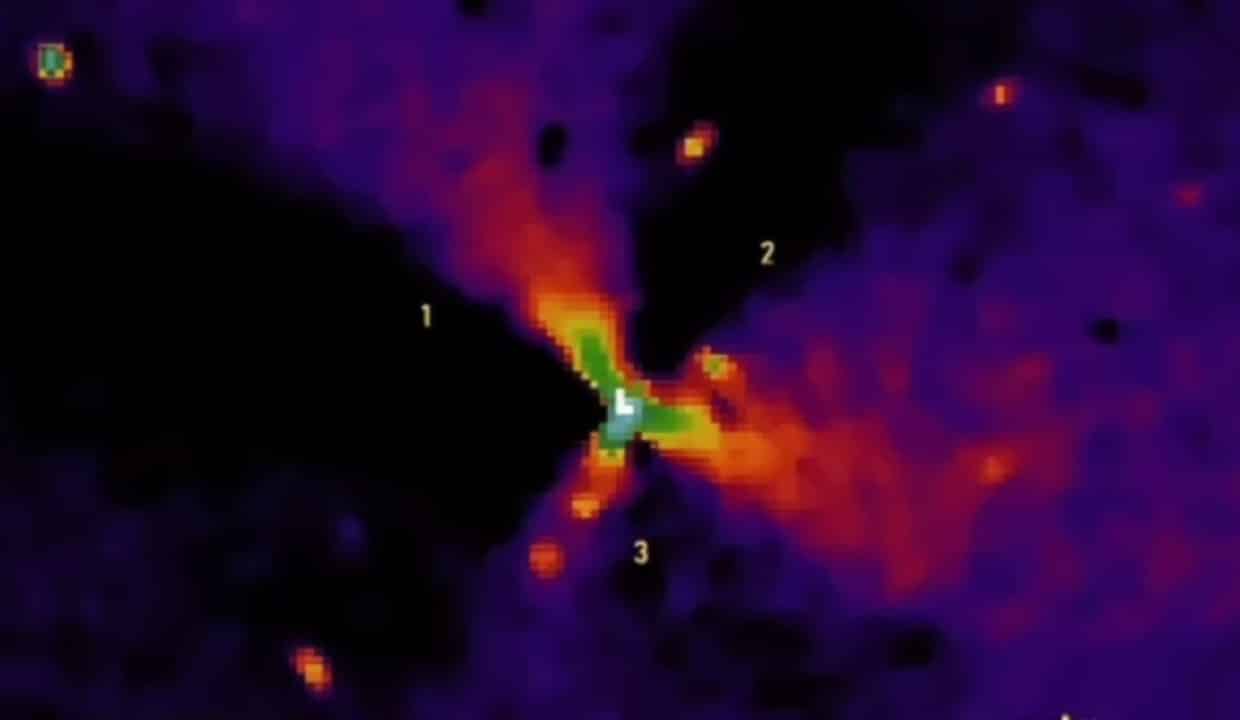
Using full-field spectroscopy allowed researchers to map the spatial distribution of elements such as iron, nickel, cyanogen, tricarbon and dicarbon around the nucleus. By subtracting the symmetric brightness from the processed images, it was possible to visualize asymmetric structures that confirm the directed release of volatiles. Enquanto most chemical species demonstrated alignment with the solar direction, tricarbon exhibited a distinct behavior.
This element formed a jet at a misaligned angle in relation to the other emissions, suggesting the occurrence of differentiated sublimation processes in specific regions of the surface. Essa anomaly indicates that the core of 3I/ATLAS has complex heterogeneities, where different parts of the surface react in a unique way to solar radiation, creating ejection patterns that do not follow geometric uniformity.
Coma expansion and thermal activity
The cloud of gas and dust that surrounds the nucleus, called a coma, also registered significant changes in its physical extent. Exponential decay radii for species such as cyanogen and nickel have increased between 6.5 and 7 times compared to measurements taken before the solar approach. Cyanogen, specifically, reached an extension of more than 6,000 kilometers.
This expansion highlights the response of the volatile material to prolonged heating. The consistency of this chemical activity with patterns observed in Sistema Solar comets after perihelion offers a new perspective on the makeup of objects formed in other stellar systems. The confirmed presence of heavy metals and carbon chains provides essential clues about the planetary building blocks that exist in other regions of the galaxy.
Context of interstellar visitors
3I/ATLAS is the third interstellar object confirmed to cross the boundaries of our system, following in the footsteps of 1I/’Oumuamua and 2I/Borisov. Sua hyperbolic trajectory confirms the extrasolar origin, and the current observations mark the first time that full-field spectroscopy has been applied to an object in this category after perihelion. The ongoing study, which should be expanded by future surveys of Observatório Rubin, promises to refine theoretical models about the diversity and origin of these nomadic celestial bodies.



