
Analysis of 3I/ATLAS interstellar object reveals atypical jet of heavy particles aimed at the Sun


The international astronomical community turns its attention to data collected during the recent passage of a celestial body that defied expectations about the formation of comets outside our system. Catalogado like 3I/ATLAS, the object exhibited a physical structure that contradicts the standard behavior of icy bodies when approaching a star, leading to a rare event. Observações carried out by large ground- and space-based telescopes confirmed the existence of an anomalous formation that persisted even as the visitor moved toward deep space.
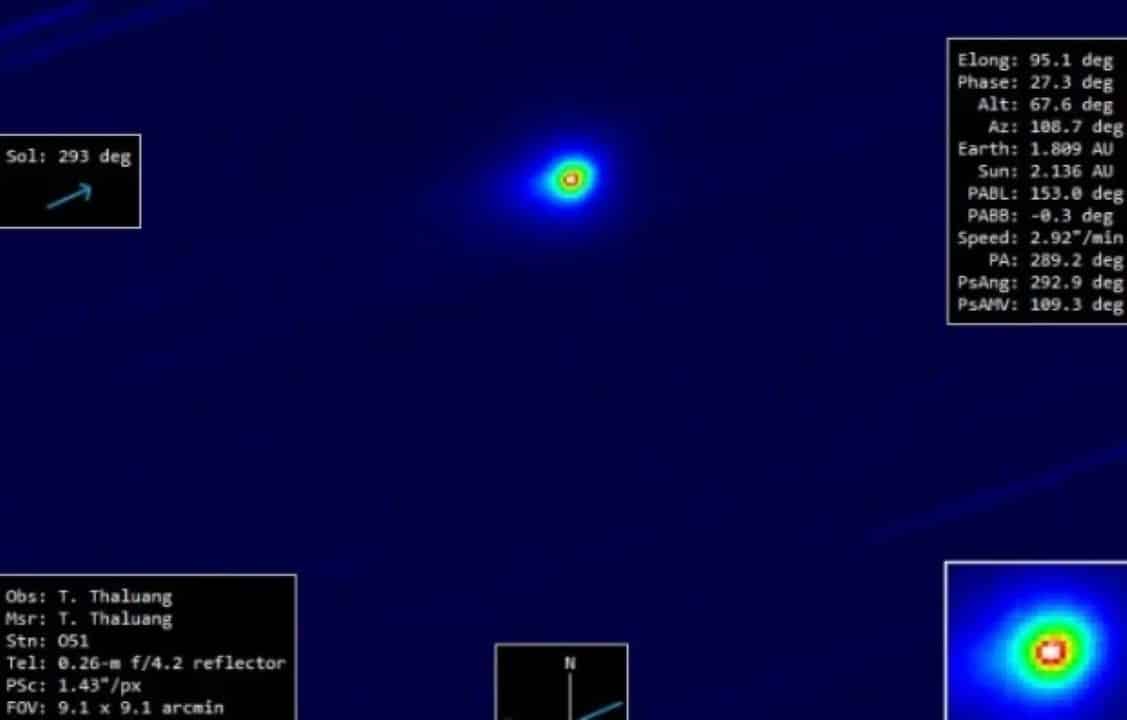
Unlike local comets, which typically develop tails of fine dust pushed by the solar wind, this interstellar visitor featured a prominent “anti-tail” pointed directly toward Sol. The phenomenon, which under normal conditions could be mistaken for an optical illusion, proved to be a real and cohesive physical structure, composed of materials that resist the pressure of stellar radiation. The discovery raises new questions about the diversity of objects that traverse the galaxy and the conditions of their home systems.
Intense monitoring and unique features
Intensive monitoring carried out by researchers from renowned institutions, including Universidade of Harvard, made it possible to map the peculiarities of this body. The stability of the observed jet suggests a complex internal dynamics, where the ejection of matter occurs in a controlled and directed manner, differing significantly from the chaotic sublimations observed in Sistema Solar comets. Essa characteristic indicates geological or thermal processes different from those we are used to seeing in bodies originating from Nuvem and Oort.
Analysis indicates that the object was discovered by the ATLAS telescope on July 1, 2025, starting a race to collect data. Entre the most striking features, the observed anti-tail stands out, which is more than 400 thousand kilometers long. The perihelion occurred at a distance of 1.4 astronomical units from Sol, the moment that triggered the intense activity now studied. Além Furthermore, the structure of the jet remains parallel, which indicates a point origin on the surface of the nucleus.
Orbital tracking and recent passage
Initially identified in mid-2025 by the ATLAS warning system on Chile, the object was soon shown to have a hyperbolic orbit, a defining characteristic of its interstellar origin. The speed and inclination of its trajectory confirmed that the body was not gravitationally bound to Sol, being a temporary traveler in our cosmic neighborhood. Perihelion, the point of closest approach to the star, was reached in October last year, when thermal activity on the surface of the nucleus intensified, allowing detailed visualization of its hair and tail.
The closest approach to Terra occurred weeks later, in December, when the object passed at a safe distance of 269 million kilometers. During this period, the observation geometry favored the study of the tail structure, which remained visible and active for a long period. The persistence of the emission of matter, even after intense solar heat has receded, has provided scientists with a unique window of opportunity to analyze the chemical composition and physics of the ejected particles.
Unusual dynamics challenge traditional models
The most intriguing aspect of 3I/ATLAS lies in the orientation and physics of its solar tail. In common comets, radiation pressure exerts a force that pushes light particles, such as submicron dust and gases, away from the star, forming the classic outward-facing tail. However, the structure observed in this interstellar visitor defiantly points toward Sol, maintaining a narrow, linear shape that spanned the distance between Terra and Lua.
For this phenomenon to occur and remain stable, the particles that make up the jet must have specific properties that allow them to resist radiation pressure. The integrity of the structure suggests that the ejected material has sufficient inertia to maintain its original trajectory towards the star, without being immediately dispersed by the solar wind. Isso points to a focused and violent ejection mechanism, possibly originating from active geological vents or faults in the object’s crust.
Particle size and radiation resistance
Analyzes led by physicist Avi Loeb and his team point to an explanation based on the size of the dust grains. Partículas typical comets, with a diameter of around 0.5 microns, would be quickly slowed down and scattered by sunlight, making it impossible for such a long and defined counter-tail to form. The proposed model suggests that 3I/ATLAS ejects significantly larger and heavier grains.
Calculations indicate that these particles are larger than 1 micron in size and can reach up to 100 microns in diameter. The presence of such massive material in the coma is unusual by the standards of our planetary system and indicates a less processed surface composition or a different agglomeration of materials. Para launch solids of this magnitude into space and form a jet of hundreds of thousands of kilometers, the object must have reserves of volatiles capable of generating a powerful and constant flow of gas.
Comparisons with previous visitors
The emergence of 3I/ATLAS establishes a new paradigm when compared to its predecessors, 1I/’Oumuamua and 2I/Borisov. Enquanto ‘Oumuamua, the first confirmed visitor, behaved like an inert rocky or metallic body, with no visible cometary activity, Borisov almost perfectly resembled a typical comet from our system. The new object, in turn, combines vigorous activity with unique structural characteristics, expanding the spectrum of diversity of interstellar bodies.
The extreme collimation of the 3I/ATLAS jet, being about ten times longer than it is wide, points to a much more point origin on the surface of the nucleus than that observed in comet Borisov. Essas fundamental differences reinforce the thesis that each visitor brings a unique chemical and physical signature, a reflection of the varied conditions of their stellar formative environments and the violent processes that eventually expelled them into the interstellar medium.
Continuous observations as the system moves away
As the object follows its definitive exit route from Sistema Solar throughout 2026, observatories around the world continue to monitor its evolution. Imagens captured by high-precision instruments, such as the Gemini telescope, confirmed the stability of the linear structure at great distances from the nucleus. The detection of gases such as cyanide, combined with confirmation that the glow is dominated by reflection from solid particles, helps refine theoretical models about mass loss in interstellar bodies.
Projects aimed at investigating extraterrestrial life and matter, such as Projeto Galileo, use the data provided by 3I/ATLAS to distinguish natural phenomena from other possibilities. Detailed study of this visitor offers valuable clues about the composition of the material that fills the void between stars, preparing the scientific community to detect and analyze future galactic travelers with greater precision and speed.



