
Dow Jones plummets 500 points as oil prices soar and interest rates rise amid escalating conflict with Iran


American stock markets experienced a sharp decline in value on Tuesday, reversing the brief recovery seen the previous day. The widespread drop was driven by the continuous rise in oil prices and the growing apprehension of investors regarding a possible prolongation of the conflict in the Middle East, which generates economic and political uncertainty.
The escalation of geopolitical tensions, particularly involving Irã, has increased borrowing costs and triggered fears of a new inflationary cycle. Essa outlook contradicts previous expectations of interest rate cuts by Federal Reserve, which were seen as an engine for growth in the American economy.
The global situation shows that regional instability has a direct and immediate impact on global financial centers, highlighting the interconnectedness of economies. Analysts point to the need for constant monitoring, as developments may continue to influence investment decisions and monetary policies.
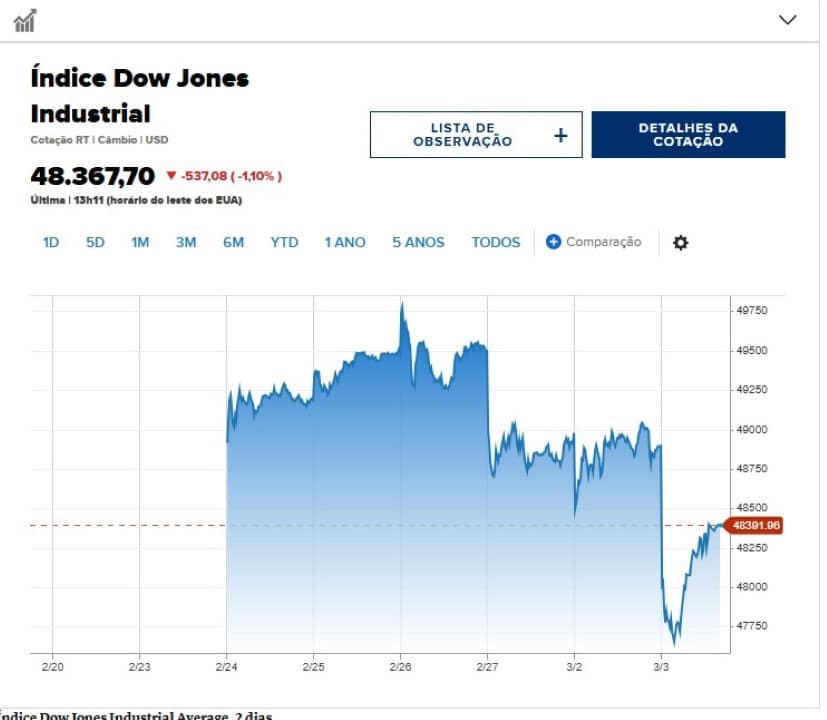
Retreat of the main global indices
The Índice Dow Jones Industrial Average recorded a drop of 537.08 points, which represents a decline of 1.10%, closing at 48,367.70 points in its most recent trading period. Durante the session, the index of 30 shares plummeted more than 1,200 points, marking a loss of approximately 2.6% at its intraday low, signaling a day of great concern for the markets.
Simultaneously, the S&P 500 index registered a devaluation of 1.2% at its daily close, reaching a maximum loss of 2.5% at its lowest point of the session. Nasdaq Composite, made up of technology and high-growth stocks, also followed the downward trend, falling 1.3% at the close and reaching a low of approximately 2.7% on the day. Estes movements indicate widespread risk aversion on the part of market participants.
Escalation of geopolitical tensions
The Estados Unidos embassy in Riade, capital of Arábia Saudita, was the target of drone attacks, highlighting the intensification of Iranian offensives against the country. In direct response to this escalation of violence, the American Departamento of Estado issued an order for the evacuation of employees from their diplomatic representations in Bahrein, Iraque and
At the same time, Hezbollah, an organization with strong support from Teerã, launched a series of missiles and drones against Tel Aviv, the largest city in Israel. Esses attacks mark a significant expansion of the theater of operations and raise concerns about an even greater destabilization of the region, with implications that reverberate globally.
The international community observes with increasing concern the resistance capacity of the Golfo countries, such as the Emirados Árabes Unidos, in the face of the continued offensive of Iranian missiles and drones. The effectiveness of its air defense systems, and how long they will be able to contain threats, has become a critical point in the analysis of regional security and global stability.
President Donald Trump had issued a blunt warning, indicating that the conflict could extend for more than four weeks, generating great uncertainty. Adicionalmente, the commander of Guarda Revolucionária Iraniana declared the closure of Estreito of Este announcement, carried by Iranian media, amplified fears of a disruption in global energy supplies.
Oil and borrowing costs put pressure on the economy
The price of Brent oil, a global market reference, registered a significant jump of 6% on Tuesday, surpassing the US$82 per barrel mark. Este increase comes on the heels of a similar 6% increase recorded on Monday, accumulating considerable appreciation in just two days of trading. The rise in prices reflects markets’ apprehension about the impact of regional conflict on global supply.
In the same period, WTI oil (West Texas Intermediate), another important reference for the American market, also increased 6%, reaching a level above US$75 per barrel. The significant appreciation of WTI, also preceded by a 6% gain in the previous session, highlights the widespread upward pressure on energy commodities in a scenario of geopolitical uncertainty.
The sudden rise in energy prices had an immediate ripple effect on Tesouro bond yields. Essa rise is due to fears that the rise in oil prices could reignite and intensify inflation, precisely at a crucial moment. Investidores in the Estados Unidos were fervently betting on further interest rate cuts by the Federal Reserve to boost the economy. The inflationary perspective generated by oil, however, calls into question the likelihood of these cuts, generating an environment of great expectation and volatility in the economic scenario.
Investor sentiment and risk aversion
The robust recovery seen on Monday, when the S&P 500 and Nasdaq managed to erase significant losses and close slightly higher, and Dow Jones also recovered from the lows, reflects a historic Wall Street strategy. Investidores often buy dips in response to geopolitical conflicts, in the belief that such tensions would be resolved quickly and would not have a lasting impact on the economy, demonstrating initial resilience.
However, market anxiety intensified overnight from Monday to Tuesday as concerns grew about the possibility of a prolonged retaliatory response by an Iranian government aimed at sowing chaos across the region. The expectation of continued attacks on essential economic and energy infrastructure in the following weeks drastically changed investors’ risk perception, leading to a more defensive stance.
Market analysts pointed out that, although the military forces of the Estados Unidos and Israel have complete dominance in the region, they face difficulties in neutralizing all the low-cost missiles and drones launched by the Irã. The situation is worsened by the rapid depletion of interceptor stocks, which suggests a persistent challenge in containing attacks and maintaining regional security, directly impacting investors’ feelings of confidence.
Performance of stock market sectors
Every sector of the S&P 500 ended Tuesday in negative territory, indicating a wide-ranging correction in virtually every area of the U.S. economy. Apenas the energy, finance and real estate sectors managed to record smaller but still significant declines of less than 1%. The relative resilience of these sectors can be attributed, in part, to rising oil prices and movements in bond yields, factors that directly influence their operations.
The materials, industrial and consumer discretionary sectors suffered the biggest losses on the day. Esta vulnerability reflects fears that the combination of high oil prices and rising borrowing costs could negatively impact consumer demand and companies’ investment capacity. The potential economic slowdown resulting from these pressures is a central concern for these segments.
Big technology companies, which often lead market recoveries, also felt the brunt of the decline. Ações of companies like Este scenario demonstrates that not even technological giants are immune to global market instability.
Blackstone, one of the world’s largest asset managers, saw its shares fall 4% after it was announced that its private credit fund recorded net outflows of US$1.7 billion in the first quarter. Este data, reported by Financial Times, added a layer of concern about liquidity and confidence in investment funds, reinforcing the perception of an environment of greater risk aversion.
The volatility jump and the Russell 2000 index
Amid market turmoil, the CBOE Volatility Index (VIX), widely known as the “fear index” of Wall Street, soared. The VIX jumped to its highest levels since November, indicating a dramatic increase in expectations for future stock price fluctuations. Essa sharp rise reflects growing uncertainty and investor nervousness regarding the near future of the market.
The Russell 2000 index, which is focused on small capitalization companies and is an important barometer for the health of the domestic economy, suffered a disproportionate impact. Enquanto the S&P 500, a broader index, registered a drop of approximately 1.2% in the middle of the session, the Russell 2000 lost almost 2%. Isso shows that smaller companies, as they are generally more sensitive to economic changes, are the first to feel the weight of risk aversion.
Tuesday’s decline reduced the Russell 2000’s year-to-date gain by 5%, although the index was still outperforming the broader market, with the S&P 500 down about 0.6% over the same period. The difference in performance between large- and small-cap indices reflects the complexity of market dynamics in uncertain scenarios and the way different segments respond to external pressures.




