
First photo of comet 3I/ATLAS captured by ESA’s JUICE probe in November


The Agência Espacial Europeia (ESA) JUICE spacecraft captured the first detailed image of the interstellar comet 3I/ATLAS using its JANUS science camera. The photo was taken on November 6, 2025, seven days after the comet’s perihelion passage, when the object was closest to Sol. At the time, JUICE was around 66 million kilometers from the comet, allowing its bright coma and tail of dust and gas to be recorded.
Comet 3I/ATLAS, discovered on July 1, 2025 by the ATLAS telescope on Chile, is the third confirmed interstellar object visiting the solar system. Diferente of native comets, it came from outside the solar system, with a hyperbolic trajectory that indicates origin in another region of the galaxy. The image reveals the core surrounded by a cloud of gas called a coma, in addition to an extensive tail formed by the sublimation of volatile materials under the action of solar radiation.
The observation occurred during the cruise phase of the JUICE mission toward Júpiter, where the spacecraft will arrive in 2031 to study the planet’s icy moons. Cinco JUICE scientific instruments were activated to monitor the comet throughout November 2025, including spectrometric analysis to identify chemical composition.
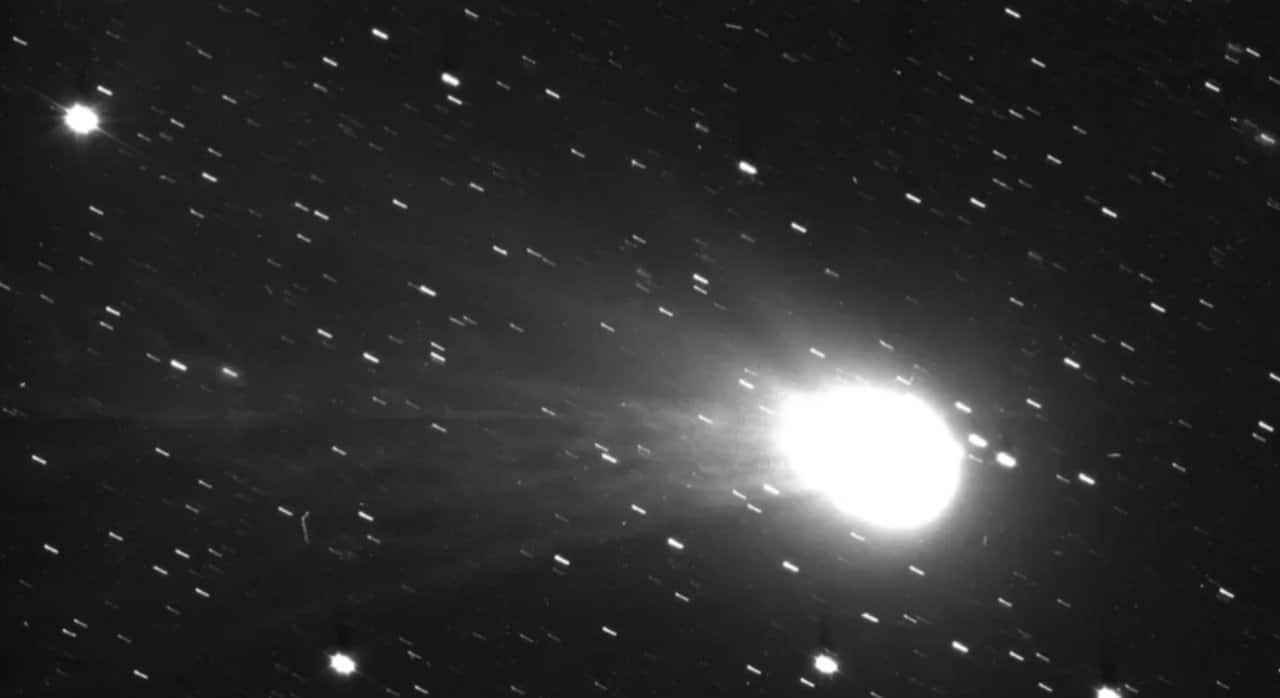
Image reveals active structure of the comet
The JANUS camera recorded more than 120 images from 3I/ATLAS, processed to highlight details of the coma and tail. The object appears almost egg-shaped, with the core not directly visible due to the glowing gaseous cloud.
The arrow indicating the direction of Sol and the speed of the comet helps to understand its orientation during capture. The inset in the image processes the same data to highlight variations in the structure of the coma.
Data reaches Terra and analysis advances
Observation data was slow to reach Terra due to the distance and configuration of JUICE’s antenna during the cruise. The information was received in February 2026, allowing scientific teams to begin detailed analyses.
Instruments such as MAJIS and UVS complement the images with spectrometry, identifying gases and molecules in the comet’s composition. The behavior of 3I/ATLAS follows patterns expected for comets, even though it is interstellar.
Multiple observations complement JUICE’s vision
Other missions, including ground-based and space-based telescopes, have tracked the comet since its discovery. JUICE offered a unique perspective from its position in the inner space of the solar system.
The comet’s speed exceeded 240,000 km/h at times, driven by solar gravity. Agora, the object heads out of the solar system, with no chance of returning.
Unexpected contribution from the JUICE mission
Capturing the comet represented an additional opportunity for JUICE, originally planned to focus on the moons of Júpiter. The relative proximity allowed observations at times of high activity of the object.
Scientists process the datasets to extract information about the origin and evolution of interstellar comets. Esses objects carry primordial material from other parts of the galaxy.
Chemical analysis in progress
Spectra obtained reveal possible unique organic and volatile compounds. Interaction with the solar wind shaped the observed tail and coma.
The study contributes to understanding how comets from outside the solar system behave when entering different stellar regions. Complete Resultados should emerge in the coming months.



