
ESA’s JUICE mission reveals detailed images of interstellar comet during trip to Jupiter


Agência Espacial Europeia (ESA) processed and released unprecedented visual records of comet 3I/ATLAS, captured by the JUICE probe during its cruise phase. The images were originally obtained in November 2025, when the spacecraft was approximately 66 million kilometers from the object, but the complete transmission of data to terrestrial bases was only completed in February 2026. The celestial body is classified as an interstellar visitor, being only the third object confirmed by science to cross our solar system from deep space, presenting a hyperbolic trajectory that indicates its exogenous origin.
Structure and composition details
The JANUS scientific camera played a central role in the operation, recording more than 120 images that reveal the comet with a predominantly oval shape. The solid core of the object is not directly visible in photographs due to the presence of a dense and bright coma, formed by gas and dust that surrounds the central structure and reflects sunlight.
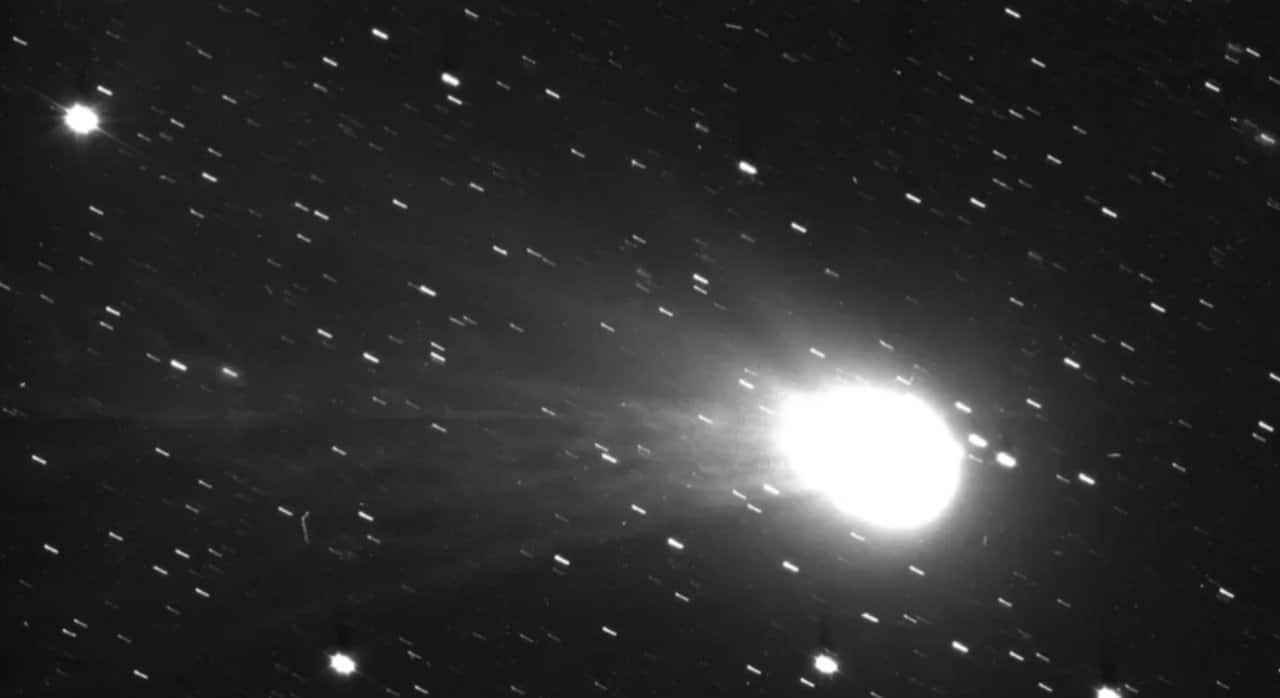
In addition to optical images, the probe activated spectrometry instruments to analyze the visitor’s chemical composition. The interaction of solar radiation with the comet caused the sublimation of volatile materials, generating an extensive tail that offers scientists valuable clues about the primordial matter existing in other regions of the galaxy.
Data logistics and technical challenges
The time interval between the capture of images and their reception at Terra was due to the probe’s communication limitations during its current trip.
As JUICE is on a cruise trajectory for Júpiter, scheduled to arrive in 2031, its main antennas do not always maintain the ideal orientation for sending large data packets at high speeds.
Mission control teams had to wait for a favorable transmission window at the beginning of the year to download the complete content, allowing astrophysicists to begin detailed analyzes now.
Relevance to planetary astronomy
– The 3I/ATLAS observation is considered an example of “opportunity science”, where equipment intended for other purposes can capture crucial data from passing events.
– The probe’s position in the inner space of the solar system offered a unique viewing angle, complementing data obtained by ground-based observatories and orbiting telescopes since the object’s discovery at Chile.
Continuity of the space mission
After this fortuitous encounter, the JUICE probe returns to focus on its main navigation towards the Jovian system, where it aims to explore the icy moons Ganimedes, Calisto and Europa in the next decade. The successful operation of the JANUS, MAJIS and UVS instruments to study the comet served as a robust technical validation of the spacecraft’s ability to perform complex scientific observations in a deep space environment.



