
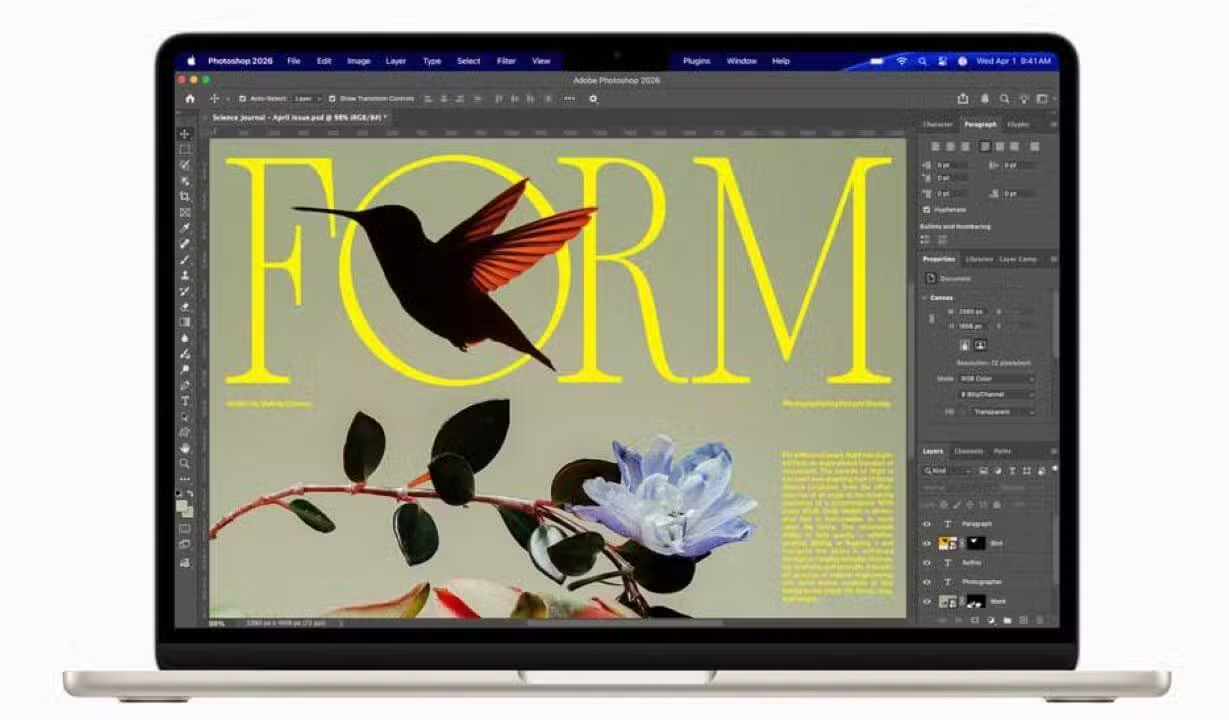
Apple recently introduced the new 13- and 15-inch Air MacBook models, which arrive equipped with the M5 chip, sparking curiosity about the true innovations compared to the previous generation, which used the M4 chip. Externamente, the devices maintain a remarkable familiarity, making the visual distinction almost imperceptible to most users. However, the real difference lies in its internal specifications, which promise improvements focused on performance and user experience.
This in-depth analysis aims to explore the internal modifications and improved features, helping to clarify whether the upgrade to the MacBook Air with M5 represents a significant step forward for different user profiles. The main focus is on improvements in processing, connectivity and storage, crucial elements for the daily performance and longevity of devices.
Understanding these changes is essential for anyone considering a new investment in technology, especially in an ecosystem as consolidated as that of Apple. The decision to upgrade or purchase will directly depend on the perception of the value added by these innovations, aligning with the specific needs of each consumer, whether for work, study or leisure.

Unchanged design and visual experience
Visually, the new MacBook Air with M5 chip remain identical to their predecessors, maintaining the same dimensions and weight in the 13-inch and 15-inch models. The Liquid Retina screen, with a maximum brightness of 500 nits and resolutions of 2560×1664 pixels for the smaller model and 2880×1864 pixels for the larger one, has also been preserved, offering the same vibrant and sharp image quality.
Improved performance with the M5 chip
The big distinction between the two generations of MacBook Air lies in their chipsets. The M5 chip, although it maintains 10 CPU cores (four for performance and six for efficiency), features an architecture with “super cores” and includes “Neural Accelerators” that optimize complex tasks. Enquanto the M4 operated with standard performance cores, the M5 increases processing capacity, especially in demanding applications.
Unified memory on both models offers 16GB, 24GB or 32GB options, but the M5’s bandwidth has been significantly improved to 153GB/s, a 28% increase over the M4’s 120GB/s. Essa improvement translates into AI performance up to four times faster, according to the manufacturer, and a 50% gain in speed for 3D rendering in software like Blender, benefiting professionals who depend on high performance. Embora Both chips integrate a 16-core Neural Engine, the M5 has an improved version, specifically designed to process large language models (LLMs) locally with greater agility and efficiency.
SSD storage and agility
The MacBook Esta change is crucial for users who demand more space for files, applications and projects.
In addition to the greater capacity, the SSD in the M5 models had its speed doubled. Este improvement translates into faster boot times, near-instant application loading and much more responsive overall system performance, directly impacting productivity and user experience when dealing with large volumes of data.
State-of-the-art connectivity
Connectivity is another point where the MacBook Air with M5 chip stands out, incorporating the N1 chip from the Apple. Este new component guarantees support for the latest wireless communication standards, such as Wi-Fi 7 and Bluetooth 6, providing faster, more stable and efficient connections.
In contrast, the MacBook Air with M4 chip is compatible with Wi-Fi 6E and Bluetooth 5.3. The transition to newer standards on the M5 means better performance in environments with many connected devices and greater compatibility with future accessories, optimizing the network experience and interaction with modern peripherals.
Maintaining sound and video quality
The multimedia experience of the new MacBook Air with M5 chip maintains the high standard established by the previous generation, without significant changes to the audio and video systems. The 13-inch models continue to be equipped with four speakers, while the 15-inch versions boast a six-speaker system, offering quality sound immersion for content consumption and calls.
Both devices are equipped with a 12 megapixel camera that includes Palco Central (Center Stage) technology, automatically adjusting the framing to keep the user in the center of the image during video calls. The camera also supports the Visualização functionality of the Mesa (Desk View) and is capable of recording videos in Full HD (1080p), ensuring clarity and sharpness in virtual communications.
Battery life and charging options
The battery life of the MacBook Air with M5 chip remains consistent with that of previous models, promising up to 18 hours of streaming video playback and 15 hours of wireless web browsing. Essa autonomy stability ensures that users can enjoy long periods of use without the need for frequent recharging, which is ideal for mobility.
In terms of charging, the new laptops are compatible with 70W or higher USB-C power adapters for fast charging. Nos Estados Unidos, the MacBook Air M5 is accompanied by a 40W adapter No Brasil, both models are sold with a 35W power adapter with two ports, maintaining charging versatility.
Price variations by region
The arrival of the MacBook Air with M5 chip on the market brought with it a reassessment of values, which vary considerably between different regions. No Brasil, for example, the 13-inch model with M5 is available for R$14,000, an increase compared to R$13,000 for the M4 version. The 15-inch model follows the same trend, being offered for R$16,000 compared to R$15,500 for its predecessor.
In Estados Unidos, the pricing policy also reflects an increase. The 13-inch MacBook Air with M5 costs $1,100, which is higher than the $1,000 for the M4. Para the 15-inch version, the price rose to US$1,300, while the M4 was sold for US$1,200.
Portugal, on the other hand, maintained the prices of the previous generation, making the MacBook Air M5 more affordable for local consumers in comparative terms. The 13-inch model remains at €1,250 and the 15-inch model at €1,550, demonstrating a differentiated market strategy on European soil.
Purchase decision: is it worth the upgrade?
The choice between the MacBook Air with M5 chip and the model with M4 will fundamentally depend on your usage profile and your specific needs. Para who uses a MacBook Air from older generations, such as the M1, the transition to the M5 represents a significant leap in performance, storage and connectivity, fully justifying the investment in a robust and updated machine.
However, if the user already has a MacBook Air with an M4 chip, the decision becomes more nuanced. The M4 is still an extremely competent and effective device for most everyday tasks, from web browsing and document editing to media consumption and more demanding work that doesn’t involve heavy 3D rendering or intensive AI processing. The M5’s performance gains, while notable in specific scenarios, may not be noticeable to the casual user.
Professionals who rely on 3D rendering software, advanced video editing, or who work with artificial intelligence models will benefit substantially from the M5’s improvements in speed and processing power. Improved memory bandwidth, faster SSD, and optimized Neural Engine are crucial factors for these intense workloads.
For those looking for the latest in technology and willing to pay the additional price, the MacBook Air M5 offers the guarantee of a machine with greater longevity and the capacity to handle future software demands. The new Wi-Fi 7 and Bluetooth 6 connectivity is also a draw for those who want to be at the forefront of wireless technology, ensuring compatibility with upcoming networking standards.