
New Hubble analysis points out rhythmic behavior and gas jets in the interstellar object 3I/ATLAS

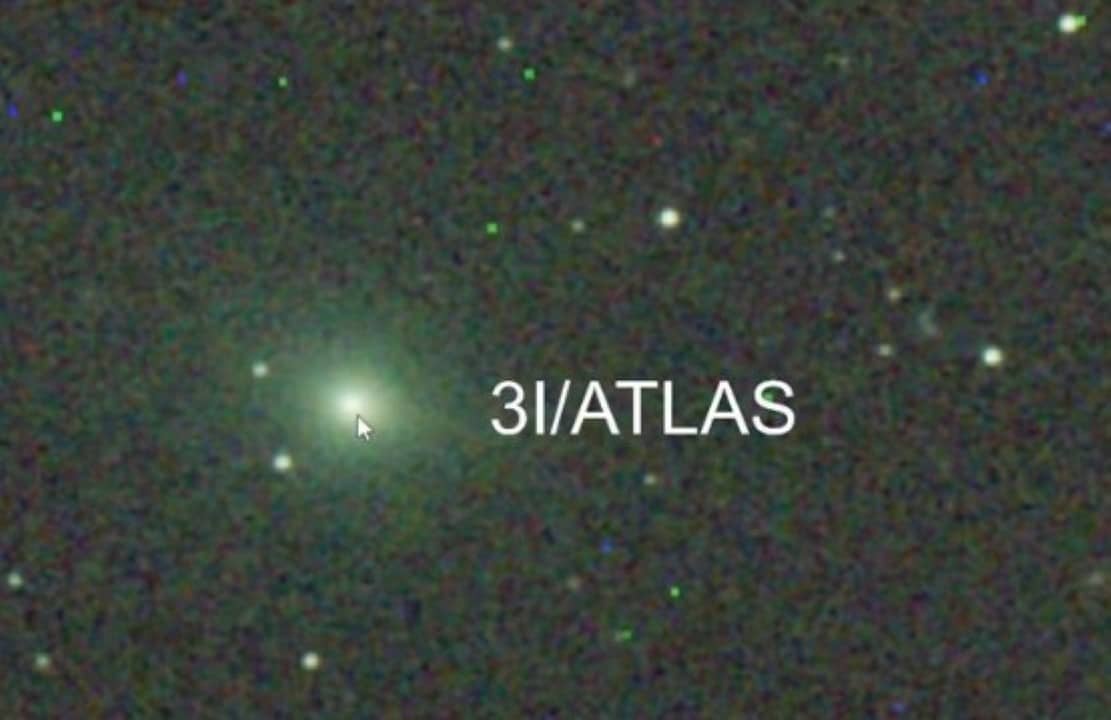
Telescópio Espacial Hubble captured detailed images that reveal surprising dynamics in the celestial body 3I/ATLAS. The most recent observations indicate that the object not only travels through space, but exhibits complex outgassing behavior, functioning with almost mechanical precision in its active structure.
Unlike ordinary comets that exhibit chaotic releases of material, this interstellar visitor demonstrates an organized choreography. Analysis of the data identified three distinct jets that operate in sync with the rotation of the nucleus, suggesting intense internal physical processes that shape their trajectory and appearance.

Movement and oscillation patterns
Astronomers focused their studies on the most visible jet, located in the opposite direction to Sol, which performs a technical angular movement known as a “wobble”. Esse phenomenon is not static, but follows a rigorous temporal cycle, proving that activity on the surface is intrinsically connected to the rotational mechanics of the object.
The measurements carried out by the telescope’s instruments made it possible to quantify fundamental discoveries about the behavior of the celestial body:
– The jet oscillation cycle lasts approximately 7.20 hours.
– The angular variation covers approximately 20 degrees during movement.
– Changes in the total luminosity of the object reach around 30%.
– The rotation period of the glow was precisely calculated to be 7.136 hours.
Physical characteristics and geometry of the nucleus
The consistency between the oscillation time of the jets and the variation in brightness reinforces the theory of a direct connection with the comet nucleus. The physics behind this behavior points to precession or nutation phenomena, which occur due to a fundamental misalignment between the axis of rotation and the axes of symmetry.
Experts indicate that the rotation axis of 3I/ATLAS remains aligned close to the solar direction, with a stability margin of 20 degrees. Essa specific configuration facilitates the maintenance of emanating dust and gas structures, allowing observation equipment to capture the morphology of the jets clearly.
Regarding dimensions, it is estimated that the core has a diameter of approximately 2.6 kilometers. Direct visualization of the solid surface is complex, as only about 1% of the captured light results from solar reflection in the core, while the vast majority of the brightness comes from light scattering in the ejecta.
Mapping gas emissions
The morphological study determined the exact position of each of the three jets, which maintain a projected separation of 120 degrees from each other. The second jet, projected in the solar direction, stands out for presenting the greatest amplitude of movement among all recorded emissions.
The anti-solar jet works as a precise indicator of rotational dynamics, alternating its shape between collimated structures and fan configurations as the nucleus rotates. The periodicity of 7.1 hours in variations in brightness and movement confirms the rotation of this misaligned nucleus, a feature that appears to be persistent in the object.
This observed symmetry, combined with the rhythmic oscillation, highlights the physical complexity of this celestial body. The data obtained is crucial for deepening understanding of the formation and behavior of objects that originate outside our solar system and cross interstellar space.




