
SpaceX elevates Starlink satellite brand with Falcon 9 rocket launch from Cape Canaveral
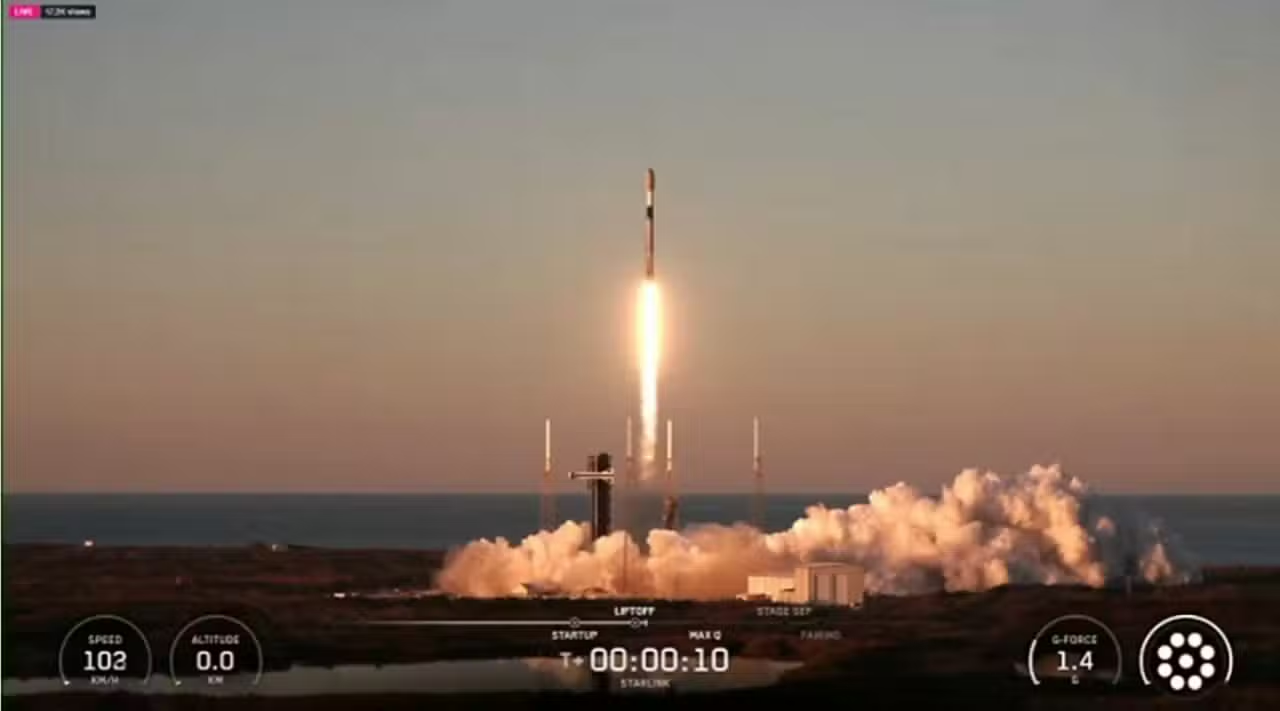
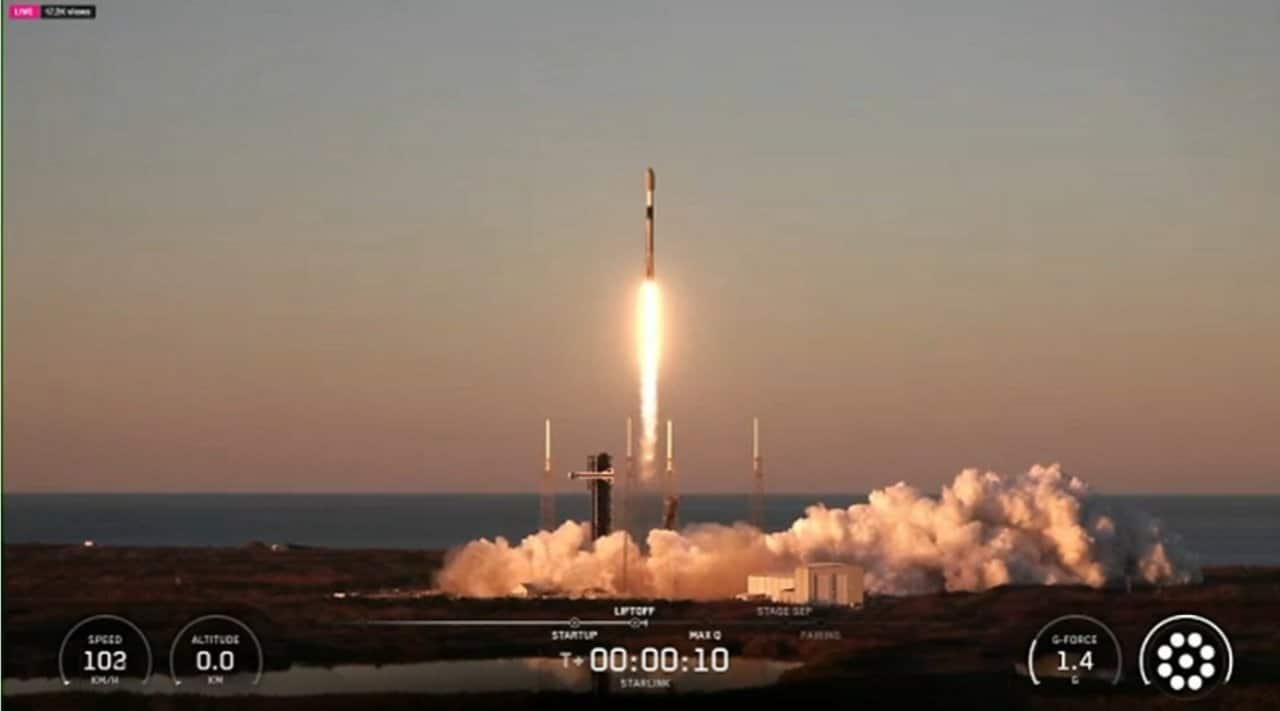
A successful operation marked the early hours of Wednesday, March 3, 2026, when SpaceX sent an Falcon 9 rocket into space, from Estação to Força Espacial to Cabo Canaveral. The mission, called Starlink 10-40, had the primary objective of expanding the constellation of broadband internet satellites Starlink in low orbit of Terra.
The pre-dawn launch occurred at precisely 5:52:20 EST (10:52:20 UTC), departing Complexo of Lançamento Espacial 40 (SLC-40). The rocket’s trajectory headed northeast after leaving the pad, lining itself against the dark pre-dawn sky.
This mission added 29 more satellites to the Starlink network, reaching a significant milestone for the company. With this flight, SpaceX celebrated the launch of the 600th Starlink satellite in 2026 alone, demonstrating the accelerated pace of implementation of its space infrastructure.
Details of Missão Starlink 10-40
The Starlink 10-40 mission was crucial to the continued expansion of SpaceX’s internet infrastructure, designed to provide global connectivity, especially in remote and underserved regions. Cada satellite contributes to network density and capacity, improving speed and latency for end users.
These satellites operate in low Earth orbit, an altitude that allows for significantly lower response time (latency) compared to traditional geostationary satellites. The rapid deployment and advanced technology of the Starlink satellites aim to democratize internet access on a global scale.
The Importância of the Constelação Starlink
The Starlink constellation represents a revolution in the way internet access is distributed, offering a robust, high-speed alternative where terrestrial infrastructures are unfeasible or insufficient. Desde the beginning of the project, SpaceX’s vision has been to create an interconnected network of thousands of satellites, working together to form continuous global coverage. Este system not only benefits individual consumers and businesses in rural areas, but also provides critical solutions for emergency operations, natural disasters and regions with little or no connectivity. The ability to provide broadband internet virtually anywhere on the planet has profound implications for education, economics and global communications, bridging digital gaps and boosting technological development on multiple fronts. With each launch, SpaceX reinforces its position as a leader in space innovation and the democratization of access to information.
Reuse of Foguetes: Um Pilar from SpaceX
SpaceX used the Falcon 9 first stage propellant with tail number 1080 on this mission, an already veteran component. Esta was its 25th trip to space, highlighting the company’s success in its rocket reuse program.
The reuse of rocket boosters is one of SpaceX’s most important innovations, allowing a significant reduction in launch costs and increasing the frequency of missions. The B1080, in particular, has previously powered notable missions.
Among its previous flights, B1080 was responsible for launching two private astronaut missions to Axiom Space, the NG-21 mission to Northrop Grumman and CRS-30 to NASA. The long service life of this particular booster underlines the effectiveness of SpaceX’s design and engineering.
Each successful reuse of the B1080, and other boosters in the Falcon 9 fleet, not only optimizes financial resources, but also contributes to the sustainability of space operations. The ability to recover and relaunch a rocket in such a short space of time is a testament to the company’s technological maturity.
Operations on Cabo Canaveral
Complexo of Lançamento Espacial 40 (SLC-40) at Cabo Canaveral is one of the most active locations for SpaceX operations. Esta strategic installation has been critical to the accelerated pace of Starlink satellite launches and other critical missions.
Estação of Força Espacial of Cabo Canaveral, located off the coast of Flórida, is a historic epicenter for space exploration. Sua privileged geographic location facilitates launch trajectories over the Atlântico ocean, minimizing risks for populated areas.



The launch routine at the base is intense, with dedicated teams working tirelessly to ensure the preparation and safe execution of each mission. Robust infrastructure and team experience are crucial to the continued success of spaceflight.
The synergy between SpaceX and Força Espacial authorities in Cabo Canaveral allows for efficient coordination, from weather forecasting to the safety of operations on the ground and at sea. Este collaborative environment is essential to maintain the release schedule.
Conditions Climáticas and Segurança
The 45th Esquadrão Meteorológico plays a vital role in all launch operations at Cabo Canaveral. Para the mission Starlink 10-40, the forecast indicated a 90% chance of favorable weather conditions during the launch window.
The main meteorological concern was the small possibility of interference from cumulus clouds, which could affect visibility or pose a lightning risk. Contudo, general conditions allowed the countdown sequence to proceed without significant delays.
Meteorologists were also closely monitoring the weather in the booster recovery area, a critical aspect for the safety of crew and equipment. Rigorous analysis ensures that the rocket landing process occurs under safe conditions.
The Pouso Preciso in the Atlântico
Recovery of the Falcon 9 B1080 propellant occurred approximately 8.5 minutes after launch. The stage successfully landed on the autonomous vessel “A Shortfall of Gravitas”, which was positioned at Oceano Atlântico, off the coast of Carolina of
This landing marked the 145th time a vessel of this type has received a SpaceX booster, and the 581st booster landing for the company to date. Precision in these operations is fundamental to the reuse program.
Expansion Contínua of Rede Global
SpaceX continues on its journey to massify internet access with the continuous expansion of the Starlink constellation, now with 600 satellites launched in 2026 alone. Este exponential growth aims to meet the growing demand for high-performance connectivity on a global scale, positively impacting the lives of entire communities. The company not only focuses on the quantity, but also on the technological innovation of its satellites, seeking constant improvements in the capacity and efficiency of the network to guarantee an increasingly robust service.
The Starlink network has proven to be a vital solution in a variety of situations, from supporting regions affected by disasters to providing internet on ships and aircraft, proving its versatility. With the goal of covering the entire planet, SpaceX projects a future where geographic distance will not be an impediment to access to information and communication, connecting billions of people and boosting development on a global scale.
Veja Tambem em News (EN)

Research reveals that parents are unaware of how their children use artificial intelligence

Samsung releases new system update with new features for Galaxy Watch 4 users

Digital retail reduces the value of the Galaxy S25 5G smartphone with bank bonuses and device exchange

Amazon’s wireless CarPlay adapter has a 50% discount and high approval ratings from drivers

Zach Cregger’s new Resident Evil ignores games and focuses on an unprecedented story with new characters

Rumor suggests that Nintendo is preparing a special edition of the Switch 2 with a remake of Ocarina of Time

Apple accelerates production of the iPhone 17e and develops new Air model with dual camera system

Epic Games platform releases twelve high-budget games at no permanent cost for PC users

PlayStation 5 Pro price drop accelerates digital retail sales and eliminates global stocks

New Galaxy Watch 9 firmware appears on server and confirms progress in software development

Apple’s commemorative project tests cell phone with 1.1 millimeter edge and curved screen for 2027
