
The distinct celestial phenomena: understand what separates the lunar, solar eclipse and the blood moon
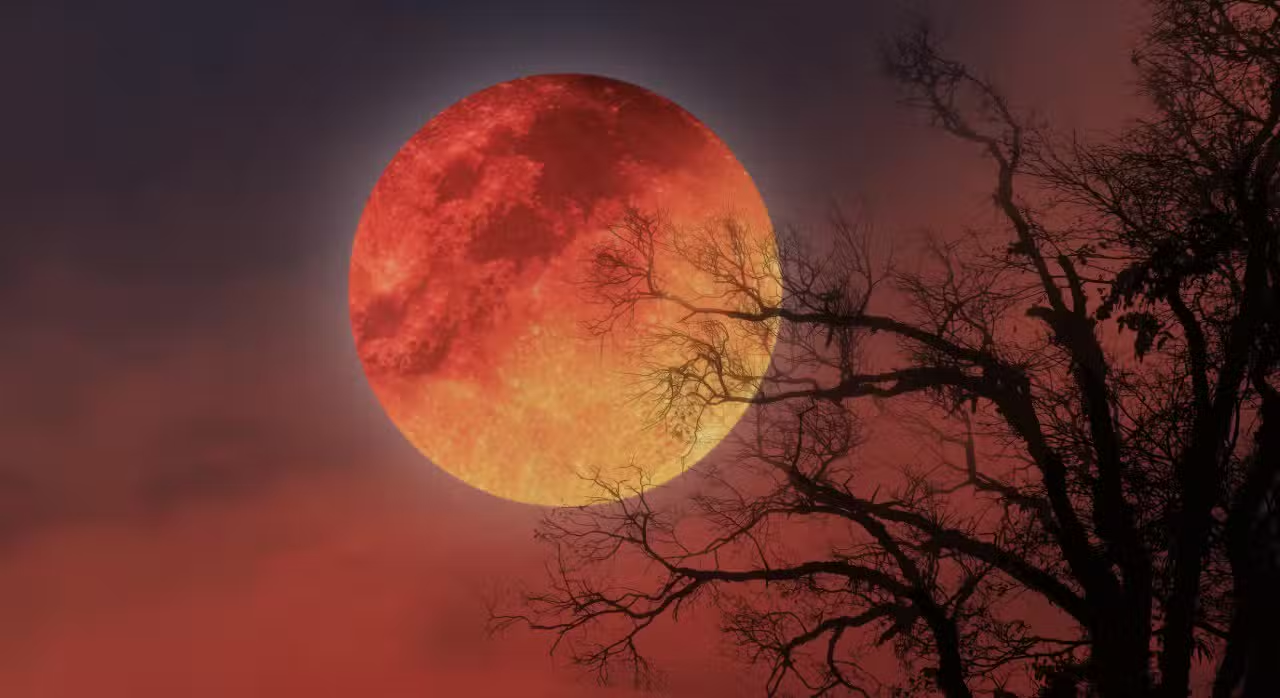
The recent lunar eclipse that occurred in March aroused great interest and moved several digital platforms. Este astronomical event reignited discussions and generated confusion between terms such as solar eclipse, lunar eclipse and the popular “blood moon” phenomenon. Apesar of all being related to interactions between celestial bodies, each describes unique and distinct events observable in the sky.
The distinction between these concepts is actually simpler than it appears. Fundamentalmente, everything resides in the spatial configuration of Sol, Terra and Lua at a given time. Cada specific alignment provides a particular spectacle, which can be seen with the naked eye or with the help of specific equipment, depending on the nature of the event.
It is crucial to understand the mechanics behind each phenomenon to fully appreciate its beauty and meaning. Astronomy offers the tools to unravel these mysteries, transforming observation into an experience of knowledge and wonder at the universe.
The celestial mechanics behind eclipses
Eclipses are, in essence, the result of the perfect alignment of three celestial bodies: Sol, Terra and Lua. The orbit of Lua around Terra and the orbit of Terra around Sol have different inclinations, which prevents these alignments from occurring frequently in every month. It is the intersection of these orbital planes that creates the right conditions for an eclipse to occur.
The gravity and trajectory of each star are determining factors for the shadow of one body to be projected onto another, creating the spectacle of eclipses. Compreender the gravitational dance of these celestial bodies is fundamental to predicting and understanding the specific characteristics of each type of eclipse, from its duration to the regions of visibility.
The spectacular solar eclipse alignment
A solar eclipse happens when Lua is positioned exactly between Sol and Terra. Durante this rare conjunction, the lunar disk totally or partially blocks sunlight, projecting a band of shadow over a specific area of our planet. For this reason, observation of a total solar eclipse is restricted to geographically limited locations.
Esse astronomical phenomenon occurs exclusively during the new moon phase, when Lua is invisible in the night sky to most observers. The absence of light reflected by Lua in this period is an indication of its positioning aligned with Sol and Terra.
Existem three main types of solar eclipse, each with distinct visual characteristics. The most impressive total eclipse occurs when Lua completely covers Sol, revealing the solar corona. A partial eclipse occurs when only a portion of Sol is hidden by the lunar disk, not forming a complete blockage of sunlight. Já the annular eclipse appears when Lua is further away from Terra in its elliptical orbit, and its apparent size is smaller than that of Sol, creating a fascinating “ring of fire” around the lunar silhouette.
Observing any type of solar eclipse requires extreme precautions to avoid irreversible damage to vision. Nunca You must look directly at the Sol without adequate protection, such as certified eclipse glasses or specific solar filters for telescopes, as the intensity of solar radiation, even if partially blocked, can cause blindness.
The Earth’s Shadow: Understanding the Lunar Eclipse
In contrast, a lunar eclipse occurs when Terra aligns between Sol and Lua. Nesse scenario, our planet casts its shadow on the lunar surface, temporarily darkening it. Unlike a solar eclipse, a lunar eclipse can be observed from any location on Terra where Lua is visible in the night sky at the time of the event, reaching a much larger audience.



Este night spectacle is only possible during the full moon phase, a period in which Lua, fully illuminated by Sol, is in apparent opposition to Sol in relation to Terra. The fullness of the Lua is a prerequisite for the earthly shadow to envelop it.
Assim Like solar eclipses, lunar eclipses are also subdivided into categories. A total lunar eclipse occurs when Lua completely immerses itself in the umbra, the darkest, central part of Terra’s shadow. Já partial lunar eclipse occurs when only a fraction of the Lua is covered by the umbra. Existe is also a more subtle penumbral eclipse, when Lua only crosses the penumbra, the outermost and diffuse part of the Earth’s shadow, resulting in a slight darkening of the lunar surface that may be difficult to perceive with the naked eye.
The fascinating coloring of the ‘blood moon’
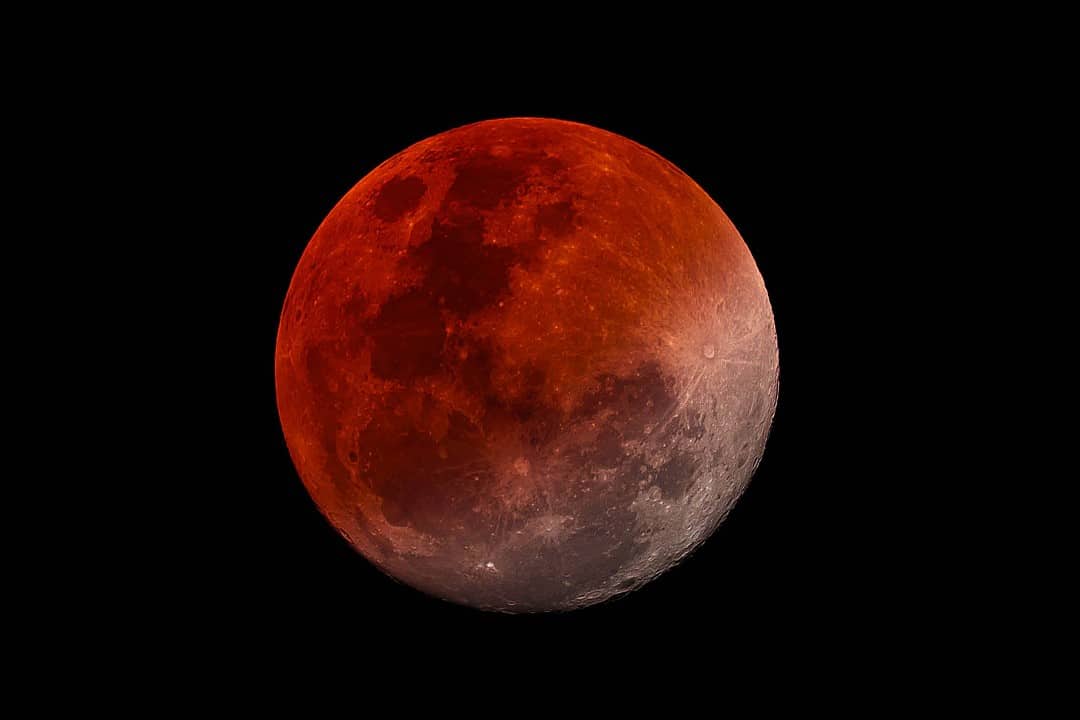
The term “blood moon” has no formal scientific basis, but has become a popular term to describe the reddish color that Lua acquires during a total lunar eclipse. Essa dramatic and mysterious hue is the result of a complex optical phenomenon involving the Earth’s atmosphere. Apesar is completely immersed in the shadow of Terra, Lua still receives a portion of the sunlight.
Our planet’s atmosphere acts as a filter and a lens, refracting light from the Sol. Most of the blue and violet wavelengths of sunlight are scattered by the Earth’s atmosphere, while longer wavelengths, such as red and orange, can penetrate and be refracted into the umbra, illuminating the Lua. Este process is identical to that which causes the vibrant, reddish colors that we observe in the skies during sunrise and sunset, providing a visual spectacle of great impact.
Crucial differences and safety in observation
Para To simplify the distinction and ensure safe observation, it is essential to retain the main characteristics of each phenomenon. A solar eclipse occurs when Lua comes between Sol and Terra, blocking sunlight and casting its shadow on specific areas of our planet; Direct observation requires the use of certified sunscreens, as unprotected exposure can cause permanent eye damage. On the other hand, a lunar eclipse occurs when Terra is positioned between Sol and Lua, projecting its shadow over the natural satellite, which causes its darkening or the reddish color characteristic of the “blood moon”; This phenomenon is completely safe to observe with the naked eye, without the need for any special protection, making it accessible to a much wider audience and without risk to visual health.
The accuracy of astronomy for future events
The ability to predict eclipses with great accuracy is one of the great triumphs of astronomy. Through complex calculations and ancient observations, scientists are able to accurately determine the dates, times and locations of visibility of future events. Essa predictability allows enthusiasts and researchers to prepare to follow the next celestial shows, contributing to education and the advancement of science.
The regularity of these events, although they vary in type and intensity, is a constant reminder of the order and laws that govern the universe. The continued study of celestial orbits and interactions enhances our understanding not only of eclipses, but also of the formation and evolution of our solar system, revealing the complexity and beauty of the cosmos.
Exploring other details of the phenomena
Além beyond the basic distinctions, there is a wealth of detail that enriches the understanding of these celestial events. Mythology and cultures around the world often associate eclipses with omens, deities or great transformations, reflecting the deep human connection with cosmic cycles. Cientificamente, each eclipse offers valuable data for studies of the Earth’s atmosphere, lunar composition and variations in solar activity, transforming a simple spectacle into an opportunity to expand our knowledge.
Veja Tambem em News (EN)

Research reveals that parents are unaware of how their children use artificial intelligence

Samsung releases new system update with new features for Galaxy Watch 4 users

Digital retail reduces the value of the Galaxy S25 5G smartphone with bank bonuses and device exchange

Amazon’s wireless CarPlay adapter has a 50% discount and high approval ratings from drivers

Zach Cregger’s new Resident Evil ignores games and focuses on an unprecedented story with new characters

Rumor suggests that Nintendo is preparing a special edition of the Switch 2 with a remake of Ocarina of Time

Apple accelerates production of the iPhone 17e and develops new Air model with dual camera system

Epic Games platform releases twelve high-budget games at no permanent cost for PC users

PlayStation 5 Pro price drop accelerates digital retail sales and eliminates global stocks

New Galaxy Watch 9 firmware appears on server and confirms progress in software development

Apple’s commemorative project tests cell phone with 1.1 millimeter edge and curved screen for 2027
