
ESA probe reveals unprecedented details about the composition and tail of the interstellar comet 3I/ATLAS

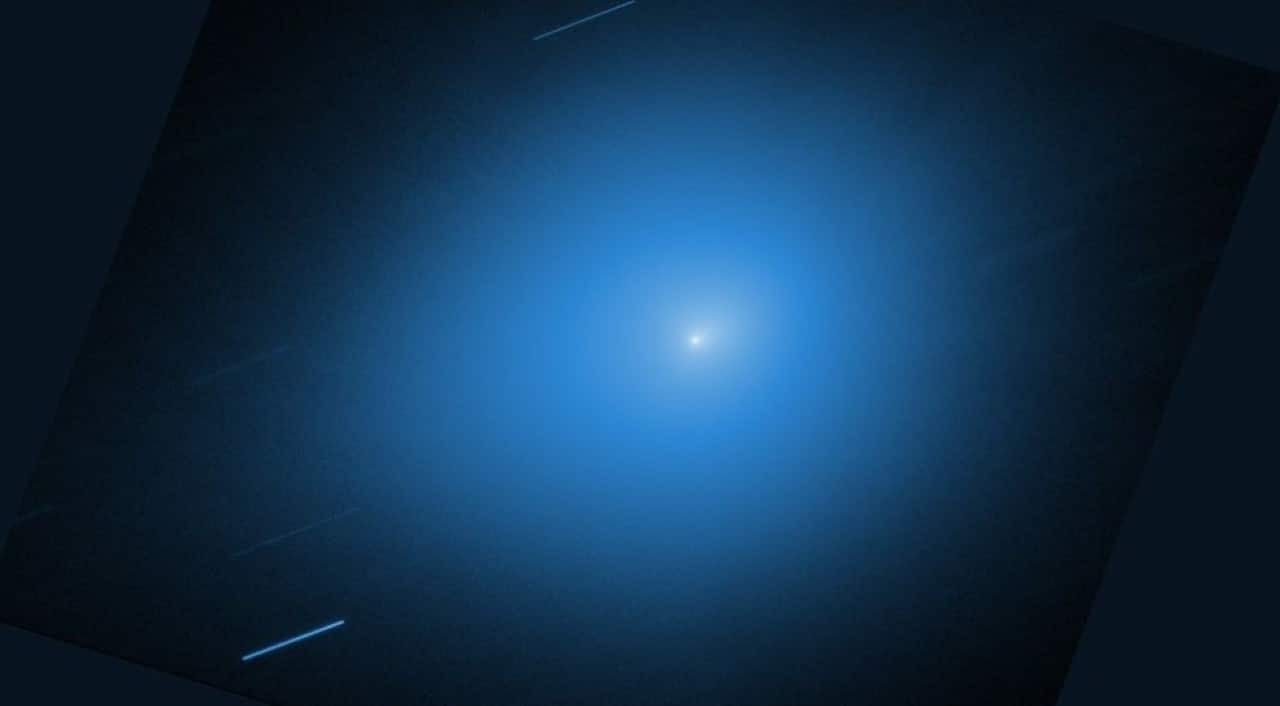
Agência Espacial Europeia (ESA) has processed and released a fascinating set of data sent back by the Juice mission, which sheds new light on the nature of objects visiting our solar system from deep space. The information, transmitted to Terra in February 2026, refers to observations carried out at the end of the previous year, when the probe took advantage of its trajectory to analyze a rare celestial body. The captured images reveal surprising characteristics of an interstellar visitor that crossed the vicinity of Sol at high speed.
The protagonist of these observations is the object identified as 3I/ATLAS, a comet that does not belong to our original planetary family. Detectado initially in July 2025 through the ATLAS telescope, at Chile, the celestial body drew a hyperbolic trajectory that confirmed its origin outside the solar system. The study opportunity arose when the Juice probe, originally designed to explore the icy moons of Júpiter, found itself in a privileged position after its close pass to Sol in October.
Planetary scientists now have a detailed visual and spectroscopic library that allows them to better understand the chemistry of other stellar systems. Diferente of observations made by ground-based telescopes, which suffer interference from the atmosphere, or from distant orbital observatories, the probe’s position allowed it to capture angles and details of the structure of the comet’s tail and nucleus that would have been impossible otherwise.
High-resolution images and cometary structure
During the period of most intense activity, between November 2 and 25, 2025, the JANUS scientific camera, on board the probe, recorded a sequence of approximately 120 images. Este visual material documented the evolution of the comet’s activity shortly after its closest approach to the central star of our system. The photographs show not just a bright spot, but a complex structure made up of an active nucleus surrounded by a luminous coma.
Preliminary analysis of the images indicates that the tail of 3I/ATLAS extends for millions of kilometers, a trail of gas and dust that reflects sunlight intensely. The JANUS camera’s ability to operate at different wavelengths allowed researchers to dissect the layers of this tail, identifying variations in the density and type of material expelled as the comet moved away from the solar heat.
In addition to the optical cameras, other instruments on the probe were activated to measure the environment around the object. Sensores of particles and magnetometers recorded subtle changes in the plasma and solar wind caused by the comet’s passage. Esses data is crucial to understanding how interstellar objects interact with the heliosphere and how their volatile materials behave when subjected to extreme temperatures.
Chemical composition and volatile activity
One of the most relevant aspects of the discovery lies in the spectral analysis of 3I/ATLAS. Unlike dry, rocky asteroids, this visitor proved to be rich in volatile elements. The probe’s spectrometers detected the significant presence of compounds essential to prebiotic chemistry, suggesting that distant stellar systems have reservoirs of materials similar to those that formed Terra.
The readings indicate that the jets expelled by the comet’s nucleus contain a complex mixture. The sublimation of the surface ice, caused by the heat of the Sol, released gases that were immediately analyzed by the instruments on board. The chemical signature revealed points to the existence of:
- Water in a gaseous state, confirming the icy nature of the nucleus;
- Carbon dioxide and carbon monoxide in abundance;
- Traces of methane and other simple organic molecules;
- Silicates and fine dust mixed with the gas stream.
This composition is more similar to the interstellar comet 2I/Borisov, discovered in 2019, than to the enigmatic 1I/’Oumuamua, which visited the solar system in 2017.
Interstellar trajectory and origin
3I/ATLAS’s orbital dynamics are what sealed its classification as humanity’s third confirmed interstellar object. Viajando at an impressive speed of about 220,000 kilometers per hour, the object possesses enough kinetic energy to escape Sol’s gravity and return to deep space. Sua route is not a closed ellipse, but an open hyperbola, indicating that he will never return.
Astronomers calculate that the object wandered around Via Láctea for hundreds of millions of years before crossing our path. Ele probably comes from a young stellar system where gravitational instability ejects planetesimals and comets into the interstellar medium. The passage through our system is a unique and ephemeral event, lasting just a few months before the object disappears into the darkness again.
The minimum approach distance to Terra occurred in December 2025, at around 1.8 astronomical units (approximately 270 million kilometers). Embora distant for amateur observers, it was close enough for space telescopes like the Hubble and the James Webb, in coordination with the Juice probe, to carry out a global observation campaign.
Challenges of space observation
Carrying out these measurements was not a simple task for the mission control team. The Juice probe was 66 million kilometers away from the comet at the time of the observations. Para To put this into perspective, it is an immense distance that required extraordinary pointing precision from the instruments. The fact that the JANUS camera was able to resolve details of the coma and tail at this distance is a testament to the quality of the mission’s optical engineering.
There was also the challenge of data transmission. Como the probe was in a critical phase of its journey, close to Sol (solar conjunction), communication with Terra suffered natural interference. Foi needed to wait until February 2026, when the orbital geometry became more favorable, so that the complete high-telemetry data package could be downloaded and processed by scientists on Europa.
This maneuver of opportunity demonstrates the flexibility of modern space missions. Embora the primary objective of the Juice is the Jovian system, the ability to reorient the ship to study targets of opportunity significantly increases the scientific return on the investment made.
The legacy of interstellar visitors
The passage of 3I/ATLAS enriches the catalog of objects that were not formed together with Terra. Cada, one of the three visitors identified to date — ‘Oumuamua, Borisov and now ATLAS — presented distinct characteristics. Isso suggests that the population of objects wandering among the stars is diverse, ranging from dry, rocky bodies to dirty snowballs packed with complex chemistry.
The data collected will continue to be analyzed throughout 2026. The presence of organic compounds reinforces theories about panspermia, the idea that the building blocks of life can be transported between planetary systems aboard comets.
As 3I/ATLAS continues its lonely journey back into the interstellar void, weakening until it becomes invisible to the most powerful telescopes, it leaves behind a treasure trove of information. Collaboration between space agencies and the use of interplanetary probes as remote observatories ushers in a new era in the detection and characterization of these galactic nomads.



