
Recent study reveals unique acceleration of the interstellar object 3I/ATLAS without unique direction in relation to the sun


The most comprehensive analysis of the non-gravitational acceleration of the interstellar object 3I/ATLAS, published in a new paper on March 3, 2026, presents conclusions that differ significantly from the official report released by NASA. Contrariando the perception of a movement predominantly away, the study suggests that the celestial body is propelled laterally with an intensity comparable to its radial movement, providing a new perspective on the dynamics of these cosmic visitors. The data point to a complex non-gravitational force, which is not limited to a direct push away from the Sol, but involves important tangential components.
The detailed research challenges previous understanding, where NASA’s Laboratório from Propulsão to Jato (JPL) had indicated a radial acceleration component five times greater than the tangential one. Essa reinterpretation of data is crucial to more accurately model the trajectory and behavior of interstellar objects that traverse our solar system. Science, by its nature, is an ongoing process of learning and refinement, where even official statements can be revised in light of new evidence and in-depth analysis.
The implications of these discoveries are vast for astrophysics, especially in understanding the mechanisms of outgassing and propulsion of comets and similar objects. The complexity of the movement of 3I/ATLAS, with its acceleration not uniformly away from Sol, opens new lines of investigation into the composition and physical characteristics of celestial bodies outside our system.
Reassessing the motion of the interstellar object
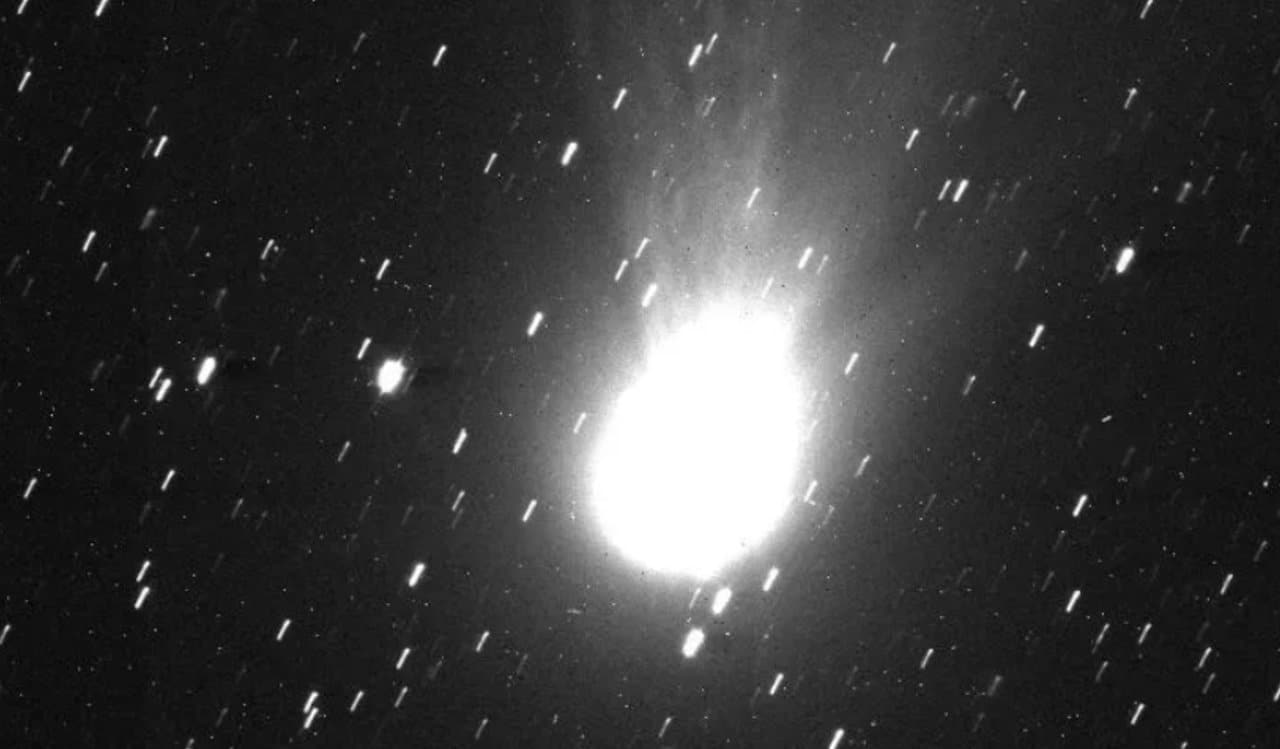
The scientific community is closely monitoring the behavior of 3I/ATLAS, an object that has defied expectations. Enquanto NASA’s initial interpretation pointed to a predominantly radial acceleration, propelling it away from Sol, the recently published study reveals a more complex dynamic, where the radial and tangential components of the acceleration have similar amplitudes. Esta new reading suggests that 3I/ATLAS is not only moving away, but also being pushed sideways on its journey through space.
This difference in the amplitudes of non-gravitational acceleration is fundamental. Non-gravitational acceleration in comets and similar objects is generally attributed to the emission of gas and dust from the nucleus, which act as small propellants. Entender the direction and magnitude of these forces is essential for tracing precise routes and inferring internal properties of the object, such as the composition and structure of its core. The new analysis deepens understanding of how these subtle forces can shape the trajectory of an interstellar visitor.
Collimated jets and rotational dynamics
Observations carried out in August 2026, when 3I/ATLAS approached Sol, revealed the presence of collimated jets at high latitudes. Essas emissions, which exhibit a periodic oscillation, are consistent with the rotation of the object’s core. Tal morphology indicates that mass loss does not occur uniformly across the entire surface, but rather from localized and directional sources, which may be a determining factor for significant non-radial acceleration.
Additional studies, using high-resolution images obtained by Telescópio Espacial Hubble, have deepened this understanding. By removing the circular glow around the nucleus in post-perihelion images, three symmetrically separate minijets were identified, in addition to a prominent jet directed towards the Sol, known as the antitail. Essas emissions are modulated by a rotation period of 7.1 hours, and the orientation of the rotation axis was inferred to within 20 degrees of the solar direction.
The complex geometry of gas emission
The observed configuration of the jets in 3I/ATLAS naturally favors the directional emission of gas and dust. Essa directed emission is capable of generating a transverse acceleration component of comparable magnitude to the radial one, which corroborates the findings of the new article. The force exerted by the ejection of volatile material from the nucleus acts as an impulse, and the asymmetry of this ejection explains the complexity of the object’s motion.
Understanding the geometry of this jet system is crucial to modeling the non-gravitational force exerted on the nucleus. Seria It is valuable to demonstrate that the mass flow carried by the different jets actually produces a tangential acceleration of a magnitude comparable to the radial acceleration, further validating the study’s conclusions. Accuracy in characterizing these jets could unlock new knowledge about the activity and internal composition of interstellar objects.
Implications for size and trajectory
The new paper’s conclusions are based on a meticulous analysis of several orbital solutions, which include symmetric radial dependencies, temporal displacement, and asymmetries in outgassing relative to perihelion. The radial (A1) and normal (A3) components of non-gravitational acceleration, in general, are consistent in all solutions evaluated, which reinforces the robustness of the results.
On the other hand, the transverse component (A2) proved to be more sensitive to the selection of specific data, correlations between parameters and coverage of the orbital phase. Essa variability indicates the complexity of accurately determining the force that pushes the object sideways. The total magnitude of the non-gravitational acceleration, although small — approximately one micrometer per second squared over the distance between Terra and Sol — is valuable data.
Essa information is key to narrowing down the diameter of the 3I/ATLAS core, which in recent studies has been inferred to be about 2.6 kilometers. Apesar of its scientific importance, the spatial displacement resulting from this acceleration is minimal, equivalent to approximately half the radius of Lua over the course of a month. This magnitude is 200,000 times smaller than the distance between Terra and
The enigma of symmetrical minijets
The origin of the three symmetrical minijets, which are equally spaced at 120 degrees, represents an intriguing mystery for scientists. Essa particular configuration has led to speculation about the possibility of it being a technological signature, a question that remains unanswered. Detailed analysis of these phenomena may, in the future, reveal more about the nature and evolutionary history of 3I/ATLAS.
Analysis methods and variables considered
The new study, to reach its conclusions, employed a methodology that explored several orbital solutions. Essas solutions were designed to implement both symmetric radial dependencies of outgassing and asymmetric, time-shifted variations with respect to the 3I/ATLAS perihelion. The scope of this approach aims to capture all possible nuances in the object’s interaction with the solar environment.
The robustness of the results is notable in the radial (A1) and normal (A3) components of non-gravitational acceleration, which demonstrated general consistency across all solution analyses. However, the transverse component (A2), responsible for the lateral push, proved to be more sensitive to factors such as the specific selection of data, the correlations between the parameters used and the scope of coverage of the object’s orbital phase. Essa sensitivity highlights the complexity inherent in the precise determination of all the forces acting on distant celestial bodies.
Context of cosmic acceleration
Non-gravitational acceleration phenomena are not exclusive to 3I/ATLAS; they are commonly observed in comets in our own solar system. In Nestes cases, the sublimation of ices on the surface of the nucleus, when heated by Sol, releases jets of gas and dust that exert a small propulsive force. The in-depth study of 3I/ATLAS, with its interstellar origin, offers a unique opportunity to compare these processes in objects of different origins.
Understanding these mechanisms is vital for refining models of cometary evolution and for determining the mass and density of their nuclei. By analyzing an object that did not form in our solar system, scientists can gain valuable information about the formation conditions and composition of protoplanets in other stars. Cada new discovery about 3I/ATLAS enriches the general picture of cosmic diversity.
The search for spatial anomalies
The detection and study of interstellar objects like 3I/ATLAS represent a milestone in modern astronomy. Eles provide empirical data from regions of the universe that would otherwise be inaccessible. Thorough analysis of their trajectories and the forces that affect them allows scientists to test theories about planetary formation and the distribution of matter in other parts of the galaxy. The accuracy in measuring these accelerations is a testament to current technological capability.
The search for anomalies is not just restricted to movements. The composition and physical characteristics of 3I/ATLAS, inferred from its behavior, offer clues about astrophysical processes occurring in distant stellar environments. Cada detail, from the diameter of the nucleus to the morphology of the jets, contributes to unlocking the secrets of the cosmos and improving our vision of the place of Terra in the universe.
Perceptions about science and learning
Science is intrinsically a process of continuous investigation, where hypotheses are formulated, tested and, at times, reevaluated based on new evidence and analysis. The case of 3I/ATLAS perfectly illustrates this dynamic, with the new research presenting a more complex view of its movement in contrast to previous reports. Essa evolution of knowledge is a fundamental characteristic of the scientific method, allowing an increasingly precise understanding of the universe.
Recognizing that statements and models can be refined is a pillar of the pursuit of knowledge. Esse collective learning process drives scientific advancement and ensures that understanding of the cosmos is always evolving, based on the most recent and comprehensive information available. The fascination with discovering enigmatic phenomena, such as the origin of symmetrical minijets, inspires the constant exploration and questioning that defines astrophysics.
Most searched keywords about the news created and according to Seo and Google ranking:
3I/ATLAS acceleration, interstellar object, astrophysics 2026, comet ATLAS, anomalous celestial motion
Non-gravitational acceleration of interstellar objects



