
The European Space Agency’s Juice probe releases new images of comet 3I/ATLAS captured by the JANUS camera

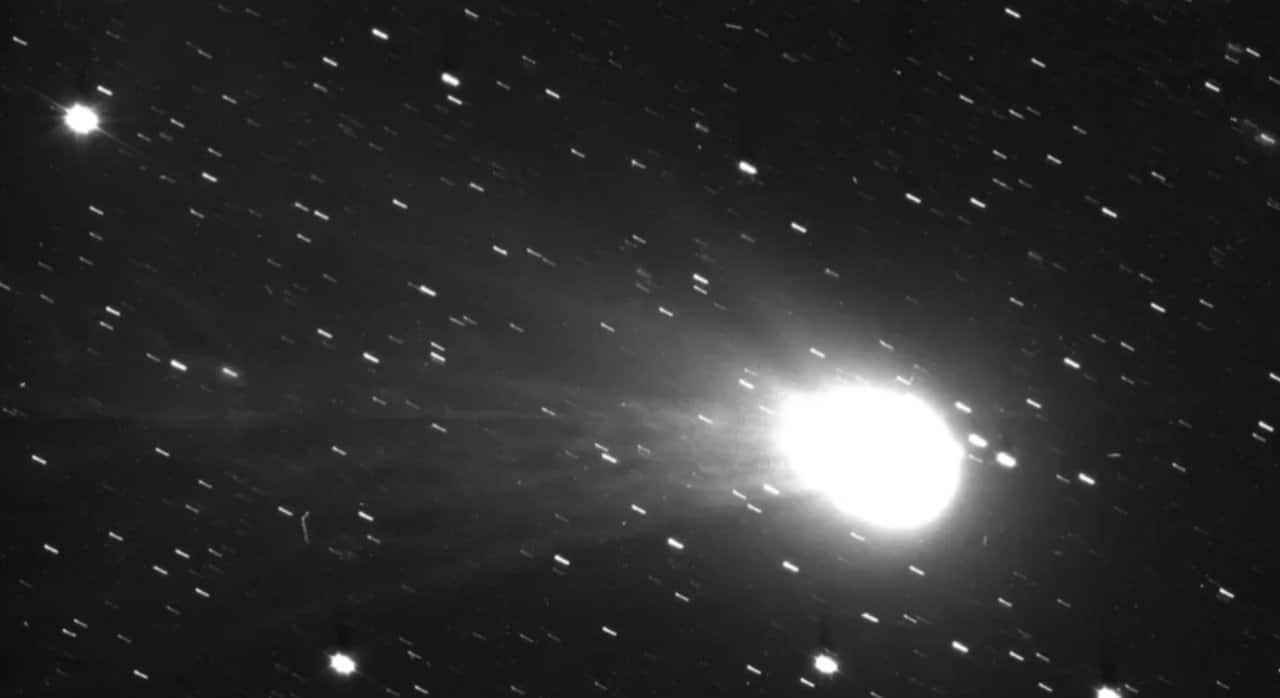
The Juice probe on its trajectory towards Júpiter managed to record more than one hundred and twenty images of the interstellar comet 3I/ATLAS during the month of November 2025. Agência Espacial Europeia recently released a processed version of these records that clearly displays the bright halo of gas around the nucleus as well as a long tail and structures such as jet rays and filaments emanating from the object. The main record occurred on November 6, 2025, exactly seven days after perihelion when the comet reached the minimum distance to Sol of approximately two hundred and ten million kilometers. Naquele moment the probe was approximately sixty-six million kilometers from the comet, which allowed a privileged observation while the object was still releasing dust and gas intensely.
Scientific teams from several countries are now working on a complete analysis of the data, which includes not only photographs but also spectral and particle measurements collected by other equipment on board. The comet was identified on July 1, 2025 by the ATLAS survey carried out on Chile and represents the third object confirmed to originate from outside the solar system. Essa discovery reinforces interest in interstellar visitors carrying primordial material possibly older than Sol itself.
The processed image highlights fine details of the coma that appear like a glowing veil surrounding the nucleus that is invisible at this distance. Blue Flechas indicate the apparent movement of the comet while yellow arrows point to the direction of Sol at the time of capture.
Comet 3I/ATLAS passed through the inner solar system in a state of high activity after perihelion. The release of material made it possible to capture dynamic structures that reveal sublimation processes typical of these celestial bodies.
Images from the JANUS camera highlight the comet’s halo and tail
The JANUS science camera aboard the Juice probe produced most of the recordings at different wavelengths. Esses data has been processed to enhance contrast and allow clear visualization of gaseous emissions.
The coma structure appears almost oval with rays extending from the center. Digital processing helped identify filaments that indicate flow of ejecta.
Five mission instruments recorded comet 3I/ATLAS
The observation involved five different pieces of equipment that acted in a complementary manner during the period between November 2nd and 25th, 2025.
Each instrument contributed specific information about the comet’s chemical composition.
The particle data helped understand the interaction with the solar wind.
Spectral analysis revealed molecules present in the tail and halo.
This image captured by the JANUS science camera aboard@esa’s Jupiter Icy Moons Explorer (Juice) shows the interstellar comet 3I/ATLAS releasing dust and gas as it traveled through the inner Solar System.
—Erika (@ExploreCosmos_)February 27, 2026
Although the comet’s small solid nucleus cannot be directly seen, it is…pic.twitter.com/Nv20bXRRhT
Collected data indicates unique composition of interstellar visitor
Comet 3I/ATLAS carries characteristics that differentiate it from comets formed in the solar system. Sua origin outside our stellar neighborhood suggests material preserved from very ancient times in the galaxy.
The hyperbolic trajectory confirms that the object is not tied to the gravity of Sol and will head to interstellar space after passing.
The high speed during the approach allowed for a short observation window that the Juice probe took full advantage of thanks to its position in space.
The records arrive at Terra late because the probe was on the opposite side of Sol in relation to the planet, which required waiting until the end of February 2026 for secure transmission of the files.
Main camera produced more than one hundred and twenty records
JANUS operated across a broad wavelength range to capture variations in the comet’s activity.
These records show the object in different phases of gas and dust release during the days following perihelion.
The volume of images allows scientists to reconstruct the dynamic behavior of the celestial body with unprecedented precision.
The resolution achieved surpasses terrestrial observations carried out at the same time and offers a unique perspective as it is outside the planet’s atmosphere and luminous influence.
Opportunistic observation during cruise from Juice to Júpiter
The Juice mission was launched in April 2023 with its main focus on studying the icy moons of the gas giant planet. Durante the long cruise trip the probe found the comet in a favorable position for observation without changing its planned route.
The coincidence made it possible to collect valuable data on a rare object without compromising the expedition’s main objectives, which include analyzing underground oceans on moons like Europa and Ganimedes.
The distance between the probe and the comet varied as both followed their independent trajectories but remained adequate for quality recordings over several weeks.
Ongoing analysis reveals more about the interstellar comet 3I/ATLAS
International teams continue to examine all files received for clues about the formation and evolution of this type of celestial body. Initial results confirm the high post-perihelion activity with continuous release of volatile materials observed in both images and complementary measurements.
The combination of visual and spectral data provides integrated vision that would not be possible from ground-based or orbital telescopes near Terra.
This multifunctional approach enriches knowledge about objects that visit our solar system from distant regions of the galaxy.
The comet now continues to move away from Sol and will gradually lose brightness as the distance increases and activity decreases.



