
Accident in Dutra: train with 13 tons of eggs crashes and closes track towards Rio; there are serious injuries

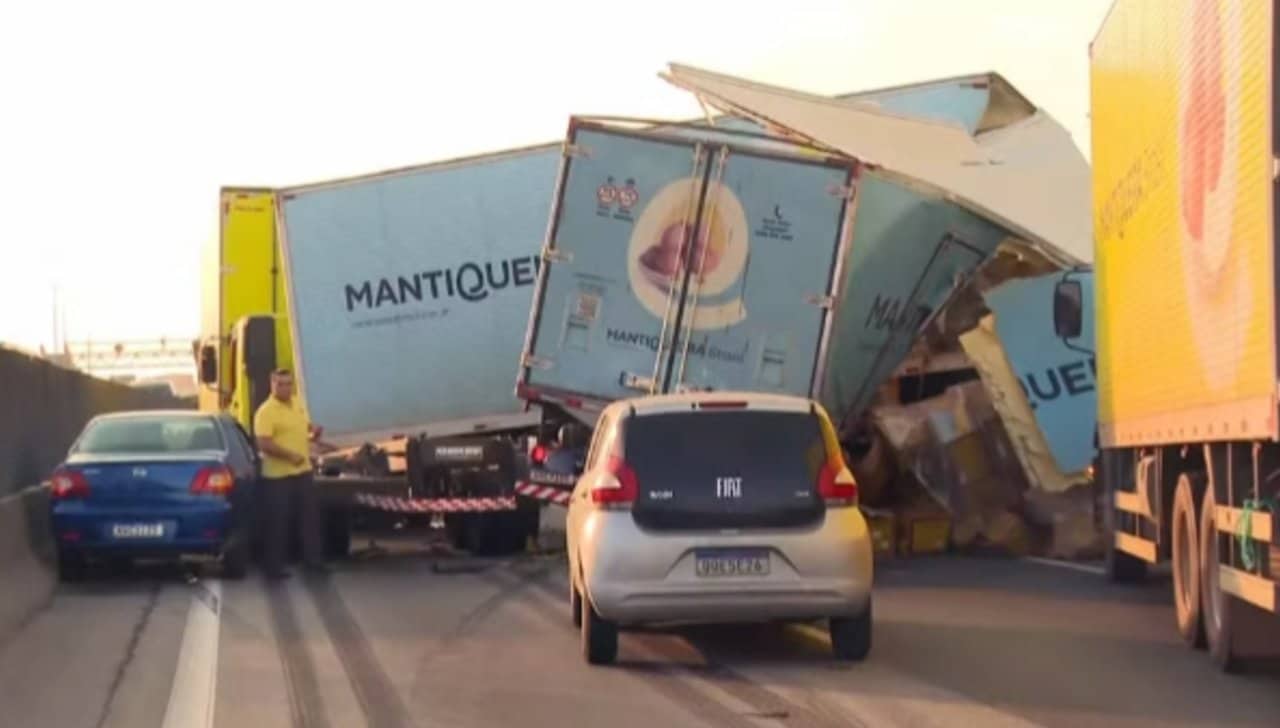
A serious collision involving four trailers and a passenger car blocked the central lane of Rodovia Presidente Dutra, in the direction of Rio of Janeiro, at the height of Nova Iguaçu, The accident, which occurred at around 5am, resulted in two injuries, one of them seriously, and caused extensive congestion on the important road.
The vehicles were part of a convoy of five trucks from an egg supplier, which transported approximately 13 tons of merchandise. The dynamics of the crash in sequence caused the immediate closure of the track, diverting the flow to the auxiliary lane and causing considerable inconvenience for drivers heading to the capital of Rio de Janeiro.
Rescue teams acted quickly to treat the victims and begin procedures to clear the runway. The impact of the pileup highlighted the vulnerability of intense road traffic and the need for constant attention on the roads that connect the country’s large urban centers.
The pileup at Rodovia Presidente Dutra
The incident occurred on the central lane of Via Dutra, in the direction of Rio from A passenger car was also involved in the chain of events, increasing the complexity of the incident and the number of damaged vehicles.
According to the testimony of Diego, one of the truck drivers in the convoy who was driving the last trailer and witnessed what happened, a bus in front had to brake suddenly. Essa maneuver forced the truck immediately ahead to also reduce speed abruptly, triggering a chain reaction that culminated in the successive collision of the vehicles following behind and unable to avoid the impact.
Assistance to victims and clinical picture
Two people were injured in the pileup and were promptly rescued by emergency teams, being taken to Hospital Geral of Nova Iguaçu, at Posse. The severity of the injuries varied between those involved, requiring different levels of medical attention and hospital procedures to stabilize patients affected by the incident.
Carlos Henrique Analio Ribeiro, 28 years old, driver of one of the trucks, was the one with the most serious condition. Ele arrived at the hospital with serious injuries, as a result of the cabin of his vehicle being completely destroyed and crushed during the crash. Carlos underwent an emergency procedure to treat injuries to his arm and collarbone, but left the scene of the accident conscious. Seu assistant, who occupied the passenger seat in the same cabin, fortunately was unharmed.
Luiz Carlos Braga, 37 years old, driver of the private car involved in the collision, arrived at the health unit with trauma to his right leg and head. Luiz Carlos’s clinical condition was considered stable, indicating that, despite the injuries, his life was not at immediate risk, allowing medical teams to continue with the necessary treatment.
Impacts on traffic and highway closures
The collision caused the total closure of the central lane of Via Dutra, direction Rio of Janeiro, requiring traffic to be diverted to the auxiliary lane of the highway. Essa measure, although essential for safety and the work of rescue teams, caused a significant impact on the flow of traffic in the Baixada Fluminense region.
The congestion extended for around 10 kilometers, reflecting the importance of Dutra as one of the main arteries connecting the Sul and Sudeste regions of Brasil, with an intense daily flow of vehicles. Horas of waiting and slowness marked the morning for thousands of drivers and passengers who depend on the highway for their daily and commercial activities.
To further worsen the situation at the scene, a private car overheated and caught fire on the side road, close to the point of the main accident. Esse additional incident forced the blocking of a lane of the road, further complicating traffic operations and the time it took to completely open the road for users.
At around 9:30 am, more than four hours after the pileup, part of the central lane was released, beginning a gradual process of normalizing the flow. Contudo, the consequences of the accident lasted for a considerable period, requiring patience and alternative routes for drivers.
Transport logistics and cargo security
The incident involving trailers from Mantiqueira, a leading company in the poultry sector, highlights the complexity and challenges of the logistics of transporting perishable products such as eggs. The route from Itanhandu, in Minas Gerais, to various addresses in Grande Rio is routinely covered by trains, which seek to optimize delivery and guarantee the freshness of the merchandise.
Preventative maintenance of vehicles and strict compliance with safety standards are crucial for large trains. The adequate safety distance between vehicles, especially on high-volume highways such as Dutra, is a determining factor in preventing chain accidents and guaranteeing the integrity of the load and, mainly, the lives of drivers and road users.
Emergency measures in road accidents
The response to major accidents, such as the pile-up on Via Dutra, involves the coordination of several security and rescue forces. The Polícia Rodoviária Federal (PRF) works to control traffic and investigate the causes, while the Corpo of
The concessionaire responsible for the highway has a fundamental role in signaling, diverting traffic, removing vehicles and cleaning the road, aiming to restore normality as quickly as possible. For Para serious victims, such as Carlos Henrique Analio Ribeiro, emergency care protocols include stabilization on site and rapid transport to referral hospitals, where specialized medical teams are waiting to begin treatment.
Repercussions and warnings for drivers
Accidents like the one that occurred on Dutra serve as a stark reminder of the risks inherent in driving on busy highways. Para drivers, it is essential to pay extra attention, respect speed limits and, above all, maintain a safe distance from the vehicle in front, especially in heavy traffic conditions or on trains.
Planning your route in advance and looking for up-to-date information about road conditions can help avoid congestion and delays. Além In addition, periodic inspection of the vehicle is essential to prevent breakdowns and other mechanical problems that could lead to incidents, such as the car overheating on the road.
The Via Dutra as a vital logistics corridor
Rodovia Presidente Dutra represents one of the most important logistics corridors in Brasil, connecting two of the largest metropolitan regions in the country, São Paulo and Rio from Janeiro. Diariamente, millions of vehicles, including a significant volume of cargo trucks, use the road to transport essential goods that supply the consumption and production chains.
Despite being a well-structured highway, the high volume of traffic and the constant demand for speed and efficiency make it susceptible to accidents. Safety challenges on Dutra include the need for continuous inspection, investments in infrastructure and awareness campaigns that reinforce individual and collective responsibility in traffic.
Accident prevention and traffic awareness
Preventing major road accidents involves a combination of factors that include traffic education, strict inspection and investment in vehicle safety technologies. Campanhas public awareness is vital to reinforce the importance of defensive driving, respecting traffic laws and the adoption of safe behavior by all road users, whether they are drivers of light or heavy vehicles.
The responsibility does not only fall on individual drivers, but also on transport companies, which must ensure the training of their drivers, the up-to-date maintenance of their fleets and compliance with working hours that avoid fatigue. Collaboration between the public and private sector is crucial to creating a safer and more efficient road environment for everyone.
Factors that contribute to pileups
Highway pileups are often the result of a combination of factors, not just a single cause. Excessive speed, combined with inattention and maintaining an inadequate safe distance, are key elements. In a convoy, the chain reaction is a high risk, where the abrupt braking of the first vehicle may not be replicated in time by those behind.
Adverse weather conditions, such as fog or heavy rain, which reduce visibility and reduce the tires’ grip on the road, can also be catalysts for this type of accident. The road infrastructure, although Dutra is well maintained, may also have critical points that require extra attention, such as sharp curves or sections with a higher incidence of traffic.
Company Mantiqueira and the poultry sector
Mantiqueira is one of the largest egg producers in América and Sul, playing a crucial role in the country’s food supply. The occurrence of an accident involving your transport vehicles, even if isolated, represents not only significant material losses, but also immediate logistical challenges for the distribution of an essential product in the Brazilian diet.
The poultry sector is characterized by the need for agility in delivery to guarantee quality and food safety. Acidentes Road transport, in addition to the human impact, can generate interruptions in the supply chain, requiring companies to have robust contingency plans to minimize losses and maintain regular supply to markets.
Road recovery and normalization efforts
After the pileup, efforts focused on removing the damaged vehicles and cleaning the roadway. The removal of the trailers and the passenger car required the use of large winches and coordinated team work. Além In addition, the runway needed to be cleared of any debris, including scattered eggs, to ensure the asphalt was safe for traffic to return.
The complete normalization of vehicle flow on the Via Dutra is a gradual process, which depends on the agility of the rescue team and the highway’s ability to absorb the backlog of traffic. Mesmo after the opening of the central lane, traffic can take hours to stabilize, with repercussions on adjacent roads and urban mobility in the region.




