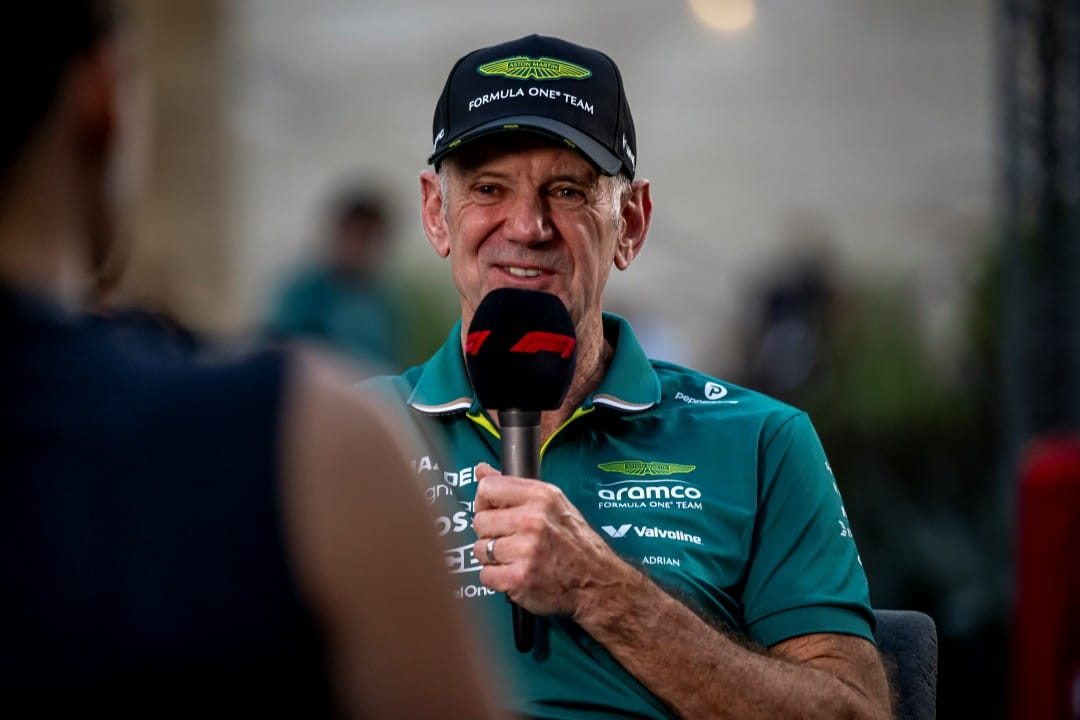
Adrian Newey, head of Essa lack of continuity has contributed to the current power unit reliability and performance problems in the AMR26 car.
The information only came to light in November last year, during a meeting at Tóquio between Newey, the owner Lawrence Stroll and the strategy director Andy Cowell with representatives from Honda. Até So, Aston Martin believed it had a consolidated technical structure, similar to the one that had recent success in the category. The late discovery worsened difficulties at the start of the 2026 season, marked by new engine rules with a 50-50 split between internal combustion and electric power.
Severe vibration problems limit participation
The power unit of the Honda presents abnormal vibrations that are transmitted to the chassis and steering wheel, creating significant risks for drivers. Newey explained that these tremors can cause permanent damage to the nerves in the hands if drivers complete longer distances, such as the 58 laps of the Austrália GP.
Fernando Alonso and Lance Stroll have already felt the effects in pre-season tests on Bahrein and Barcelona. The team accumulated just 334 laps in total, equivalent to around 1,807 km, the lowest volume among all teams. Falhas in the battery, aggravated by vibrations, forced premature stops and limited the car’s development.
Recast left Honda at a disadvantage
After announcing the departure of Fórmula 1 at the end of 2021, Honda saw a significant part of its original team disperse to other sectors, such as solar panels. Quando resumed the project in 2023, only about 30% of the experienced group remained. Isso occurred in the first year of the budget cap for engines, while competitors continued development without restrictions in 2021 and 2022.
Newey highlighted that Honda started the current cycle at a clear competitive disadvantage. The combination of loss of expertise and financial constraints made catching up difficult. The Japanese manufacturer is now working on countermeasures to mitigate vibrations and improve battery durability, but progress is still limited.
Critical situation at the GP of Austrália
In Circuito of Albert Park, in Melbourne, the problems persisted in free practice on Friday. Alonso did not participate in FP1 due to a power unit failure and completed just 19 laps in FP2. Stroll ran in both sessions, but was instructed to return to the pits early in both to preserve components.
The team reached the weekend with just four heats and already lost two due to conditioning or communication problems. Newey described the situation as worrying, as the lack of spare parts threatens even full participation over the weekend. The team seeks to complete the minimum necessary to avoid penalties, while awaiting more definitive solutions from Honda.
Technical challenges and tight schedule
The AMR26 car, first designed under Newey’s leadership since its arrival in March 2025, has suffered from a condensed development schedule. The simultaneous transition of chassis and engine rules represented an additional challenge for all teams, but Aston Martin faced particular delays in wind tunnel testing and integration with the new power unit.
The Honda implemented initial adjustments based on dynamometer testing to reduce vibrations transmitted to the battery. Apesar Furthermore, the main source of the problem remains in the internal combustion engine and possibly in the MGU. The team plans to introduce more countermeasures over the weekend, but the immediate focus is on managing limited resources to avoid serious failures.
Partnership in the initial adaptation phase
Aston Martin has reached an exclusive supply agreement with Honda targeting 2026 rules, but initial setbacks highlight the complexity of the integration. Newey emphasized that the chassis itself has the potential for significant evolution, with an aggressive development plan underway. However, the mileage restriction prevents a full evaluation of the package.
Pilots and engineers continue to collect limited data to refine adjustments. The expectation is that gradual improvements will allow for greater participation in future races, although the start of the season requires extreme caution to protect equipment and the health of competitors.