Mercedes’ dominance marks Formula 1 stage in Australia with unprecedented triumph for British driver


The opening of the motorsport world championship season took place on the Albert Park circuit, in Melbourne, marking the beginning of a new technical era for motorsport. The Australian event highlighted the aerodynamic superiority of the German team, which secured the top spot on the podium after an intense and tactical battle in the opening laps against the representatives of the Italian team. The 58-lap race was contested under clear skies and mild temperatures, conditions that tested the rigorous thermal management of the new tire compounds supplied for the international competition.
The British driver who started in pole position remained focused on the strategy outlined in the pits, controlling the wear and tear on his equipment to cross the finish line in first place with a safe margin of advantage. The result consolidated the sixth achievement of his professional career in the maximum category and placed him at the top of the general classification table in isolation, an unprecedented and remarkable feat in his career in elite motorsport.
The inaugural race under the new technical regulations featured important historical milestones for different teams and newcomers to the grid:
- Mercedes took the lead in the constructors’ championship with 43 points accumulated in the first stage.
- Audi recorded its first official points through the consistent performance of its South American debutant.
- Young talent Arvid Lindblad became the third youngest driver to score points in the history of the competition.
- The high rate of abandonments due to mechanical breakdowns highlighted the fragility of the new hybrid power units.
The overall performance of the competitors clearly demonstrated that the efficiency in electrical energy consumption and the mechanical reliability of combustion engines will be the main defining factors throughout the extensive calendar of events planned for the current year.
Tactics in the pits define advantage over Italian rival
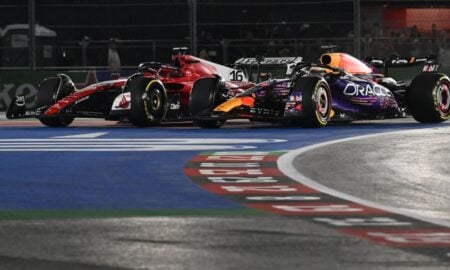
The start of the race was marked by an extremely aggressive maneuver by the representative of Ferrari, who jumped from fourth position directly to the lead before the braking zone of the first corner of the Australian circuit. The Monegasque took advantage of a slightly slow reaction from the pole sitter when the red lights went out to dictate the initial pace of the competition. Essa movement generated a spectacular sequence of six lead changes during the first ten rounds, with the two drivers alternately using the new aerodynamic overtaking systems allowed by the updated regulations, raising the public present in the Melbourne stands.
The definition of the lead, however, took place away from the track disputes, during the first intervention period of the virtual safety car, caused by a serious mechanical failure in the Red Bull car on lap 12. The silver team acted quickly and opted to call its two competitors to change tires in a perfectly executed double pit stop. The Italian rival, on the other hand, decided to keep its cars on the track, betting on a later stopping window with a clean track. Essa strategic choice resulted in an irreversible loss of time, as the new compounds installed in the German cars delivered a much higher pace immediately after leaving the pit lane.
Young Italian talent secures podium in his debut race
Andrea Kimi Antonelli faced a moment of high tension at the start, suffering from the traction of his car and losing five crucial positions in the opening meters of the race. The rookie needed to remain calm and extremely concentrated to begin a complex recovery race against vastly more experienced drivers on the current grid.
With precise maneuvers in heavy braking zones and intelligent use of the energy recovery system, the Italian overcame direct opponents, including cars from McLaren and Red Bull, climbing the field in a methodical manner. Logo after the end of the yellow flag regime on lap 16, the representative of Mercedes was already in provisional fourth place on the timesheets.
The rhythmic consistency demonstrated in the second half of the race allowed him to manage tire wear maturely and cross the finish line exactly 2.9 seconds behind the race winner. The excellent practical result immediately validated the team’s management’s aggressive commitment to promoting him directly to the coveted starting spot.
South American debutant scores first points for German team
Gabriel Bortoleto delivered a performance marked by resilience in his first official participation defending the colors of Audi in the highest category of motorsport. The competitor started from tenth position and had to deal with the fluctuations in behavior of an aerodynamic project that is still in the initial phase of development and data collection on the tracks.
Após lost some ground in the characteristic turmoil of the first lap, the driver adopted a constant race pace and carried out crucial overtakes on cars from traditional teams, such as Alpine and Aston Martin. Thorough management of the wear of rubber compounds was essential during successive incidents that temporarily halted the stage.
Nas dozens of final laps, the representative of Audi fought wheel-to-wheel against the also freshman Arvid Lindblad, driver of The constant changes of positions in the movable wing activation zones excited the spectators positioned around the fast park circuit.
The final ninth place achieved yielded two fundamental points for the German brand, establishing the manufacturer’s first official record as a factory team in the history of the competition. The achievement of the points contrasted sharply with the early retirement of his garage mate due to a terminal electrical failure during the presentation lap.
British performance contrasts with failures in the Austrian team
Lando Norris assumed full responsibility for scoring points for the McLaren team after his teammate collided severely with the protective barriers during the grid formation lap. The British driver withstood the intense pressure from his direct opponents and secured fifth place overall, establishing himself as the main competitive force outside the dominance exercised by the two leading teams at the start of the world championship.
The Red Bull Racing faced a weekend of extreme technical and operational complexity, with the Max Verstappen crossing the finish line only in sixth position after being unable to find the ideal chassis balance adjustment. The Austrian team’s worrying situation was significantly worsened by the abandonment of Isack Hadjar in the early stages of the stage due to catastrophic problems with the newly installed powertrain.
Overheating problems affect new power units
The high rate of abandonments recorded in the opening stage of the calendar served as a clear and blunt warning about the enormous challenge of reliability under the new technical guidelines imposed on engineers for this regulatory cycle. A total of six cars failed to take the checkered flag, including veteran competitors and multiple champions who suffered from sudden losses of electrical power and critical failures in the single-seaters’ internal cooling systems. Cadillac, officially acting as the eleventh integral force on the grid, specifically suffered from the thermal management of its newly developed engines, which caused the forced retirement of Valtteri Bottas on lap 19 and severely limited Sergio Pérez’s race pace and engine mapping options. The vast telemetric data collected over the weekend at Austrália will force factories to urgently review their complex cooling systems and internal air flows before the next stages in places with historically higher ambient temperatures, under the imminent risk of compromising the physical integrity of internal components in the first third of the competition season.
Preparation for the next challenge on the Asian continent
The world motorsport championship will not have long breaks and will immediately move on to the gigantic Xangai circuit, which will host the second stage of the season on March 15th. The Chinese circuit, widely known for its long straights and long-radius curves, will host the first sprint race of the year, drastically limiting the free practice time available for mechanical configurations.
The lean schedule for the Asian weekend will require maximum efficiency and absolute precision from mechanics and track engineers to fine-tune the cars’ aerodynamics. The teams that presented serious reliability failures in the Austrália will have a few working days to design, manufacture and implement definitive solutions in their single-seaters before embarkation