
Extreme heat from the Sun activates nucleus of interstellar comet 3I/ATLAS and multiplies water emission

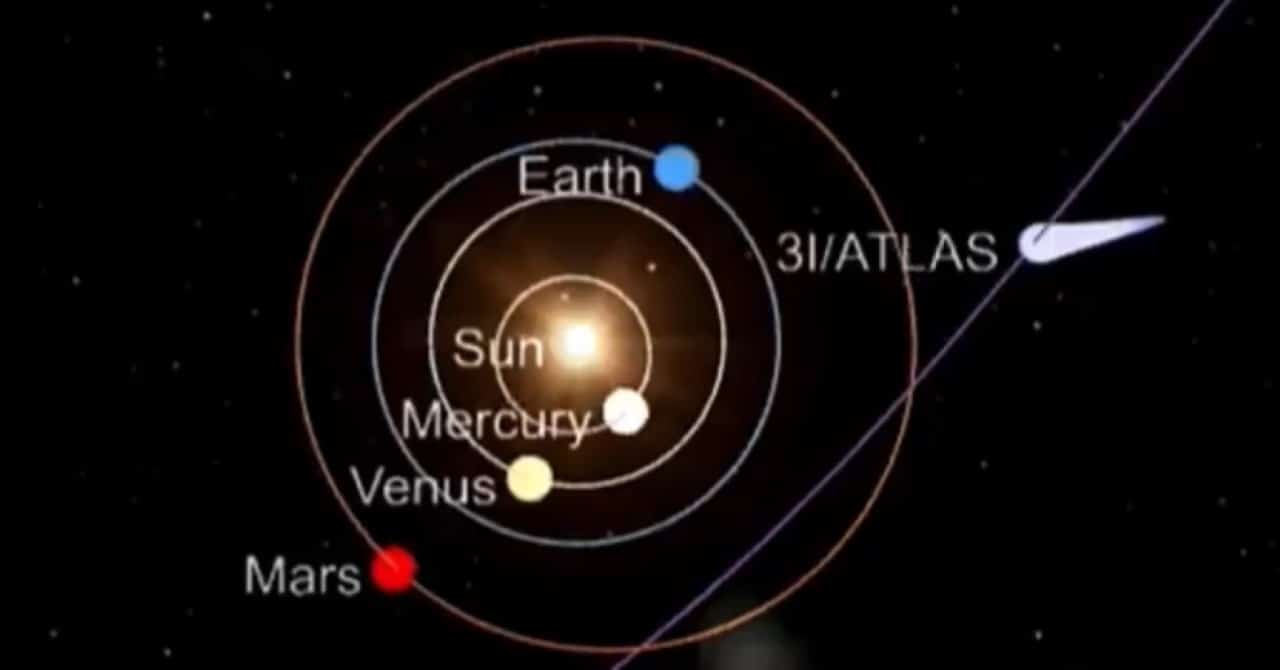
Continuous monitoring of deep space has revealed an unprecedented physical transformation in an object newly discovered by scientists and astrophysicists. The SPHEREx space observatory captured the exact moment in which the celestial body underwent a profound structural change due to its closest approach to the main source of energy in our system. The thermal interaction generated immediate changes on the surface and interior of the cosmic visitor, providing unprecedented data for the global scientific community.
The passage through the hottest region of our space neighborhood occurred at the end of October, triggering a physical chain reaction in the crust of the asteroid and cometary object. The intense heat generated by the star managed to penetrate the outermost, rocky layers of the structure, reaching vast reservoirs of ice. Esses internal deposits remained intact, protected and completely frozen for millennia as the body traveled through the absolute darkness of the unmapped universe.

With this severe thermal interaction, the object demonstrated an abrupt intensification in its sublimation activity, definitively changing its state of inertia. The rate of water vapor expelled directly into the space vacuum increased twenty-fold compared to initial measurements taken in August of the previous year, marking the beginning of a phase of extreme structural volatility.
Thermal impact on the structure of the celestial body
The approach to the solar heat source represents an event of extreme mechanical stress for objects that usually travel through the coldest regions of the galaxy, where temperatures are close to absolute zero. The radiation falls directly on the comet’s irregular crust, causing deep fractures that expose the primitive internal material to the hostile space environment and bathed by solar winds.
This thermal shock process results in the immediate breakdown of the primordial ice barriers that supported the object’s cohesion. The energy absorbed in a short period is enough to convert matter from a solid state directly to a gaseous state, creating a vast and dense cloud of particles around the central rocky core.
Sublimation dynamics and volatile materials
The release of volatile materials and cosmic dust particles increased to exponential proportions during continuous observations throughout the month of November. Advanced detection instruments recorded not only the massive presence of water, but also the clear chemical signature of complex organic compounds that were mixed into the stream of gas ejected into space.
The continuous and violent ejection of this matter creates the characteristic luminous tail that allows precise tracking of the object through orbiting telescopes. The volume of ejected material and particle speed provide researchers with essential data about the actual density, porosity, and exact internal composition of the interstellar body.
The role of the space observatory in measurements
The detailed capture of this astrophysical data was only possible thanks to the extreme sensitivity of the infrared sensors on board the SPHEREx equipment. The probe was specifically designed to map the sky at multiple frequencies and identify unique spectral signatures of molecules across gigantic astronomical distances.
Throughout the approach and perihelion event, the satellite maintained uninterrupted focus on the hyperbolic trajectory of 3I/ATLAS, recording every minimal variation in light and heat emission. The absolute precision of these measurements allows systems on the ground to separate the natural background noise of space from the actual emissions generated by the comet’s activity.
The technical and scientific team responsible for the mission uses this raw information to create complex three-dimensional models of the core’s behavior under thermal stress. Continuous degradation analysis helps predict the object’s rate of wear and tear and estimate how much of its mass will be lost as it continues its journey toward the edges of the solar system.
Characteristics of visitors from outside the system
3I/ATLAS is officially recognized and cataloged as the third interstellar visitor confirmed by the astronomical community since the beginning of modern records. Sua’s open trajectory and its anomalous speed unquestionably indicate that it is not tied to the gravitational pull of our star and came from a completely different region than Via Láctea.
Objects with this specific classification travel at extreme kinetic speeds, much higher than those recorded by the asteroids and comets that inhabit our local belt. Essa vertiginous speed is the main physical indicator that the celestial body was ejected from its planetary system of origin countless millions of years ago, wandering aimlessly until it crossed our neighborhood.
Rapid passage through our stellar domain offers an incredibly short window of opportunity for collecting high-fidelity scientific data. Diferente Unlike traditional periodic comets, which return at mathematically predictable intervals, interstellar visitors cross our observation area only once before disappearing forever.
The in-depth study of these nomadic bodies works as a direct, physical sampling of matter existing in other unexplored corners of the galaxy. Eles carry within them the original, unchanged chemistry of the cloud of gas and dust that formed the distant stars around which they were born.
Chemical composition and origin of matter
The confirmed identification of organic compounds in the internal structure of 3I/ATLAS reinforces fundamental astrophysical theories about the distribution of essential elements throughout the cosmos. Moléculas based on carbon chains, when perfectly preserved in the frozen interior of a large comet, demonstrate the ability to survive intense cosmic radiation during interstellar journeys that last entire geological eras. The sudden release of these elements under the influence of solar heat demonstrates in a practical way that the building blocks of complex organic chemistry are common phenomena in other stellar systems, traveling protected under thick and resistant layers of ice and rock until they find a source of thermal energy capable of activating them and exposing them to open space.
The exact ratio of water vapor to other heavy gases ejected also serves as a historical barometer of the object’s original formation. Corpos Extremely water-rich celestial bodies often form in peripheral, icy regions of their original star systems, far enough from their parent stars for the liquids to quickly freeze and coalesce with the surrounding cosmic dust. The fact that the visitor has such abundant and pure reservoirs suggests that it originated in a dark and cold zone analogous to our Nuvem of
Relevance of data to the astronomical community
The visual and chemical transformation of a body in a state of ancient dormancy to a highly active, disintegrating nucleus provides a real-time natural laboratory for researchers. The technical ability to observe the aggressive sublimation of materials that have remained intact and unchanged since the early formation of another star system represents a historic milestone in modern space exploration and long-distance spectroscopy. The vast volumes of data collected by the observatory’s sensors during the object’s flyby feed global information banks that will be used extensively to calibrate the precision instruments of future interplanetary space missions. Somado to this, the direct and thorough comparison between the chemical signature of this distant visitor and the composition of comets native to our own system helps to establish a scientific pattern of similarities and divergences in planetary formation on a galactic scale. The detailed understanding of fluid physics and how deep ice and organic compounds react to extreme radiation directly helps in the development of theoretical models on the natural transport of water and organic matter between different and isolated regions of the universe, consolidating fundamental knowledge in advanced research on the structural chemical evolution of spiral galaxies.
Continuity of scientific monitoring
Technical observations of the celestial body continue uninterruptedly as it rapidly moves away from the inner, illuminated region of the solar system, beginning its one-way journey back into deep space. Scientists keep the telescope lenses pointed towards its exit trajectory, seeking to record the exact moment when the drastic drop in temperature will cause the nucleus to cease its emissions and return to its original frozen state of dormancy.



