
Extreme solar heat awakens interstellar body and causes strong ejection of water into the space vacuum

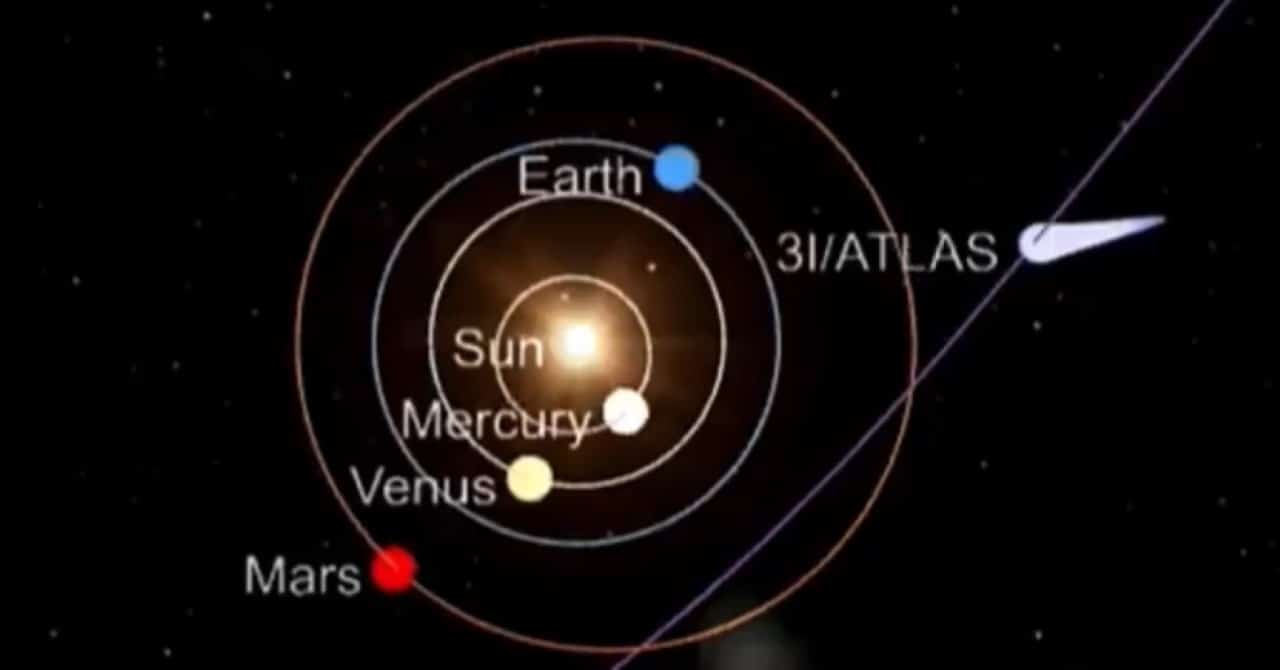
The passage of an external celestial body into the local planetary system recorded a profound structural change resulting from exposure to high levels of thermal radiation. The object cataloged as 3I/ATLAS, monitored continuously by precision equipment from the SPHEREx mission, abandoned its state of thermal dormancy upon reaching the point of greatest proximity to the system’s central heat source. The physical transition resulted in the continuous emission of cosmic dust and volatile substances directly into the space vacuum.
The sudden warming acted on the visitor’s rocky core, triggering sublimation processes in ice sheets that had remained inactive during eons of travel through deep space. The phenomenon generated a complex cloud of ejected gases, allowing a detailed spectral reading by observatories positioned on the ground and in orbit. Collecting data on this astronomical event establishes new parameters for understanding the formation of organic and inorganic matter in remote regions of the galaxy.
Information capture operated through advanced instrumentation focused on specific wavelengths, ensuring accurate measurement of thermal emissions. Key factors observed during the approach window include:
- Extreme variation in the amount of fluids ejected into outer space.
- Identification of chemical signatures of prebiotic compounds in the newly formed coma.
- Confirmation of the hyperbolic orbital dynamics that prevent the gravitational capture of the body.
- Recording of non-gravitational forces generated by directional jets of pressurized gas.
Mechanisms of thermal activation and coma formation
The reactivation of the core of the interstellar body occurred in a reduced time interval, driven by the direct thermal shock against the frozen surface crust. Sublimation, a physical process in which matter transitions from a solid state directly to a gaseous state, was accelerated by the absence of atmospheric pressure in the microgravity environment. Pre-existing fractures in the object’s external structure served as escape channels for pockets of pressurized gas located inside the core.
The violent release of particles and fluids transformed the visual signature of 3I/ATLAS, which initially presented the characteristics of a dark and inert asteroid. The development of a visible and bright coma marked the object’s morphological transition, aligning its behavior with that of active comets originating from the local system itself. The debris cloud generated around the rocky body reflects incident light, facilitating continuous optical tracking.
The directional jets identified in the hemisphere facing the heat source act as natural thrusters, exerting a direct influence on the object’s route. The asymmetric distribution of ejecta adds complex variables to astronomical trajectory calculations, requiring constant updates to space monitoring matrices. The mechanical force generated by the expulsion of gases demonstrates the structural instability of celestial bodies subjected to extreme temperature variations.
Exponential increase in the ejection of space fluids
Technical reports based on daily telemetry revealed a drastic change in the volume of water released by the active nucleus. Spectrometric measurements indicate that the amount of vapor ejected has grown twentyfold compared to preliminary data collected in August of the previous observation cycle. The quantitative jump highlights the degree of exposure of internal structural ice to high-intensity radiation.
Accelerated vaporization of frozen material occurs at rates that defy theoretical models applied to bodies of similar proportions. The core’s ability to sustain such a voluminous emission of fluids suggests an internal composition that is highly porous and saturated with volatile compounds. The internal pressure generated by heating forces the expansion of gases, which rupture the surface layers at points of lower structural resistance.
Monitoring ejection rates provides crucial indicators about the object’s total mass and the thickness of its insulating crust. The continuous dissipation of water and dust gradually reduces the comet’s physical integrity, although the speed of travel limits the time of exposure to maximum heat. The correlation between the rate of mass loss and the distance from the heat source follows rigorous mathematical patterns recorded by orbital sensors.
Fluid dynamics in the space vacuum differ substantially from terrestrial thermodynamic processes, operating in a regime of free expansion and instantaneous cooling. The expelled water vapor crystallizes quickly as it moves away from the heated core, forming a halo of microcrystals that reflects the incident radiation in infrared spectra. Analysis of this crystalline halo makes it possible to precisely quantify the exact volume of material lost with each rotation of the rocky body.
Spectroscopy and identification of organic compounds
The period of greater luminosity provided ideal operating conditions for carrying out high-resolution spectroscopy examinations. The chemical signature extracted from the ejecta demonstrated a high concentration of elements fundamental to prebiotic chemistry, including cyanogen, methanol and formaldehyde. The simultaneous detection of simple hydrocarbons, such as methane and ethane, attests to the occurrence of complex chemical reactions within the celestial body.
The clarity in identifying organic molecules in a target with a high degree of kinetic displacement eliminates the possibility of false positives when reading the data. Spectroscopy works by analyzing specific wavelengths absorbed and emitted by gases, functioning as an infallible chemical barcode. The presence of carbon- and water-based compounds in a visitor of external origin reinforces the universal standardization of star formation processes.
Hyperbolic trajectory and speed of travel
The 3I/ATLAS ballistic mapping, initiated by the deep scan automated warning systems, establishes a route with hyperbolic characteristics that preclude any form of local gravitational capture. The rocky body crosses the space quadrant at a confirmed speed of 57 kilometers per second, an acceleration rate that mathematically proves its origins from beyond the borders of the planetary system. Unlike periodic objects that maintain closed, elliptical orbits, the visitor has enough excess kinetic energy to overcome the pulling force of the central star and continue its progression toward dark interstellar space.
The magnitude of the displacement speed imposes severe operational limitations on astronomical observation protocols, restricting the useful time for primary data collection. Celestial bodies on hyperbolic trajectories make single passes, requiring absolute synchronization of the entire global network of radio telescopes and orbital observatories to avoid loss of critical information. The absence of a second chance for monitoring makes processing current data a scientific priority, the volume of telemetry of which will require years of advanced computational calculations to be fully decoded and understood by space research agencies.
Taxonomy and history of extrasolar visitors
The technical documentation of the current celestial body adds fundamental variables when placed in the context of records of the first confirmed extrasolar visitors, specifically the ‘Oumuamua and 2I/Borisov objects. Comparative analysis demonstrates a clear behavioral divergence: while the first object detected in astronomical history was characterized by an elongated morphology and complete absence of gaseous activity, the second exhibited properties identical to local long-period comets from the initial stages of approach. 3I/ATLAS establishes an unprecedented intermediate pattern, marked by a prolonged dormancy followed by an extremely vigorous thermal reactivation only at the limits of the intense radiation zone. The similarity in the proportions of carbon monoxide and water between these bodies originating from different spatial coordinates provides the empirical basis for the formulation of new models on the distribution of matter in the galaxy. The taxonomy of wandering objects depends on the continuous amplification of this statistical sampling, allowing us to calculate with greater precision the density of fragments ejected by the Oort cloud and the Kuiper belt from neighboring stellar systems during their respective phases of primordial planetary formation.
Parameterization of observational instrumentation
The accuracy of the data collected depended on the thorough calibration of the optical and infrared sensors directed to the quadrant of the object’s passage. The ability to separate the reflective signature of inorganic dust from the fluorescent signature of gas molecules required the employment of narrowband spectral filters. The isolation of these variables guaranteed the integrity of the chemical information cataloged during the critical perihelion phase.
Progressive distancing and structural freezing
Uninterrupted tracking follows the gradual removal of the celestial body from the zone of high incidence of thermal radiation. Progression along its exit vector results in an abrupt drop in surface temperatures, inducing the gradual cessation of sublimation reactions and the closure of fissures in the rocky crust. The decline in gas emission reduces the density of the coma, returning the object to its state of visual and thermal dormancy.
The structural freezing of the core marks the final phase of the active observation window permitted by orbital physics. The object will resume its rectilinear journey through the galactic vacuum, carrying the chemical and physical changes generated by its brief interaction with the local heat source. The journey into deep space will proceed silently until an eventual intersection with the gravitational field of another star system in the remote future.
Ejection mechanics in microgravity environments
Fluid physics applied to the behavior of space ice under direct radiation reveals the formation of complex crystalline structures around the emitting core. The expanding force of underground gas pockets overcomes the structural cohesion of the surface, throwing blocks of unprocessed material into the comet’s wake. Photometric analysis of these fragments helps to determine the original density of the body before the partial disintegration phase.
Mechanical interactions between ejected dust and stellar radiation pressure modify the geometry of the object’s visible tail in real time. The separation of the heavier components from the light gases creates a double trail signature, a phenomenon clearly captured by the high-resolution lenses. Monitoring these particular dynamics closes the cycle of collecting primary data on the visitor’s interaction with the local interplanetary environment.
Luís Henrique Costa é jornalista formado pela FMU, editor-chefe e fundador do Mix Vale, portal de notícias em atividade desde 2013. Responde pela direção editorial do veículo, que cobre Brasil e mundo em economia, benefícios sociais, esportes, tecnologia, ciência e entretenimento. Atua na área há mais de 15 anos e lidera uma equipe de cerca de 15 colaboradores.


