
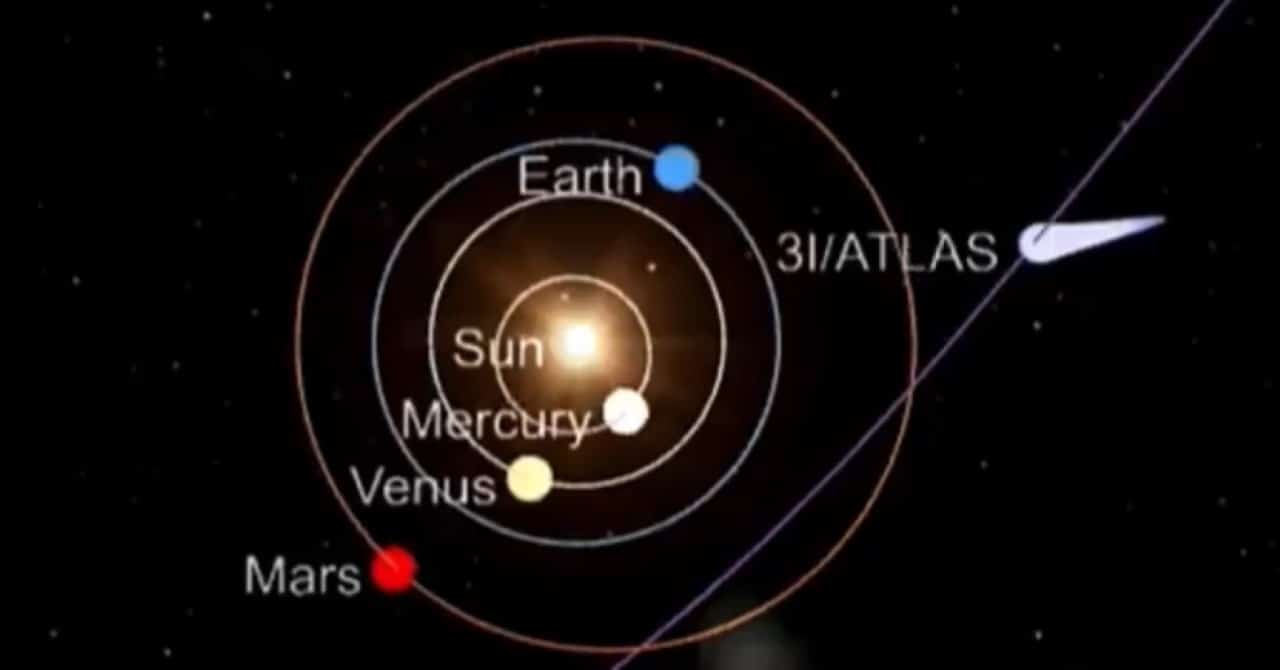
The approach of a celestial body of external origin to our planetary system is revealing rare physical dynamics due to exposure to intense thermal radiation. The object, classified by space agencies and detected by high-precision instruments, reached a critical point of proximity to the central star, triggering severe structural reactions. The absence of atmospheric pressure in a vacuum accelerates processes that, under other conditions, would take millennia to occur.
During this passage through perihelion, the zone of greatest heating, the internal composition of the space visitor underwent an abrupt phase transition. Frozen Materiais, which remained intact during the journey through deep space, began to instantly vaporize, creating a visual and physical phenomenon of great magnitude. Essa ejection of matter acts as a natural engine, altering the body’s original course and challenging initial calculations of its trajectory.
Scientists following the path noted that the cloud of dust and gas formed around the nucleus creates a temporary barrier, but also exposes the fragility of objects formed in extremely cold environments. The interaction between the solar wind and the ejected particles generates a luminous trail that allows the collection of data on the chemical composition of distant stellar systems, functioning as a natural probe of other parts of the galaxy.
Sublimation dynamics and the direct impact on the structure of the celestial body
The sublimation process, where ice passes directly into a gaseous state without becoming liquid, is mainly responsible for the physical changes observed. In the microgravity environment of outer space, this phase transition occurs violently, breaking the object’s surface crust and releasing intense jets of trapped material.
When thermal radiation penetrates fissures in the core, pockets of gases undergo rapid and uncontrollable expansion. Essa internal pressure overcomes the body’s weak structural cohesion, resulting in targeted explosions that eject tons of matter into the vacuum. The phenomenon not only drastically reduces the object’s total mass, but also changes its center of gravity, causing irregular rotations that expose new frozen areas to extreme heat, creating a continuous cycle of degradation.
Spectroscopic analysis of this debris cloud reveals that water is the predominant component, accompanied by traces of carbon monoxide and simple organic compounds. The speed at which these molecules are thrown exceeds theoretical expectations, indicating that the internal structure of the object is highly porous. Essa porosity acts as a network of channels that directs the gas in concentrated jets, similar to the operation of artificial rocket thrusters. The continuous force of these jets is enough to divert the celestial body from its original ballistic path, a phenomenon known in astrophysics as non-gravitational acceleration, which requires constant revisions in mathematical tracking models.
Advanced monitoring and data captured by the SPHEREx space mission
Detailed detection of this event was possible thanks to instruments on board the SPHEREx mission, designed to perform infrared mapping of the entire sky. The equipment was able to isolate the object’s thermal signature as it crossed the orbit of the rocky planets, providing a clear reading of its emissions.
The data processed by the control team confirmed that the mass loss rate of the celestial body called 3I/ATLAS increased exponentially in a period of just eight days. Essa continuous observation is essential to calibrate sensors and avoid false positives in identifying other interstellar visitors crossing our cosmic neighborhood.
Non-gravitational acceleration and changes in trajectory through the solar system
The propulsion effect generated by the ejection of water and dust creates a measurable deviation in the object’s trajectory. Diferente of local planets and asteroids, whose orbit is dictated almost exclusively by the pull of gravity, ice-rich bodies develop highly dynamic orbits when heated.
With each explosion of steam, the object receives a push in the opposite direction, changing its speed by tens of kilometers per hour. Essa force, although small compared to the gravitational pull of Sol, builds up over weeks, resulting in a completely new route.
The precision in measuring this acceleration allows researchers to calculate the exact density of the nucleus and estimate how long it will be able to maintain its structural integrity. Monitoring these forces reveals the physical limits of frozen materials when subjected to extreme conditions.
Historical comparison with visitors Oumuamua and Borisov
The arrival of 3I/ATLAS marks the third confirmed encounter with an object from outside our planetary system, following in the historic footsteps of Oumuamua and comet 2I/Borisov. Cada one of these celestial bodies displayed distinct features that provided different pieces to the astronomical puzzle.
While Oumuamua exhibited an elongated shape and the absence of a visible coma, suggesting a rocky or metallic composition, Borisov behaved like a classic comet, rich in gases and with an extensive tail. The new visitor appears to occupy a physical and behavioral space that helps connect these profiles.
The intense activity of 3I/ATLAS in its approach phase provides vital data for understanding the diversity of systems from which these objects originate. The amount of water ejected suggests that it was expelled from an icy, peripheral region of its home star during chaotic formation events.
The comparative study of these three bodies consolidates the understanding that interstellar space is full of ejected fragments. The ability to observe these pieces of matter up close revolutionizes the way equipment is calibrated for future detections.
The behavior of ice and dust in microgravity environments
The interaction between solid particles and gases in an environment without significant gravity generates complex dispersion patterns. Quando the water sublimates, it drags with it microscopic grains of dust and rock that were embedded in the ice, forming a diffuse aura that reflects sunlight. The analysis of this reflected light makes it possible to identify the average size of the particles and their mineralogical composition, revealing that many of these grains are formed by primitive silicates that have not undergone changes since their initial formation in deep space.
As the cloud expands, solar radiation pressure begins to act on the smaller particles, pushing them to form a tail that always points in the opposite direction to the star. Larger Partículas, however, tend to remain in a cloud around the nucleus, creating their own orbital dynamics. The mechanical separation between the light gas and the heavy dust provides crucial clues about the physical conditions that prevailed in the protoplanetary disk where the object was born, before being thrown into the void.
Structural disintegration and the survival limit close to Sol
Continued heating and rapid mass loss place the interstellar body at imminent risk of total and irreversible disintegration. As structural ice evaporates, rocks and denser compounds lose the matrix that held them together, leading to deep fractures that cross the entire diameter of the rocky, icy core. If the rate of sublimation exceeds the force of mutual attraction of the remaining fragments, the object could shatter into multiple smaller pieces, an event that would exponentially increase the surface area exposed to heat and further accelerate its physical destruction. Observações of local comets that have undergone similar processes indicate that this survival limit depends strongly on the rotation speed of the body; objects that rotate very quickly tend to break more easily due to the centrifugal force added to the pressure of the internal gases that try to escape. Acompanhar the final stages of this disintegration offers a unique window to observe the interior of a cosmic fossil, exposing materials that have been protected from light and heat for billions of years, traveling in the absolute darkness of interstellar space until the present moment.
Relevance of the discovery for understanding planetary formation
The chemistry revealed by the visitor’s gas emissions serves as a direct record, showing the exact ingredients that were available in another system. The abundant presence of water reinforces the fact that the essential components are distributed widely across the galaxy through these nomadic travelers.
The role of high-precision telescopes in anomaly detection
Early identification of orbital anomalies is only feasible with the use of networks of automated telescopes that continuously scan the night sky. The ability to process large volumes of images in real time allows researchers to detect the movement of faint points of light against the background of fixed stars.
Continuous improvement of these optical and infrared technologies ensures that future visitors will be detected even further away from our planet. Isso will provide increased alert time for planning observations, increasing the accuracy of astronomical research and deep space mapping.