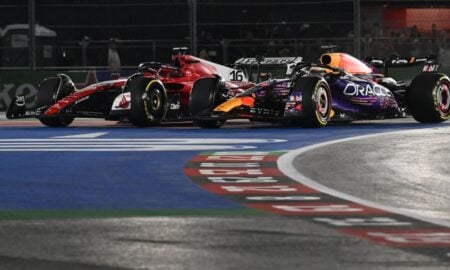
FIA stewards confirm that George Russell respected rules at the start of the F1 Australian GP


The Grande Prêmio of Austrália of Fórmula 1, held this Sunday in Albert Park, ended with the official confirmation of the victory of the British George Russell, of Mercedes. The Federação Internacional of
The stewards’ detailed analysis used images from onboard cameras and sensors installed on the grid to verify compliance with the 2026 sporting regulations. The verdict indicated that the W17 single-seater remained static at the critical moment, ensuring that the result obtained on the track was maintained without penalties being applied to the stage winner.
- Artigo B5.11.1 requires total immobility until the green light.
- Pressure sensors in the asphalt did not detect irregular movement.
- The Mercedes has adjusted the clutch system to optimize response.
- Rivals requested an immediate review shortly after the final flag.
The controversy arose on social media and between opposing teams in the first minutes of the race, when videos suggested a slight rocking of Russell’s car. However, the race management clarified that small fluctuations within the sensors’ tolerance do not constitute an infraction, as long as the vehicle does not exceed the line demarcating the position of honor.
2026 technical regulations impose new challenges on teams
The category’s new guidelines for the 2026 season brought significant changes to the management of power units and torque delivery. According to the new set of rules, cars must be completely still when all five red lights go out, marking the official start of the sporting contest at Melbourne.
Mercedes engineers worked hard to ensure that the engine mapping allowed for aggressive output without violating the physical limits set by the federation. Russell’s success at the start was one of the determining factors in him maintaining the lead and controlling the pace of the race until the last lap on the Australian circuit.
The FIA’s strict supervision of starts has been a priority since the introduction of new hybrid engines, which have greater initial torque. Qualquer advantage obtained by milliseconds can drastically change the result of a street race, where overtaking is historically more difficult and strategic.
Electricity crisis affects performance in the middle of the field
While Mercedes celebrated the legality of its pilot, the rest of the grid faced serious difficulties with the management of energy recovery systems. The formation lap proved to be an unexpected obstacle, with several drivers arriving at the starting grid with battery levels dangerously below ideal for initial acceleration.
This phenomenon caused a dangerous disparity in speeds when the cars left, creating near-collision situations between the competitors. Restrictions in the current regulations limit the use of electric assistance until the vehicle reaches the 50 km/h mark, which severely penalizes teams using larger turbochargers.
- Engines take longer to reach ideal speed without boost.
- Slow accelerations made it easier to overtake lagging cars.
- Engineering teams seek solutions for heating tires.
- The zero battery prevented the execution of burnout maneuvers.
Thermal management also played a crucial role, as the effort to heat the front brakes ended up draining the MGU-K’s recharging capacity. Sem the necessary energy, the pilots were forced to save fuel and electricity on the first lap, changing the entire strategy planned by the teams for the start of the race.
Technical problems compromise newcomers and veterans in Melbourne
Rookie driver Franco Colapinto experienced tense moments when he almost collided with Liam Lawson due to a sudden failure in his opponent’s power unit. Lawson’s car was momentarily paralyzed on the asphalt, forcing evasive maneuvers by those behind at high speed in the initial sector of the track.
In addition to the propulsion problems, Colapinto suffered a stop-and-go penalty applied by the stewards during the race. The punishment occurred because a mechanic on his team touched the vehicle after the 15-second warning signal, which is strictly prohibited by Fórmula 1’s safety protocols.
The situation of Nico Hulkenberg, representative of Audi, was even more drastic, resulting in his exclusion from the conventional start on the Melbourne grid. The German driver’s car developed a system failure that required him to be pushed into the pit lane, where the team attempted to carry out emergency repairs to allow his later participation.
Load recovery strategies define the pace of the race
The need to perform the procedure known as lift-and-coast became a constant for most drivers during the first ten laps of the competition. Essa technique consists of lifting your foot off the accelerator before braking zones, allowing the car to glide and recover kinetic energy more efficiently to the batteries.
Andrew Shovlin, director of track engineering for Mercedes, publicly acknowledged that the team did not do the best job of managing the electrical load. Mesmo with the victory of Russell, the team admitted that both of its drivers started the race at a technical disadvantage, which required defensive and precise driving to avoid losing position.
The balance between heating the rear tires and preserving the battery became the main dilemma for the strategists of the ten teams on the grid. On circuits like Albert Park, where traction is essential to exit slow corners, the lack of available energy can mean a loss of lap time of more than half a second.
Engineers analyze thermal impact on braking systems
The complexity of the 2026 cars requires the brake balance to be constantly shifted to the front axle during the warm-up lap. Essa action aims to generate enough heat for the tires to reach the ideal operating window, but ends up drastically reducing the effectiveness of energy recovery by the rear axle.
Laurent Mekies, team leader of The search for maximum grip ends up sacrificing electrical reserve, leaving competitors vulnerable when the lights go out and full power is required.
- Shifting the brake balance inhibits the MGU-K from functioning.
- Tire temperatures varied between 80°C and 100°C on the grid.
- Energy consumption was 15% higher than predicted in the simulations.
- Telemetry sensors indicated excessive heat spikes in the disks.
This scenario of technical instability should force a review of the preparation procedures for the next stages of the Fórmula 1 world championship. The FIA and the teams plan technical meetings to discuss whether adjustments to the reloading regulations are necessary to ensure safety and competitiveness in future starts.
Future of competitions under the new technical regulations
George Russell’s validated victory serves as a milestone for Mercedes, who appears to have better understood the limits of the 2026 regulations compared to their rivals. The ability to deliver a clean and compliant start, even under pressure from highly sensitive sensors, puts the German team in a prominent position at the start of the season.
The other teams are now racing against time to resolve the software and hardware failures that caused chaos in the middle of the pack in Melbourne. The focus of the factories in Brackley, Milton Keynes and Maranello will be to optimize thermal and electrical efficiency so that drivers do not suffer from a lack of power in the opening laps of upcoming races.
The final analysis of the Austrália GP reinforces the importance of technical precision in an era where electronic details define the winners. With the FIA maintaining a rigid, data-based stance, the expectation is that the rigor of inspections will remain high, demanding absolute excellence from drivers and engineers at all stages of the event.