
Hubble Telescope records 7.2-hour oscillation in gas jets from interstellar comet 3I/ATLAS

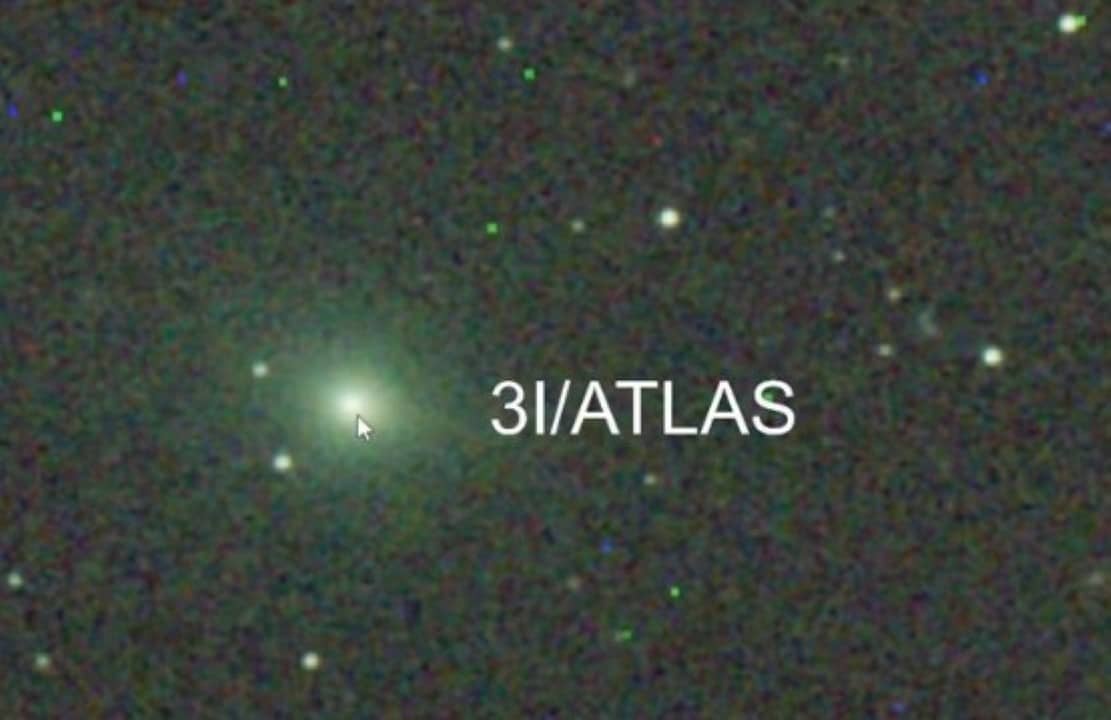
Recent images captured by Telescópio Espacial Hubble revealed that the interstellar object 3I/ATLAS has a complex structure composed of three jets of gas and dust that exhibit perfectly synchronized periodic oscillations. The astronomical observations occurred in a critical period, shortly after the celestial body passed through its perihelion, which represents the point of closest proximity to the Sol on its trajectory.
Data collected by the space observatory’s high-precision instruments detail a fascinating mechanical phenomenon in the comet’s nucleus. Analysis of images recorded between the end of November and the end of December 2025 demonstrates that the material ejected into deep space does not follow a static flow, but rather a dynamic pattern of constant precession.

This behavior directly affects the way the object is viewed from Earth’s orbit, influencing both its apparent geometry and the amount of light it reflects and emits. The discovery provides new clues about the internal composition and physical forces acting on celestial bodies originating outside our solar system.
Detailed configuration of the three jets and their measurements
Astronomers identified that the three jets ejected by the comet’s nucleus exhibit distinct position angles, known in astronomy by the acronym PA, with specific oscillation amplitudes for each of them. The first jet analyzed has a position angle of 55 degrees, recording an angular movement amplitude of 12.8 degrees during its directional activity cycle.
The second jet, which is oriented in the opposite direction to Sol, is classified as the most prominent and concentrates the most evident oscillation movement of the entire structure. Este anti-solar jet registers a position angle of 290 degrees, with an amplitude of angular variation that reaches the 20-degree mark in space.
The third component of this symmetrical formation shows a position angle of 170 degrees, accompanied by an oscillation amplitude of 12.6 degrees. Essa triple configuration indicates a complex system of thermal heating and ice sublimation that interacts directly with the rotational speed of the cometary nucleus itself.
The precise measurements derive from intense image processing that managed to isolate the brightness of the central coma to reveal the symmetry and morphological evolution of the jets. The main jet demonstrates a complete oscillation cycle that lasts exactly 7.20 hours, serving as a natural clock for measuring the rotation of the celestial body.
Interpretation of precession and the movement of the nucleus
The interstellar object’s total brightness variability closely follows this physical movement, recording a luminous period of 7.136 hours and an amplitude of



