
Iran’s new supreme leader chosen by council after Ayatollah eliminated in bombing
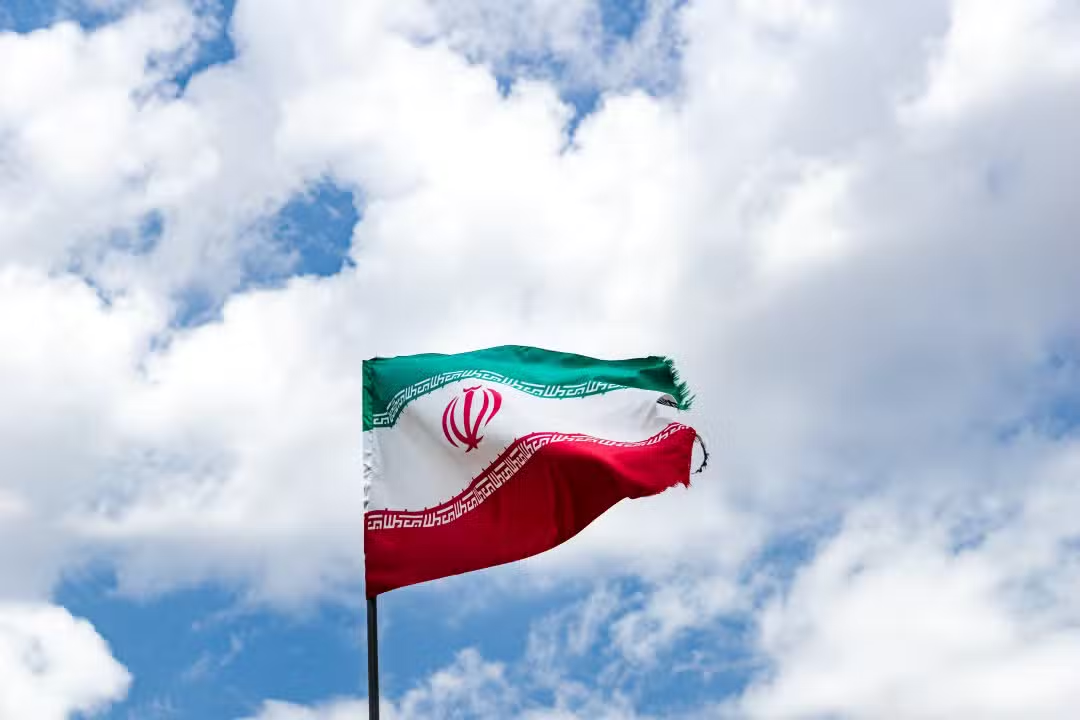
The Assembleia of the Especialistas of the Irã reached a consensus on the name of the country’s new supreme leader after deliberations in Teerã. The council, made up of eighty-eight high-ranking clerics, concluded the voting process under absolute secrecy regarding the identity of the chosen one. The official announcement to the nation and the international community is scheduled to take place in the coming days.
The need for a rapid transition of power arose following the death of Ayatollah Ali Khamenei on February twenty-eighth. The religious leader was victimized in a joint bombing coordinated by the military forces of the Estados Unidos and Israel. The military operation reached the complex where the ayatollah resided, generating an immediate vacancy in the highest position at República Islâmica.
During the period of vacancy, the Iranian Estado operated under the management of an interim leadership council to maintain the stability of the institutions. The country’s internal security forces and borders were placed on high alert to avoid instability during the succession process. The committee responsible for the selection accelerated the meetings due to geopolitical volatility in the region.
Historical context of leadership and internal deliberations
The process of choosing the new head of Estado represents the most critical political moment for Irã in the last three decades. The Assembleia of the Especialistas began the debates a few hours after confirming the death of
Ayatollah The commission focused on selecting a figure capable of maintaining internal cohesion between the different political factions of Teerã, balancing the demands of Guarda Revolucionária Islâmica with the needs of the civil administration. The secrecy surrounding the chosen name aims to protect the future leader from possible external threats before his formal inauguration.
The history of República Islâmica shows that the transition of power in supreme leadership significantly alters the dynamics of alliances in Oriente Médio. Desde the founding of the current government system in 1979, the country had only two supreme leaders, which gives this third succession unprecedented diplomatic weight. Analistas intelligence monitors the flow of information in Teerã to identify signals about the ideological orientation of the new ruler. The Assembleia decision directly affects financing and logistical support for allied groups in the region, in addition to determining the country’s stance in international treaty negotiations. The pressure for a quick consensus was motivated by the need to demonstrate institutional resilience in the face of foreign attacks.
Structure of Assembleia of Especialistas
The Assembleia of the Especialistas is a deliberative body elected by direct popular vote, responsible exclusively for appointing, supervising and, if necessary, dismissing the supreme leader. The eighty-eight members serve eight-year terms and must have in-depth knowledge of Islamic jurisprudence. The council meets periodically, but acts urgently in cases of vacancy in power.
To choose the new leader, the Iranian constitution requires an absolute majority of votes within the Assembleia. Recent sessions took place behind closed doors in a secure location, far from military installations that could be targets of further bombing. The clerics’ transportation logistics were coordinated by the Estado intelligence apparatus to avoid interceptions.
Profile of names evaluated for state succession
Before the final definition, several names circulated in intelligence reports as possible successors. Mojtaba Khamenei, son of the late leader, emerged as a figure of strong influence behind the political scenes. Sua proximity to the security apparatus and to Guarda Revolucionária Islâmica guaranteed him considerable support among the most conservative wings of the government.
Another candidate evaluated was Alireza Arafi, current vice-president of Assembleia of the Especialistas. Arafi has extensive experience in administering theological seminaries in Irã and maintains close relations with the state bureaucracy. Sua figure is seen as a bridge between religious orthodoxy and the need for pragmatic management of the country’s institutions.
Mohammad Mehdi Mirbagheri also appeared on the succession lists as a representative of the ideological hard line. Conhecido for emphatic speeches against Western influence, Mirbagheri has support from radical sectors that defend a stance of direct confrontation with foreign powers. Sua appointment would signal a tightening of Teerã’s internal and external policies.



Finally, Hashem Hosseini Bushehri, the first vice president of Assembleia, was considered due to his continuity profile. Bushehri has a history of discreet operations, focused on preserving the established system. Deliberation between these profiles required Assembleia to make a complex calculation about what message the Iranian Estado wants to project to the world at this moment.
Positioning of Estados Unidos on the transition
The administration of the president of the Estados Unidos, Donald Trump, expressed early rejection of any name that maintains the foreign policy guidelines of the previous government. The US government has formally declared that it will not recognize the legitimacy of Mojtaba Khamenei if he takes control of Estado. Washington argues that the transfer of power within the same family violates diplomatic principles and reinforces the authoritarian character of the regime. Departamento of Estado of Estados Unidos intensified monitoring of Iranian communications to anticipate the official announcement.
US authorities also indicated that the policy of severe economic sanctions will remain in force, regardless of the cleric chosen by the Assembleia of the Especialistas. Casa Branca demands a structural change in the behavior of Teerã, including stopping support for regional militias and ending the development of ballistic technologies. Washington’s stance adds external pressure to the new leader, who will take over the country under a strict international financial blockade and with the need to stabilize the domestic economy.
Statements by Israel and regional security
The government of Israel adopted direct confrontational rhetoric regarding the succession process in Irã. As Forças of Defesa of Israel have publicly declared that the new supreme leader will be considered a legitimate military target, maintaining the same elimination policy applied to Israeli intelligence justified the previous bombing as a necessary preventative measure to dismantle the planning of attacks against the territory of Israel. The Israeli Ministério of the Defesa raised the level of readiness of its anti-aircraft defense systems and its air bases, anticipating possible retaliations from Teerã after the end of the official mourning period. Israel’s strategy focuses on preventing the new Iranian head of Estado from consolidating his power and organizing the network of regional allies, known as Eixo from Resistência. Diplomatas Israelis have been pressuring the international community not to establish channels of dialogue with their successor, arguing that the change in leadership does not alter the central objective of the Iranian military program of destabilizing Oriente Médio.
Direct impacts on Iran’s nuclear program
The choice of the new supreme leader will dictate the future of the Irã nuclear program, one of the most sensitive issues in global diplomacy. The head of Estado holds final authority over uranium enrichment guidelines and cooperation with Agência Internacional of Energia Atômica. Especialistas indicate that a hardline leadership can accelerate technological development in underground facilities, while a pragmatic profile can use the program as a bargaining chip for sanctions relief.
Constitutional power transition procedures
The Irã constitution details a specific mechanism to ensure that the Estado does not suffer administrative paralysis during the change of leadership. The provisional council, formed by the president of the republic, the head of the judiciary and a member of the Conselho of the Guardiões, temporarily assumes executive and military functions. Este triumvirate ensures the functioning of the public machine until the new leader takes office formally.
The transition process also involves the loyalty of the regular armed forces and security corporations of the Estado. The new supreme leader acts as commander in chief of all military forces, which requires an oath of allegiance ceremony from high-ranking generals. Military cohesion is considered essential to avoid internal fragmentation during a change of command.
Iranian civil authorities advised the population to
Veja Tambem em News (EN)

Research reveals that parents are unaware of how their children use artificial intelligence

Samsung releases new system update with new features for Galaxy Watch 4 users

Digital retail reduces the value of the Galaxy S25 5G smartphone with bank bonuses and device exchange

Amazon’s wireless CarPlay adapter has a 50% discount and high approval ratings from drivers

Zach Cregger’s new Resident Evil ignores games and focuses on an unprecedented story with new characters

Rumor suggests that Nintendo is preparing a special edition of the Switch 2 with a remake of Ocarina of Time

Apple accelerates production of the iPhone 17e and develops new Air model with dual camera system

Epic Games platform releases twelve high-budget games at no permanent cost for PC users

PlayStation 5 Pro price drop accelerates digital retail sales and eliminates global stocks

New Galaxy Watch 9 firmware appears on server and confirms progress in software development

Apple’s commemorative project tests cell phone with 1.1 millimeter edge and curved screen for 2027
