
Unpublished Hubble Telescope data reveals 7.2-hour cycle on interstellar comet 3I/ATLAS

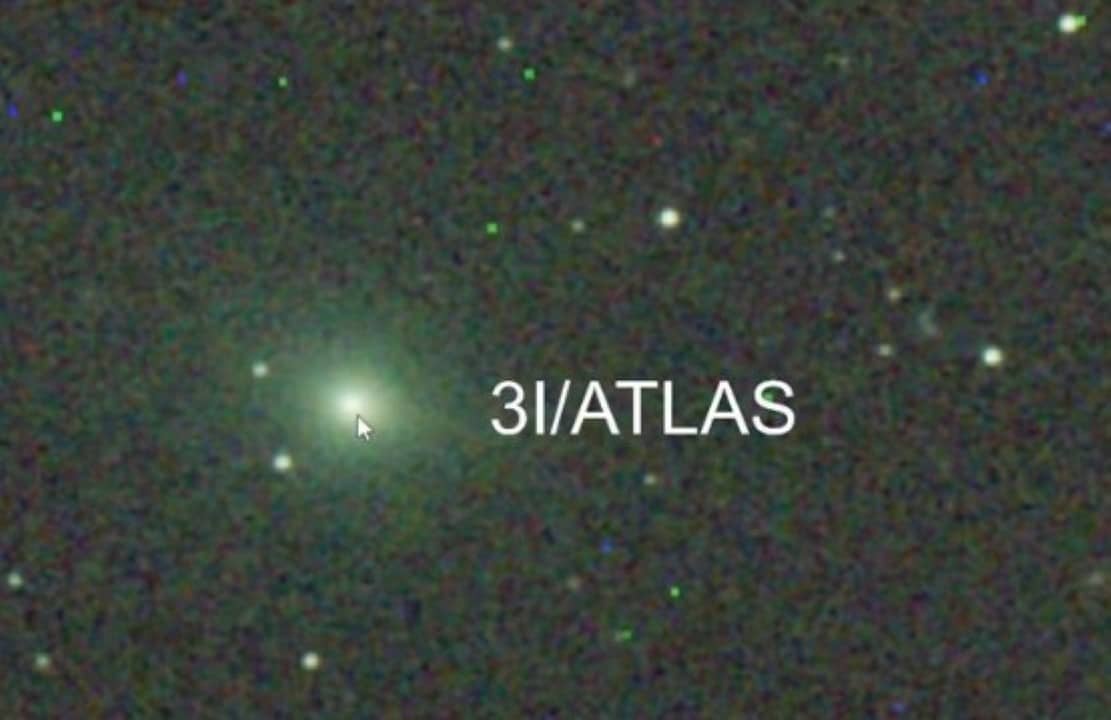
Recent images captured by orbital equipment revealed that the interstellar object has a complex structure made up of three jets of gas and dust that exhibit perfectly synchronized periodic oscillations. The astronomical observations occurred in a critical period, shortly after the celestial body passed through its perihelion, which represents the point of closest proximity to the Sol on its trajectory through our planetary system.
Data collected by the space observatory’s high-precision instruments detail a fascinating mechanical phenomenon in the comet’s nucleus. Analysis of the recorded images demonstrates that the material ejected into deep space does not follow a static flow, but rather a dynamic pattern of constant precession that changes the morphology of the debris cloud around the main body.
Esse behavior directly affects the way the object is viewed from Earth’s orbit, influencing both its apparent geometry and the amount of light it reflects and emits. The discovery provides new clues about the internal composition and physical forces acting on celestial bodies originating from outside our immediate cosmic neighborhood.
Structural dynamics of gas and dust emissions
Astronomers identified that the three jets ejected by the comet’s nucleus exhibit different position angles, known in astronomy by the acronym PA. Cada one of these jets has specific oscillation amplitudes that vary according to its orientation in relation to the center of the solar system.
The first jet analyzed has a position angle of 55 degrees in relation to the observation axis. Durante its directional activity cycle, this specific emission registers an angular motion amplitude of 12.8 degrees, demonstrating a highly regular and measurable mechanical behavior through the lenses of the space observatory.
The behavior of the main antisolar jet
The second jet, which is oriented in the opposite direction to Sol, is classified by researchers as the most prominent of the entire gas structure. Esta specific formation concentrates the most evident oscillation movement, standing out significantly in the captures made by the orbital equipment during the continuous monitoring period.
Este anti-solar jet registers a position angle of 290 degrees, representing a massive ejection of material into the void of space. The amplitude of angular variation of this component reaches 20 degrees, making it the most dynamic element among all those observed on the surface of the cometary nucleus.
The intensity of this opposite ejection suggests a direct reaction to solar radiation during the perihelion phase. The thermal heating of the core causes the sublimation of the internal ice, which violently escapes through the fissures of the celestial body, creating this extensive and oscillating trail of particles that spreads through the vacuum.
Symmetry and measurement of the celestial body’s natural clock
The third component of this symmetrical formation shows a position angle of 170 degrees. Este specific jet is accompanied by an oscillation amplitude of 12.6 degrees, completing the object’s complex structural configuration as it travels at high speed through our planetary system.
Esta triple configuration indicates a complex system of thermal heating and sublimation of primitive ice. The process interacts directly with the rotational speed of the cometary nucleus itself, creating a synchronized mechanism that resembles a precision instrument floating in the cosmic vacuum.
The precise measurements derive from intense image processing conducted by the astronomical teams. The applied technique managed to isolate the brightness of the central coma to reveal the symmetry and morphological evolution of the jets without the interference of the diffuse light that normally covers the surface of these celestial bodies.
The main jet demonstrates a complete oscillation cycle lasting exactly 7.20 hours. Esta precise timestamp serves as a natural clock for measuring the rotation of the celestial body, allowing scientists to calculate the exact speed at which the nucleus rotates on its own axis of gravity.
Luminous variation and orbital data processing
The total brightness variability of the interstellar object closely follows this physical movement of the jets, recording a luminous period of 7.136 hours. The slight difference between the mechanical oscillation and the luminous variation provides crucial data about how the ejected dust disperses and reflects sunlight as the comet rotates. The amplitude of this luminous variation acts as a direct indicator of the amount of material being expelled and how the comet’s irregular surface exposes different areas of volatile material to solar heat during its continuous rotation in deep space.
To arrive at these precise numbers, equipment onboard the telescope needed to capture a continuous sequence of high-resolution exposures over several weeks. The orbiting observatory used its advanced cameras to map the density of the coma and the exact trajectory of the ejected particles. Separating the signals emitted by the gas and dust required the application of complex mathematical filters, ensuring that the final measurements of angles and rotation periods were completely free from optical distortions caused by the vast distance between the lens and the interstellar visitor.
Implications for the study of extrasolar objects
The detailed observation by 3I/ATLAS represents a significant milestone in understanding bodies formed in other stellar systems that occasionally cross our cosmic neighborhood. Diferente of local comets, which share a common origin in the Nuvem of Oort or the Cinturão of The precise 7.2-hour rotation measurement and mapping of the three synchronized jets offer a unique window into the structural cohesion of these objects. The fact that the core can withstand this rapid rotation and violent outgassing without immediately fragmenting suggests a solid internal composition, possibly rich in complex silicates and tightly bound primordial ice. Esta structural resilience helps astronomers model the conditions of the protoplanetary disks where these comets originally formed billions of years ago before being gravitationally ejected into interstellar space and eventually captured by the gravitational pull of our Sol.
Continuous space trajectory monitoring
Tracking of the comet continues as it moves away from the inner solar system, returning to the depths of space. The astronomical community maintains an active observation network to record any sudden changes in the jets’ emission or rotation period as the solar influence gradually diminishes.
Advances in modern astronomical instrumentation
Success in capturing these intricate details highlights the continued ability of established space observatories to provide cutting-edge data. The ability to resolve angular differences of just a few degrees in an object moving at extreme speeds demonstrates the technical rigor of orbital tracking operations.
The data cataloged during this pass will serve as a calibration basis for future observations of similar objects. The methodology developed to isolate the jets and calculate their exact rotation will be applied to the new interstellar bodies that will inevitably cross the detectors of the next generation of ground-based and space telescopes.




