
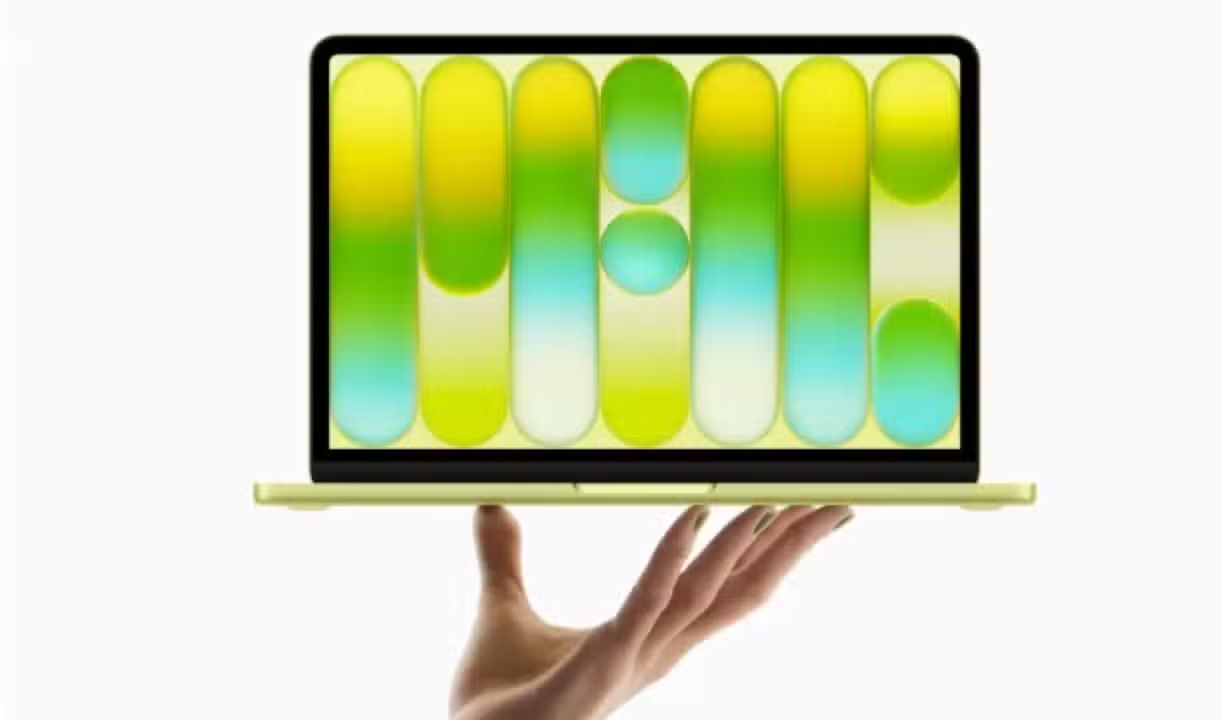
The MacBook The test carried out on the Geekbench 6 highlighted the advancement of the Apple Silicon architecture applied to the A18 Pro chip, a version adapted for the affordable laptop. The Essa comparison highlights the significant improvement in the efficiency of the Apple chips in tasks that depend on a single processing core, even in a device with limited resources.
The result reinforces the superiority of the ARM design over older Intel architectures in single-threaded scenarios. The MacBook Neo, powered by the heavily optimized A18 Essa difference becomes even more notable considering the price positioning and target audience of the new model.
MacBook Neo configuration and key specifications
The MacBook Neo features a 13-inch Liquid Retina screen with a resolution of 2,408 x 1,506 pixels and a brightness of 500 nits. The device has a colored aluminum structure, Touch ID, dual speakers with support for Spatial Audio and a 1080p front camera. Connectivity includes two USB-C ports with varying speeds, which requires user attention when connecting peripherals.
The A18 Pro chip present in the Neo is a binned version of the same SoC used in the iPhone 16 Pro, with one less GPU core. RAM memory starts at 8 GB, a configuration that suits everyday tasks but can limit more demanding applications. Storage starts at 256 GB, with an option for 512 GB.
Single-core benchmark highlights evolution
At Geekbench 6, the MacBook Neo achieved single-core scores that tripled that of the Mac Pro with 28-core Xeon. Essa metric reflects fast processing capability in sequential operations such as web browsing, light document editing, and running simple apps. The leap demonstrates how the A18 Pro’s performance cores prioritize speed and energy efficiency.
The comparison serves as an example of the transition from Apple to its own chips. Older Modelos Intel, even with multiple cores, lose in tasks that do not exploit full parallelism. The Neo delivers agile performance in everyday use, exceeding expectations for an entry-level laptop.
Critical limitation in real-world and multi-core usage
The big caveat in this comparison lies in the fact that most current programs are optimized for multi-threading. Tarefas professionals such as video editing, 3D rendering and code compilation rely on multiple cores, where the older Mac Pro maintains a significant advantage thanks to 28 physical cores. The MacBook Neo, with just six cores in the A18 Pro, does not compete in these scenarios.
Furthermore, the uniform 8GB of RAM represents a major bottleneck. Aplicações that require high memory for extended single-core suffer limitations, reducing the advantage observed in the isolated benchmark. Essa configuration prioritizes cost-benefit and portability, but requires careful management in heavy workflows.
Comparison with other recent Apple models
The MacBook Neo delivers a gain of up to 43% in overall performance over the MacBook Air with M1, a model launched years ago. Initial Benchmarks show single-core scores close to 3,461 and multi-core scores around 8,668 in Geekbench 6. The integrated GPU reaches Metal scores around 31 thousand points, suitable for light graphics tasks.
In relation to more advanced lines, the Neo is behind models with M4 or M5, which offer more cores and higher memory bandwidth. The focus of the Neo remains on affordability, with an efficient battery and premium construction in a compact package.
Target audience and market positioning
The MacBook Neo serves students, mobility professionals and users looking to transition to the Apple ecosystem without a high investment. The starting price of US$599 makes the model competitive with equivalent Windows laptops for basic tasks. Recursos how optimized macOS and integration with iPhone and iPad add value.
The Apple strategy expands the reach of A-series chips for computers, demonstrating versatility. The Neo serves as a gateway, while lines Pro and Air cover more intense demands.
Additional design and usability details
The design maintains uniformity in the bezels and offers a backlit keyboard with colors matching the body. The trackpad lacks advanced haptic feedback, but maintains Apple’s renowned precision. The absence of extra doors reinforces the minimalist profile.
Users report a fluid experience in everyday apps, with fast startup and light multitasking without noticeable stutters. Energy efficiency allows for good usage time without a socket.