Consumers report condensation on Galaxy S26 Ultra lenses after exposure to intense cold
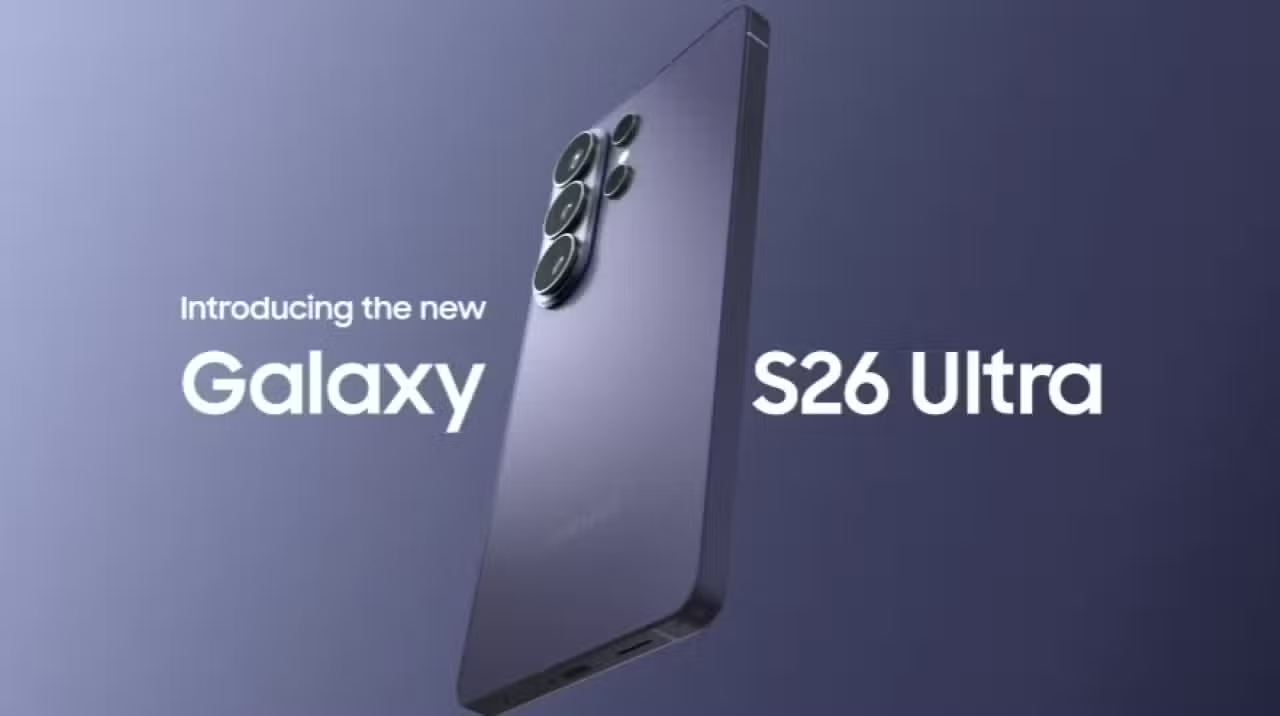
Owners of the South Korean manufacturer’s recently launched high-end smartphone began to identify a physical anomaly in the rear photographic modules. The phenomenon manifests itself through the formation of water droplets on the inside of the protective glasses, directly affecting the mobile device’s image capture capacity.
The situation becomes evident when the equipment is subjected to environments with thermometers showing negative degrees, such as the range of six degrees Celsius below zero. The transition from a warm place to a cold external environment triggers the physical reaction that compromises the immediate use of optical zoom telephoto lenses.
Sold globally since March, the device has official certification against the entry of liquids and dust. The presence of moisture inside the camera block raises technical questions about the efficiency of the seal applied during the equipment’s industrial assembly process.
First records of the optical defect
Initial demonstrations about the irregularity appeared on international technology forums and Asian discussion platforms in the first weeks of the product’s retail availability.
Consumers in regions of the northern hemisphere, who are still facing the harsh winter period, were the first to document the failure visually through practical tests in open environments.
Images shared by specialized sources in the brand’s ecosystem show the three and five times zoom lenses completely opaque, proving that the visual block occurs behind the primary protective glass.
The community has identified that the problem frequently occurs when taking a phone out of one’s pocket into the cold outdoors, leaving heated vehicles in the snow, or transitioning from climate-controlled homes to extreme cold.
Mechanics behind blurring
Internal condensation in sealed electronic devices occurs due to basic thermodynamic principles, where hot air trapped inside the chassis carries a microscopic amount of residual moisture from the factory. Quando the external glass surface undergoes an abrupt cooling, the water vapor present in the internal air loses kinetic energy and transforms into a liquid state when it comes into contact with the cold barrier. Este physical process is intensified in telephoto camera modules because these parts have an elongated cylindrical shape, which creates a small isolated air chamber between the image sensor and the external lens, facilitating the visible accumulation of droplets.
Hardware engineers point out that the device’s advanced heat dissipation system may act as an unintentional catalyst for this specific phenomenon. The phone uses a large internal vapor chamber to cool the main processor during demanding tasks, which generates internal heat distributed throughout the metal structure. When exposing this heated structure to an external thermal shock, the temperature difference between the device’s core and the surface of the lenses reaches its maximum point, forcing the immediate precipitation of residual moisture directly onto the most exposed optical components.
Resistance certification in question
The presence of water inside equipment classified with IP68 protection level generates debates about the limits of manufacturing guarantees in the mobile phone industry. Esta certification ensures that the product withstands submersion in fresh water for up to thirty minutes at a depth of one and a half meters, blocking the entry of liquids under external pressure. However, the adhesive sealants and specialized membranes used to isolate the speakers and connection ports are designed to prevent infiltration from the outside to the inside and are not effective against the condensation of gases that are already inside the chassis from the moment of assembly on the production line. Extreme thermal variation tests the elasticity and adhesion of the industrial glues that fix the camera glass, and although the seal remains intact against diving, it cannot alter the laws of physics that govern the relative humidity of the air trapped inside the phone. Especialistas indicate that the total elimination of this humidity would require the devices to be assembled in absolute vacuum chambers or in environments filled with inert gases, a process that would exponentially increase large-scale manufacturing costs and alter the entire production chain.


Losses in image capture
The visual blockage caused by the internal fog makes it impossible to use the photographic system at crucial moments, frustrating buyers who invested amounts close to one thousand and three hundred dollars in the equipment. Photographs recorded during the blurring period show a total loss of sharpness, reduced contrast and a strong light diffusion effect, resembling images captured by damaged sensors.
Recovering the optical capacity requires patience on the part of the owner, as the evaporation of the droplets occurs slowly and gradually. The device needs to return to a temperature-controlled environment and remain at rest for several hours until the moisture returns to a gaseous state and dissipates inside the chassis, freeing vision from the lenses.
Technical guidance for owners
Specialized technicians recommend that users avoid drastic measures in an attempt to speed up the lens defogging process. Application of direct heat sources, such as hair dryers or proximity to electric heaters, can melt the sealing adhesives and cause irreversible damage to the internal components of the printed circuit board.
The main guideline is to keep the phone at absolute rest on a flat surface at a stable room temperature, allowing natural thermal equalization. The use of thermally insulated protective covers and carrying the device in internal coat pockets help to minimize the speed of temperature drop, reducing thermal shock.
If condensation persists even after days in hot environments, the recommendation is to immediately seek an authorized repair center. Prolonged residence of liquid water near the image sensors can cause oxidation of the electrical contacts, requiring complete replacement of the photographic module.
Photographic hardware specifications
The premium model’s camera array is led by a two-hundred-megapixel main sensor, accompanied by ultra-wide-angle lenses and two optical approximation units. Todo image processing is managed by the Snapdragon 8 Elite Gen 5 chip, which applies advanced artificial intelligence algorithms to correct distortions and improve light capture in nighttime scenarios.
The physical structure that houses these sensors was designed to keep the phone’s thickness at seven point nine millimeters, requiring extremely dense packaging of the parts. Essa extreme compaction leaves little space for internal air circulation, which concentrates any variation in humidity directly in areas of lower thermal resistance, such as the external glass of the cameras.
Positioning of the South Korean manufacturer
To date, the corporation responsible for developing the smartphone has not published an official document recognizing condensation as a chronic manufacturing defect. The engineering department continues to monitor occurrences recorded in global technical assistance to determine whether the volume of cases justifies the opening of a parts replacement program or whether the situation will be treated as a physical limitation inherent to the use of electronic equipment in extreme climates.
Veja Tambem em News (EN)

Research reveals that parents are unaware of how their children use artificial intelligence

Samsung releases new system update with new features for Galaxy Watch 4 users
Digital retail reduces the value of the Galaxy S25 5G smartphone with bank bonuses and device exchange
Amazon’s wireless CarPlay adapter has a 50% discount and high approval ratings from drivers

Zach Cregger’s new Resident Evil ignores games and focuses on an unprecedented story with new characters

Rumor suggests that Nintendo is preparing a special edition of the Switch 2 with a remake of Ocarina of Time
Apple accelerates production of the iPhone 17e and develops new Air model with dual camera system

Epic Games platform releases twelve high-budget games at no permanent cost for PC users

PlayStation 5 Pro price drop accelerates digital retail sales and eliminates global stocks

New Galaxy Watch 9 firmware appears on server and confirms progress in software development

Apple’s commemorative project tests cell phone with 1.1 millimeter edge and curved screen for 2027