
Discovery of mysterious cylinder on Mars mobilizes scientists and raises debate about debris

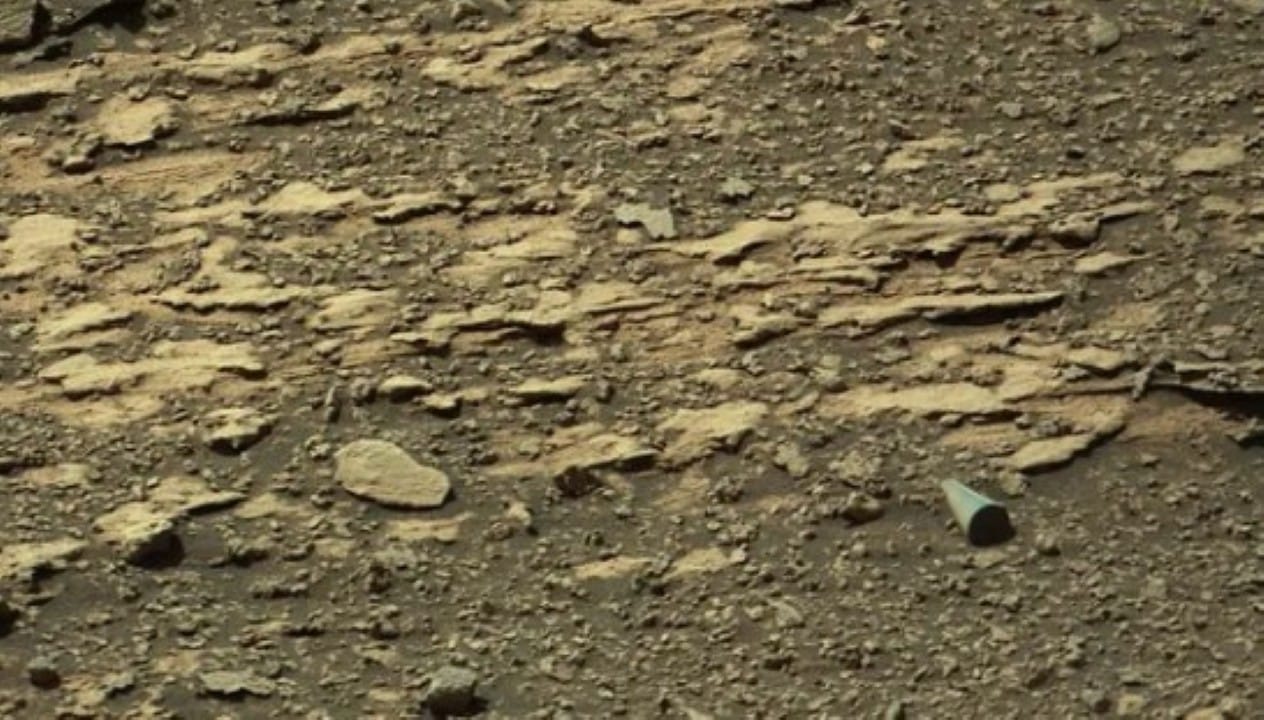
An image captured by the Mastcam camera on the Curiosity rover, on Nasa, revealed the presence of an unusual cylindrical object buried in the soil of Marte, specifically on Passo Paraitepuy, on Cratera Gale. The record, originally made in August 2022, returned to the center of global scientific discussions after detailed analyzes by independent researchers and experts in space anomalies. The structure has an extremely regular geometric shape, approximately 20 centimeters long and with a flat end, which differs from the natural rock formations usually found on the red planet.
Researchers like Rami Bar Ilan and Dr. Jan Špaček, who studies signs of life on Martian soil, brought the case to the attention of Avi Loeb, astrophysicist and professor at Universidade of Harvard. Public discussion about the origin of this item has gained traction in scientific forums and US space agency data repositories, where the object appears in multiple high-definition photographs captured by different rover lenses. The complexity of the find lies in its symmetry, sparking debates about the need for closer investigation to rule out hypotheses of non-human origin.
- The object was detected on the slopes of Monte Sharp, a region of rugged relief and narrow crevices.
- Technical data from the MSL (Mars Science Laboratory) mission documents the part as object 713174794 in the WUSTL repository.
- The exact location of the record occurred in a geological transition area constantly monitored by the team of space geologists.
- The Curiosity rover has been traveling the region since 2012, accumulating more than a decade of continuous exploration and mechanical wear and tear.
Technical origin and possibility of space debris on Martian soil
The explanation most accepted by the scientific community to date suggests that the cylinder is, in fact, artificial debris resulting from the process of human exploration itself. It is common for landing systems, such as the aerial crane or the heat shields used in the 2012 descent, to leave fragments scattered for kilometers due to the force of the impact and the dispersion caused by Martian winds. Este shiny metallic cylinder could be a wiring component, a mechanical seal or a fragment of the Curiosity’s own wheels, which suffer severe wear in abrasive terrain.
The Curiosity rover is a complex machine the size of an SUV, weighing nearly 2,000 pounds and equipped with robotic arms and six solid aluminum wheels. Over the years, visual inspections of the wheels have shown punctures and the detachment of small pieces of metal, which reinforces the theory that the object is a lost component of the mission itself. Especialistas recall that previous anomalies, which initially seemed inexplicable, were later identified as plastics or metals originating from the robot’s protective structure during entry into the atmosphere.
Strategic location and geological details of Gale Crater
The point where the cylinder was photographed is at Passo Paraitepuy, an area that requires careful maneuvering by Curiosity due to the narrowness of the path. The Esta region is rich in information about the wet past of Marte, containing minerals that indicate the historical presence of liquid water and sediment accumulated over billions of years. The object’s appearance contrasts sharply with Martian “blueberries,” which are small spherules of hematite, and the gypsum crystals that the rover often finds in its excavations.
The geometric precision of the cylinder is what most attracts the attention of observers looking for evidence of less conventional anomalies. Embora wind erosion in Marte can sculpt rocks in surprising ways, the uniformity of the piece suggests an industrial manufacturing process. For this reason, the debate among researchers is divided between those who consider the case closed as space debris and others who defend a chemical analysis at the site.
Maneuver proposal for detailed analysis of the object
Avi Loeb and other scientists suggest that Curiosity, which is currently exploring lower areas of Monte Sharp, could make a strategic return to the discovery site. Atualmente, the rover is approximately 8 kilometers from the crack where the cylinder was spotted in 2022, a distance that would require careful logistical planning. Mesmo operating at its maximum speed of 0.16 kilometers per hour, the robot would take a few days of continuous navigation to return and perform new photos or instrumental tests.
The return proposal aims to guarantee scientific transparency and eliminate any doubt about the nature of the finding, avoiding speculation without technical basis. Para advocates of this idea, collecting additional data is the only way to turn a visual mystery into a proven scientific fact. Nasa, however, tends to prioritize pre-established research objectives and the conservation of the rover’s useful life, avoiding route deviations that could compromise the main mission of searching for organic compounds.
Rover trajectory and history of visual anomalies
Since its triumphant landing on Cratera Gale, Curiosity has uploaded thousands of images that periodically generate heated discussions on the internet about strange shapes. On several occasions, objects that looked like spoons, doors or artificial lights were explained as pareidolia or lighting effects on natural rock formations. The difference with the current cylinder is the consistency of the images at multiple angles and different focal lengths, which rules out digital processing errors in the Mastcam cameras.
Rigorous monitoring of raw data allows independent analysts to find these details before they are even processed for the missions’ official public website. Curiosity’s health record shows that the robot is resilient, but not immune to the planet’s extreme conditions, where temperature variations and fine dust affect every gear. Accurately identifying each missing part helps Nasa engineers design more resilient rovers for upcoming missions, such as the Artemis program and future crewed explorations.
Transparency in data from American space agencies
Access to repositories from institutions such as JPL (Jet Propulsion Laboratory) and Universidade from Washington to St. Louis allows citizen science to collaborate with government agencies. The discovery of this cylinder by external researchers demonstrates the effectiveness of the open data policy maintained by Nasa for Mars missions. Quando anomalies are discussed openly, the global scientific community can apply different analysis methodologies to reach an informed conclusion.
The glowing object remains a point of technical interest that illustrates the challenges of maintaining planetary cleanliness during space exploration. As more machines are sent to Marte, the presence of debris manufactured at Terra becomes a constant variable that scientists must learn to catalog and distinguish from native discoveries. The discussion led by names like Avi Loeb reinforces the commitment to the search for direct answers, regardless of how common the object’s origin may prove to be in the future.



