
Discovery reveals unique chemical composition of comet 3I/ATLAS with abundance of organic alcohol by ALMA

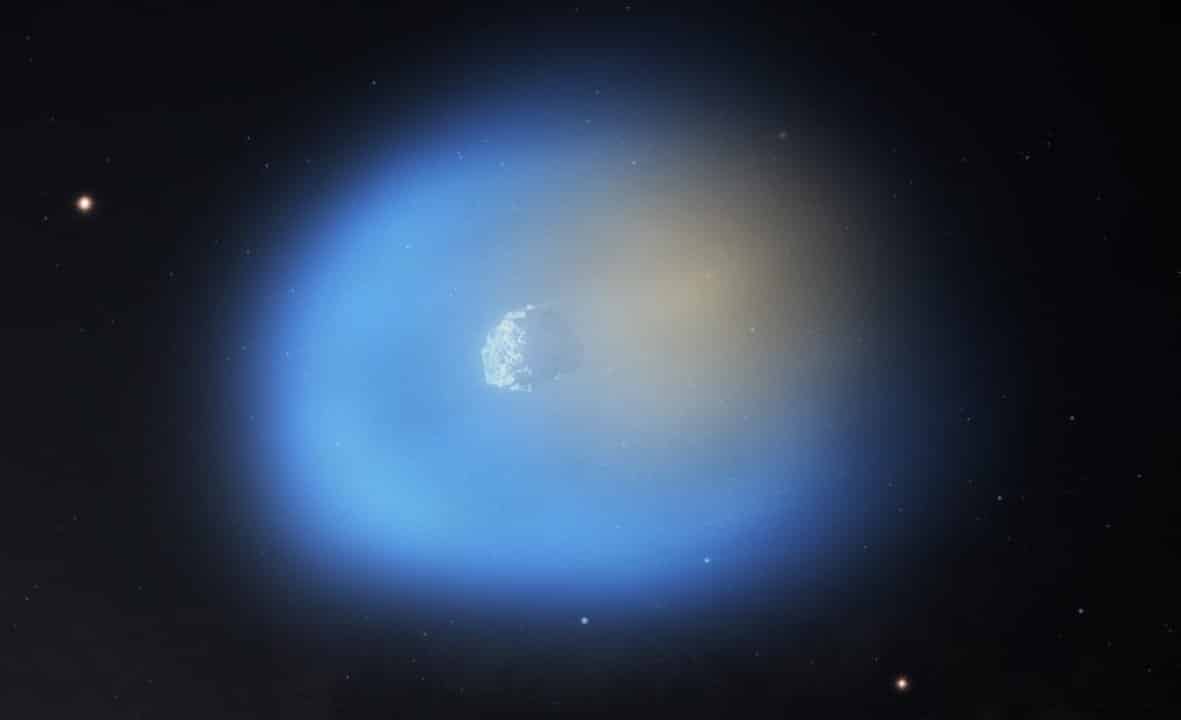
Astronomers have announced the detection of an unusually high amount of methanol in the interstellar comet 3I/ATLAS. The observations were carried out with the ALMA telescope, at Chile, during the end of 2025.
This discovery highlights the comet’s distinct chemical composition compared to objects in the solar system. The data indicate that methanol, a simple organic molecule, dominates the release of gases in the comet’s coma.
The research, led by Nathan Roth from American University, was published in a specialized scientific journal. Ela provides clues about formation conditions in other planetary systems.
Chemical composition revealed by observations
Scientists have measured methanol to hydrogen cyanide ratios ranging between 70 and 120 on specific dates. Essas proportions position 3I/ATLAS among the richest comets in methanol ever studied. The emissions were captured at submillimetre wavelengths, allowing a precise analysis of the origin of the gases.
Methanol arises both from the core and from ice grains in the coma, while hydrogen cyanide comes mainly from the core. Essa difference suggests varying sublimation behaviors, influenced by proximity to Sol.
Methods used in detection
Observations occurred on multiple dates on Atacama Compact Array. ALMA instruments made it possible to map molecular movements with high resolution.
This approach revealed distinct outgassing patterns, with methanol behaving like mini-comets in ice grains. The data was collected as the comet approached Sol, activating its gaseous activity.
Implications for planetary formation
The abundance of methanol indicates that the comet formed under different environmental conditions than solar comets. Esses findings contribute to understanding how planets develop in distant star systems.
Previous research with other telescopes, such as James Webb, had already noticed carbon dioxide in the coma. Agora, methanol adds a layer of complexity to observed interstellar chemistry.
Details about comet 3I/ATLAS
Confirmed as the third interstellar object in the solar system, 3I/ATLAS follows a hyperbolic trajectory. Sua origin outside the solar system has been verified by detailed orbital analyses.
The comet displayed an illuminated coma on one side close to Sol, with gases distributed asymmetrically. Imagens represent methanol in blue and cyanide in orange to illustrate the distributions.
This spatial configuration helped astronomers differentiate emission sources. Measurements took place at local times at Chile, adjusted for the comet’s position.
Comparisons with solar comets
In comets in the solar system, methanol represents smaller fractions in the gaseous composition. In 3I/ATLAS, it reaches levels that exceed most known cases.
This variation suggests differences in the primordial chemistry of stellar systems. Estudos comparatives help map chemical evolutions on galactic scales.
Technological advances in ALMA
The ALMA telescope, operated by an international consortium, uses antenna arrays to capture weak signals. Sua’s desert location minimizes atmospheric interference.
The 2025 observations explored specific frequency bands to identify molecular fingerprints. Essa precision made it possible to quantify gas production with unprecedented accuracy.
Future scientific perspectives
New space missions could target similar interstellar objects for in-situ analysis. The 3I/ATLAS data serves as a benchmark for computational simulations.
Integrations with observatories such as Hubble and Webb expand the spectrum of available data. Essas collaborations accelerate discoveries about cosmic chemistry.
Applications in astrobiology
Organic molecules like methanol are precursors to complex compounds. Sua presence in interstellar comets suggests widespread distribution of ingredients for life in the universe.
Astrobiological studies use this data to model panspermia scenarios. The detection reinforces theories about the universality of organic chemistry.
Observational evolution of the comet
During its passage, 3I/ATLAS exhibited variations in outgassing rate. Medições sequences captured these dynamic changes over time.
The coma expanded as the comet heated, releasing more volatiles. Essas temporal observations provide insights into internal physical processes.
International collaborations
The project involved institutions from Estados Unidos, Chile and other countries. Recursos shared resources like ALMA facilitate global astronomy research.
These partnerships ensure access to high-quality data for scientists in diverse regions. Elas promote collective advances in cosmic knowledge.
Quantitative detection data
Measured ratios indicate methanol productions of around 40 kilograms per second at certain times. Esses values exceed solar comet averages by significant factors.
Calculations based on submillimeter emissions confirm the quantifications. Modelos mathematicians validate the interpretations of the observed spectra.
Hydrogen cyanide detection complements the chemical profile. Sua lower relative abundance highlights the dominance of methanol in the composition.
Historical context of interstellar objects
The first interstellar object, 1I/’Oumuamua, was discovered in 2017 with no detectable gaseous activity. Já 2I/Borisov, in 2019, showed compositions more similar to solar comets.
The 3I/ATLAS adds variety to the list, with its richness in methanol. Essa diversity illustrates the heterogeneity of materials ejected from other systems.
Historical comparisons emphasize the rarity of these events. Cada detection expands the catalog of observed interstellar properties.
Impacts on computational modeling
Comet formation simulations incorporate this data to refine parameters. Modelos predict molecular distributions based on initial environmental conditions.
Updates to computational codes integrate the observed relationships. Essas tools help predict future detected objects.
Additional observations
Telescopes like James Webb have captured infrared data from the comet. Esses complement ALMA’s millimeter observations.
Multi-wavelength integrations provide holistic views of the composition. Elas reveal additional layers of chemical and physical information.
Challenges in observations
The comet’s distance demanded extreme sensitivity from the instruments. Interferências potentials were mitigated by ALMA’s remote location.
Data processing involved advanced algorithms to isolate weak signals. Essas techniques guaranteed the reliability of the detections.



