
ISS astronauts record red sprites and gigantic jet above storms

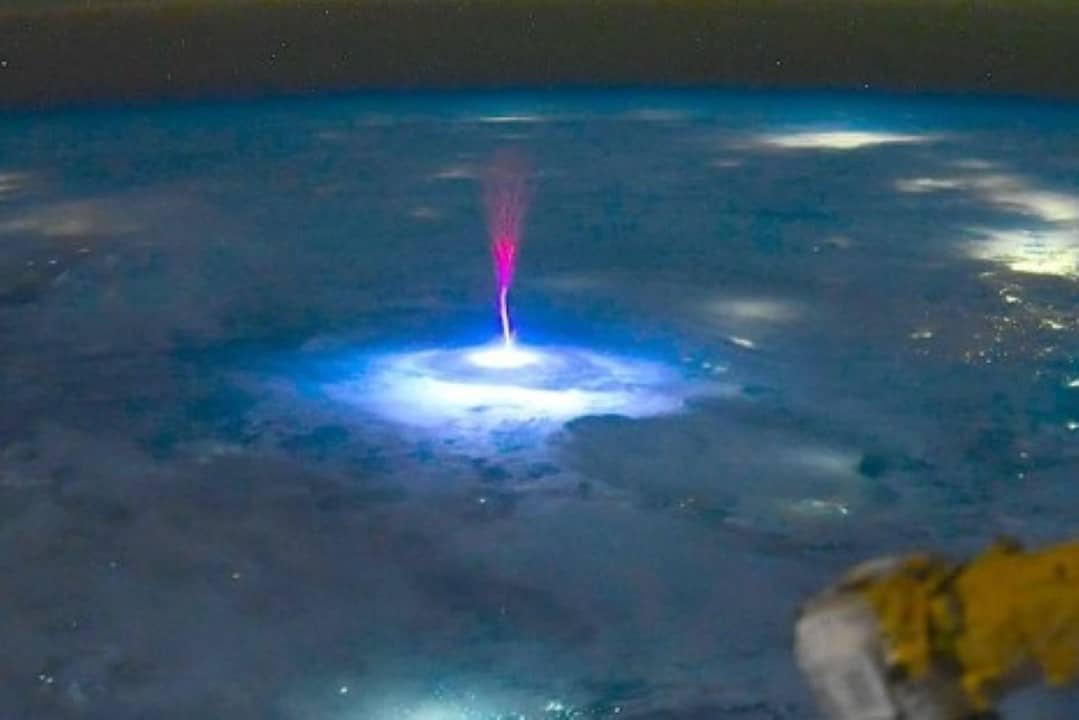
The Estação Espacial Internacional (ISS) has provided a privileged view of rare atmospheric phenomena known as transient luminous events (TLEs). Astronautas recorded impressive photos of electrical discharges occurring tens of kilometers above storm clouds. Esses events include red sprites, blue jets and ultraviolet rings, recently captured in regions such as the border between México and Estados Unidos.
The images shared by Nasa highlight the occurrence of red sprites and a gigantic jet, brief phenomena that last milliseconds and are difficult to observe from the ground. The orbital position of the ISS allows these flashes to be captured clearly, contributing to studies on the interaction between thunderstorms and the upper atmosphere.
Specialized instruments monitor high discharges
The Atmosphere-Space Interactions Monitor (ASIM), installed by Agência Espacial Europeia since 2018 on the outside of the ISS, records tiny, ultra-fast flashes. Seus high-speed cameras and photometers detect events like ELVES, luminous rings that expand for hundreds of kilometers in the ionosphere.
These rings can change the ionic charge and interfere with long-distance radio transmissions. ASIM also identified ultra-brief corona discharges, which pave the way for conventional cloud lightning.
Research based on this data confirms that cloud top discharges inject electromagnetic energy into the upper atmosphere. Cientistas analyze how these processes affect atmospheric chemistry and storm models.
Red sprites appear as inverted structures
Red sprites appear in the mesosphere as inverted jellyfish-like shapes, lasting about ten milliseconds. Eles are triggered by intense electrical activity in thunderstorms below.
Images from the ISS show these sprites above strong convective systems. A recent example recorded the phenomenon over areas of México and southwest of Estados Unidos, with city glow visible in the background.
These observations help map exact altitudes and relationships with Earth’s radii. The data refines electrical charging models in clouds and guides aviation safety guidelines.
Gigantic blue jets pierce atmospheric layers
Blue jets emerge from the cloud tops and extend into the stratosphere in a conical shape. A rarer type, the gigantic jet, reaches higher altitudes and was recently photographed by astronaut Nichole Ayers.
The photo captured the event near the Texas-Mexico border, with urban lights from Dallas, Austin, San Antonio, Houston and Torreón in the background. Esses jets transfer electrical charge to higher layers, influencing the ionosphere.
ISS records reveal details about the propagation and duration of these phenomena. Eles contribute to understanding risks to communications and chemical variations in the atmosphere.
Experiments in the ISS cupola film at high speed
The ISS cupola, with its seven windows, serves as an observation point for experiments such as Thor-Davis. Tripulantes install advanced cameras that capture storms at up to 100,000 frames per second.
This slow-motion footage shows electrical filaments and unexpected branches in lightning. The videos validate laboratory plasma testing with real events.
The images help improve algorithms for alerting power grids during severe storms. The orbital perspective reveals invisible ground dynamics.
CubeSat detects invisible gamma flashes
CubeSat Light-1, launched in partnership with agencies such as JAXA, records pulses of terrestrial gamma rays (TGFs) associated with lightning. Esses pulses emit energetic radiation equivalent to X-rays in fractions of a second.
The small satellite, the size of a loaf of bread, maps occurrences over equatorial regions and intense storms. Seus detectors align timestamps with terrestrial ray networks to create three-dimensional atlases.
This data identifies risk zones for aviation, as flashes can expose aircraft to brief doses of radiation. Estudos continue to refine location predictions.
Impacts on communications and atmospheric chemistry
Transient luminous events disturb ionized layers that propagate radio waves. Sprites, jets and ELVES can cause fading in long-distance signals and affect underwater communications.
For polar or equatorial air routes, understanding these phenomena improves safety planning. Descargas alter nitrogen oxides and ozone, influencing radiative balance.
Climate models incorporate this vertical mixing for more accurate warming predictions. Observações from the ISS accumulate a library of events for future analysis.
Future Advances in Orbital Monitoring
The ISS is expected to operate for more years, allowing ASIM and successors to collect continuous data. Engenheiros develop automatic detectors with greater speed and a broad spectrum, from radio to X-rays.
Fleets of CubeSats can provide real-time alerts to weather agencies and satellite operators. Cada orbit adds records to the understanding of atmospheric electricity.



