
Solar radiation hits interstellar comet 3I/ATLAS and increases ejection of water vapor into space

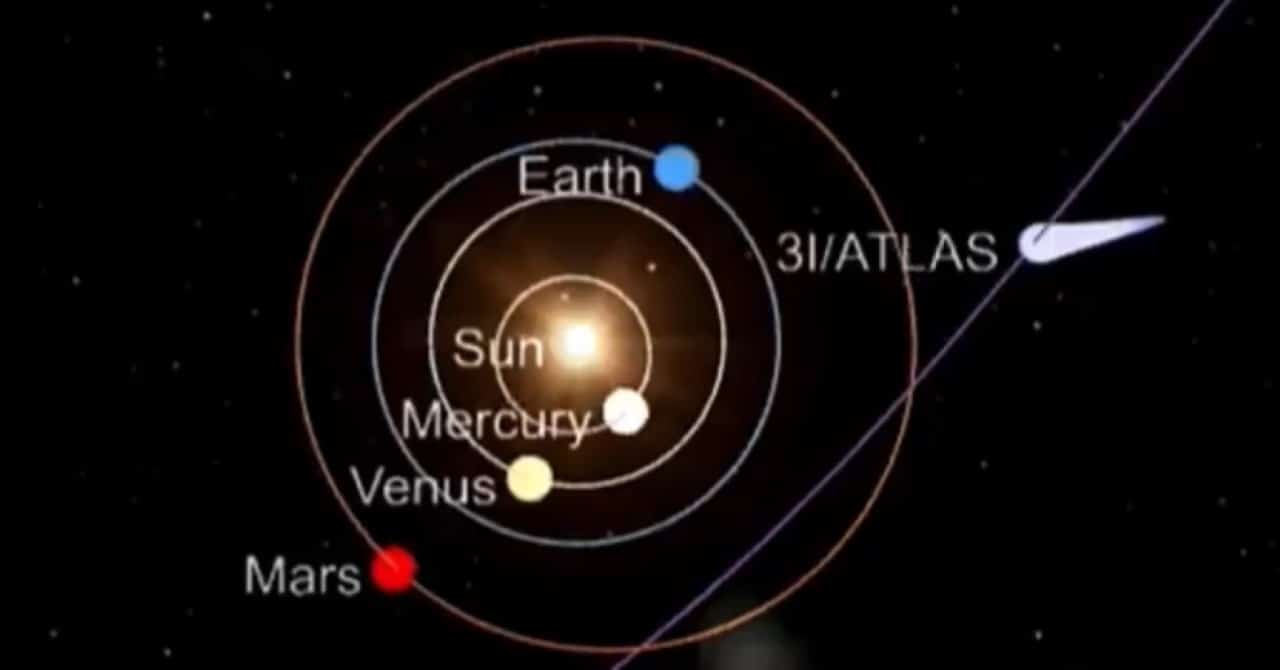
The passage of a celestial body from outside our planetary system revealed unprecedented physical behavior during its closest approach to the central star. Continuous monitoring of deep space recorded the exact moment the cosmic visitor’s frozen structure underwent drastic changes due to intense thermal radiation. The direct interaction with stellar energy caused immediate changes to the object’s surface and inner layers, providing an unprecedented volume of data to the global astrophysics community.
The approach event occurred at the end of October, triggering a chain reaction in the rocky and cometary crust. The extreme heat penetrated the structure’s outer barriers, reaching vast reservoirs of primordial ice that remained intact and protected during millennia of travel through the darkness of the universe. The sudden exposure to high temperatures broke the celestial body’s state of inertia, initiating a violent process of sublimation of volatile materials.

The intensification of structural activity resulted in a series of phenomena observable from equipment in Earth orbit. The logs indicate the following major changes in object dynamics:
– Aumento of the rate of water vapor expelled into the vacuum by twenty times compared to the August measurements.
– Formação of a dense cloud of particles surrounding the rocky central core.
– Liberação of complex organic compounds mixed with the ejected gas stream.
– Criação of an extensive luminous tail that facilitates continuous trajectory tracking.
Thermal dynamics in the crust of the cosmic visitor
The abrupt transition from the coldest regions of the galaxy, where temperatures approach absolute zero, to the zone of intense solar radiation represents a severe mechanical stress event. The direct incidence of energy on the irregular surface of the celestial body causes deep fractures in its external structure. Esse process exposes the previously protected internal material to the hostile environment bathed by constant solar winds.
The immediate thermal shock results in the breaking of the ice barriers that guaranteed the object’s physical cohesion during its interstellar journey. The amount of energy absorbed in a short period of time converts solid matter directly to the gaseous state. Essa rapid transformation generates internal pressure that forces the ejection of materials through newly formed fissures in the rock crust.
The cloud of particles resulting from this aggressive sublimation completely surrounds the central core, altering the visual signature of the celestial body. The density of this haze of gas and dust increases proportionally to the proximity to the heat source, creating a dynamic envelope that continually reacts to variations in stellar radiation along the hyperbolic trajectory.
Advanced monitoring by infrared sensors
Capturing detailed astrophysical phenomena depended on the extreme sensitivity of instruments on board the SPHEREx space observatory. The equipment was specifically developed to map the sky at multiple frequencies of the infrared spectrum. Essa technology allows the identification of unique spectral signatures of molecules present at astronomical distances, separating real emissions from the background noise of space.
During the perihelion phase, the satellite maintained uninterrupted tracking of the target, recording each variation in light and heat emission. The precision of the data collected makes it possible to create three-dimensional models of the nucleus’ behavior under extreme stress. Continuous analysis of this information helps predict the rate of structural degradation and estimate mass loss during passage through our system.
Characteristics of nomadic celestial bodies
The object called 3I/ATLAS is part of a rare category in modern astronomy, being cataloged as the third scientifically confirmed interstellar visitor. Sua open trajectory and anomalous speed prove that it does not suffer the primary gravitational influence of our star. Esses factors clearly indicate its origin in a distant and unmapped region of Via Láctea.
Bodies with this classification travel at kinetic speeds much higher than local asteroids and comets. Essa dizzying acceleration suggests the object was violently ejected from its native planetary system millions of years ago. Desde then, he wandered through deep space until he crossed the limits of our stellar neighborhood.
The passage of these cosmic nomads offers an extremely short observation window for collecting high-fidelity data. Diferente of periodic comets, which have predictable orbits and return cyclically, interstellar visitors make a single crossing before definitively disappearing into the vacuum of space.
The physical study of these bodies works as a direct sampling of the matter present in other sectors of the galaxy. Eles carry the original chemistry of the cloud of gas and dust that gave rise to distant stars, preserving crucial information about the formation of planetary systems beyond our local domain.
Chemical signatures and organic elements
The confirmed detection of organic compounds in the visitor’s internal structure reinforces fundamental theories about the distribution of essential elements throughout the cosmos. Molecules based on carbon chains, preserved in the frozen interior, demonstrate the ability to resist intense cosmic radiation during journeys that last geological eons. The release of these elements under thermal influence proves that the building blocks of complex chemistry are common in other stellar systems. Eles travel protected under thick layers of ice and rock until they find the right conditions for their activation and exposure to open space.
The proportion of water vapor in relation to other heavy gases works as a historical indicator of the object’s formation. Corpos celestial bodies with a high concentration of water often form on the icy outskirts of their original systems, where liquids quickly freeze together with cosmic dust. The abundance and purity of the internal reservoirs suggest an origin in a zone analogous to Nuvem of Oort, followed by a long period of stability before gravitational ejection caused by giant planets from their native system.
Relevance of records for space exploration
The transformation of a body in a state of ancient dormancy to an active nucleus provides a real-time natural laboratory for astrophysics. The observation of aggressive sublimation of materials intact from the early formation of another star system represents a significant advance in long-distance spectroscopy. The massive volumes of data collected by the sensors during the flyby feed information banks that will calibrate the instruments of future interplanetary missions. Direct comparison between the chemical signature of this visitor and the composition of native comets establishes a pattern of similarities and divergences in planetary formation on a galactic scale. Understanding fluid physics and the reaction of deep ice to extreme radiation helps develop theoretical models about the natural transport of water and organic matter between isolated regions of the universe. Esse process consolidates fundamental knowledge in research into the chemical and structural evolution of spiral galaxies, allowing us to map the distribution of vital elements far beyond the known frontiers of current astronomical exploration.
Removal and cooling trajectory
Technical observations continue as the celestial body rapidly moves away from the illuminated region of the solar system, beginning its journey back to deep space. The equipment maintains focus on the exit trajectory to record the exact moment at which the drop in temperature will cause the core to cease its emissions, returning to the original frozen state of dormancy.
Ground data processing
The scientific team responsible for the mission uses the raw information transmitted by the satellite to deepen analyzes of the object’s mechanical behavior. Continuous processing of these records allows the creation of virtual simulations that replicate the extreme conditions faced by the nucleus during perihelion.
The results obtained in this phase of study will be integrated into global astronomical catalogs, serving as a comparative basis for identifying future interstellar visitors. Rigorous documentation of each sublimation step ensures that the knowledge gained is applied to improving early detection systems for anomalous celestial bodies.



