
Scientists detail daring mission to intercept comet 3I/ATLAS traveling at 60 km/s in deep space

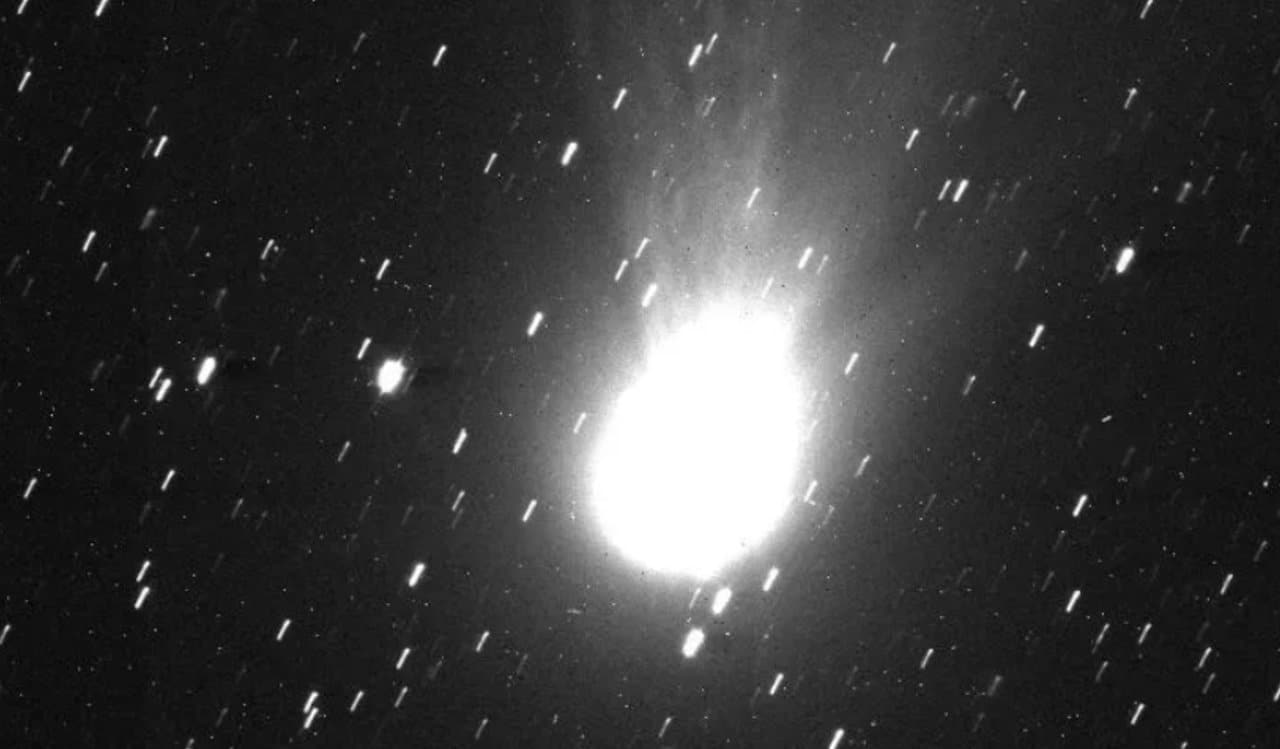
Astronomers from Iniciativa to Estudos Interestelares, led by Adam Hibberd, The object, detected in July 2024, moves at more than 60 kilometers per second and is already moving away quickly.
The scientific community faces the challenge of studying celestial bodies so rare that they offer a unique window into the composition of other planetary systems. Devido to its trajectory and speed, the window for a direct and rapid mission has already closed, making the pursuit a long-term endeavor.
Despite the difficulty, the team of researchers outlined a complex strategy that would involve launching a probe in 2035, with the expectation of reaching it around 2085. Este plan, which would span decades, aims to capture valuable data from one of the oldest and most distant fragments to cross our cosmic neighborhood.
The unique journey of the interstellar comet
Comet 3I/ATLAS represents an extraordinary phenomenon in the astronomical context. Diferentemente of the comets and asteroids that are born and orbit the Sol in our own system, this celestial body has its origin in a distinct planetary system. Ele makes a brief pass through our cosmic region before returning to the depths of interstellar space.
Its detection in July 2024 generated great interest, as it revealed that the comet was already within the orbit of Júpiter, advancing at an impressive speed of more than 60 kilometers per second. Essa rapidity, combined with the exit trajectory, limited the chances of a conventional mission to study it closely in the near term. The opportunity to organize a traditional expedition, which would allow the collection of detailed information before its definitive departure, proved to be unfeasible due to the necessary response time.
Audacious plan to intercept the object
The initiative led by Adam Hibberd, together with Marshall Eubanks and Andreas Hein, proposes a bold plan to make up for the lost window of opportunity. The strategy involves sending a space probe on a chase that would last many decades, taking advantage of favorable launch windows and advanced propulsion technologies.
According to the team’s detailed calculations, a spacecraft launched in the year 2035 would have the possibility of intercepting 3I/ATLAS around 2085. Essa temporal projection highlights the unprecedented scale of the mission, which would require planning and execution that would span approximately half a century. At the time of the possible encounter, the comet would be at an estimated distance of 732 astronomical units from Sol.
To put it into context, this distance is more than four times greater than that which the iconic Voyager 1 probe traveled over almost fifty years of uninterrupted travel. The specific choice of the year 2035 for launch is not arbitrary, but strategic. Neste period, a particularly beneficial planetary alignment will occur between Terra, Júpiter, Sol and comet 3I/ATLAS itself, a crucial factor in optimizing the trajectory and minimizing energy requirements for the long-range mission.
The innovative Oberth maneuver
The execution of the plan depends crucially on an orbital engineering concept known as the Oberth effect, which was initially formulated by scientist Hermann Oberth in 1929. Essencialmente, this technique exploits the immense gravitational force of the The spacecraft would be designed to approach the star at an extremely reduced distance, and at the point of its maximum speed – perihelion – it would activate its thrusters to obtain additional thrust.
The effectiveness of the effect Essa innovative maneuver would allow the probe to reach speeds never before seen in space missions, surpassing the limits of conventional propulsion technologies. If the speed variation (delta-V) generated during this solar passage reached 10.36 kilometers per second, the spacecraft could intercept the comet in around 30 years. If the thrust were slightly lower, at 8.36 kilometers per second, the encounter would occur approximately 50 years after launch. NASA’s Dawn mission, for example, reached speeds of about 11 kilometers per second, indicating that the challenge, while complex, is within the scope of contemporary physics and engineering.
Extreme conditions and thermal protection
The implementation of this orbital strategy, despite its potential, poses significant challenges related to the environment that the spacecraft would have to withstand. The main obstacle lies in the need for the probe to approach Sol at an extraordinarily small distance to perform the Oberth maneuver, specifically just 3.2 solar radii from the center of the star. Essa extreme proximity represents an unprecedented challenge for space engineering.
This distance is considerably smaller than that achieved by Parker Solar Probe, the mission that to date holds the record for closest proximity to Sol. At the closest point, temperatures would be hellish, exposing the spacecraft to levels of heat that require extremely advanced thermal protection solutions. The researchers propose equipping the probe with multilayer heat shields, possibly combining materials such as carbon and airgel.
These materials would have to be able to withstand conditions similar to those faced by the Parker Solar Probe, whose shield has already been shown to withstand temperatures exceeding 1,300 degrees Celsius. The design and integrity of these shields would be crucial to the probe’s survivability and data collection, representing one of the most complex and innovative aspects of the proposed mission.
Mission engineering and technological capability
The design of the 3I/ATLAS comet interception mission is not limited only to the solar maneuver, but encompasses an entire complex engineering architecture. The project includes an initial flyby of Júpiter, which would be used strategically to assist in redirecting the spacecraft towards Sol, establishing the ideal trajectory before the crucial Oberth maneuver. Essa gravitational assistance is a fundamental element for optimizing fuel consumption and route efficiency.
In terms of specifications, the interceptor would have an estimated mass of approximately 500 kilograms, a weight comparable to that of the New Horizons probe, which carried out the famous flyby of Plutão. Para to launch a mission of this magnitude and with such energy requirements, the proposal considers the use of a high-capacity launch vehicle, such as SpaceX’s Starship Block 3 spacecraft. The choice of emerging and proven technologies reinforces the viability of the venture, combining classic principles of orbital mechanics with the most recent innovations in propulsion and space launch.
Future opportunities and scientific debate
The proposal to chase comet 3I/ATLAS, although ambitious, raises a relevant debate within the scientific community about the best approach to studying interstellar objects. With the recent entry into operation of Observatório Vera C.
An earlier detection of future interstellar objects could allow much simpler and more efficient mission planning, with the possibility of intercepting them in regions closer to Sol and in a much shorter time frame. For this reason, some scientists argue that it may be a more pragmatic strategy to wait for the next visitor to arrive that offers a more accessible window of opportunity for exploration. Este viewpoint contrasts with the proactive approach of a decades-old mission, raising questions about resource allocation and the focus of space research.
The meaning of an extraterrestrial celestial body
As the scientific community ponders future strategies, comet 3I/ATLAS continues its relentless journey out of the solar system, carrying with it priceless cargo: primordial material formed in another planetary system billions of years ago. Cada fragment of its composition offers clues about star and planetary formation beyond our cosmic neighborhood.
The possibility of achieving it, whether through the proposed bold mission or by awaiting a new visitor, represents a milestone for astrophysics and space exploration. Independentemente from being intercepted, 3I/ATLAS has already fulfilled its role in stimulating scientific imagination and improving our understanding of the diversity of celestial bodies that permeate the galaxy. Este cosmic traveler stands as a reminder of the vast, unknown universe that still awaits exploration.



