
Harvard astrophysicist questions origin of mysterious cylinder detected on Mars by NASA

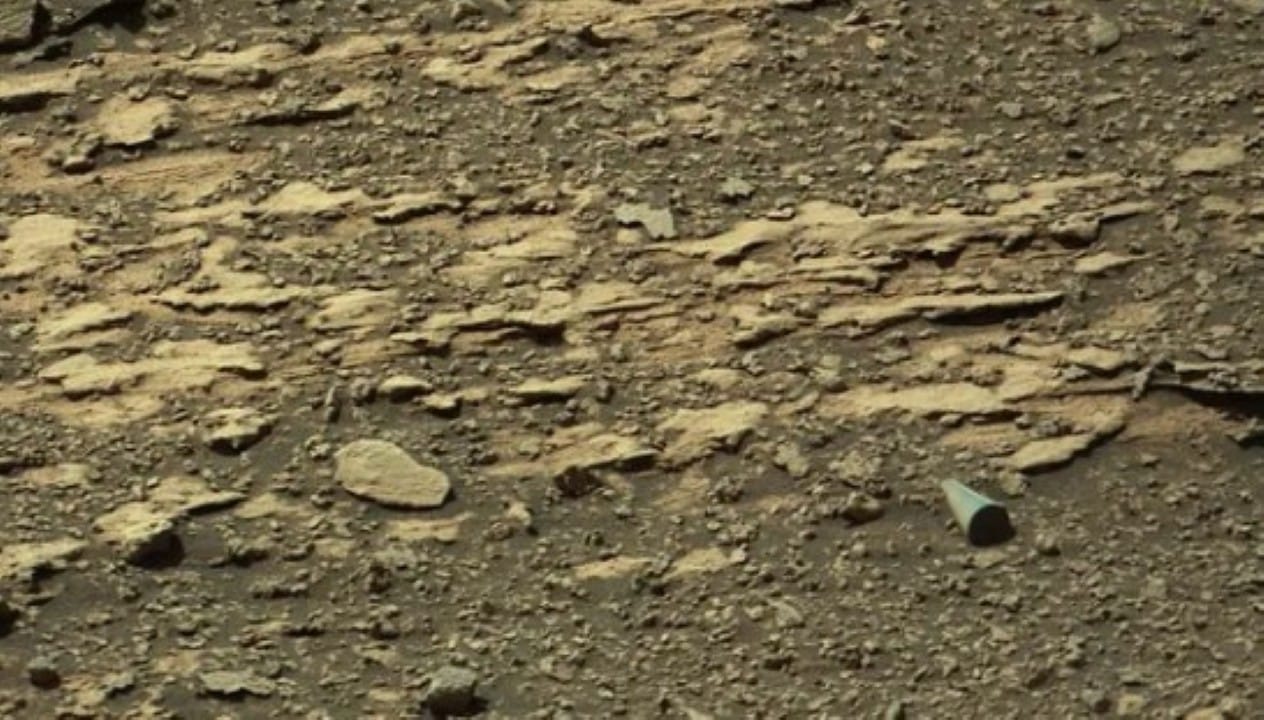
A cylindrical object, captured in images by NASA’s Curiosity probe, has provoked intense debate in the scientific community and instigated the curiosity of the global public. The image of the artifact, with a peculiar shape, was recorded on Martian soil, reigniting discussions about the nature of discoveries on other planets and the possibility of unnatural elements on the surface of Marte.
The record, made on August 7, 2022, shows the cylinder in a narrow crack located at Cratera Gale, specifically on the slopes of Monte Sharp. The Curiosity probe, which has been exploring the red planet since 2012, documented the object which, at first glance, presents a perfectly cylindrical shape, measuring approximately 20 centimeters in length and displaying a remarkably flat end. Esta unusual configuration is the focal point of investigation and speculation.
Recently, the debate about the origin of the cylinder gained significant prominence after publications, including text and video, by the renowned astrophysicist Avi Loeb, from Universidade Harvard. Loeb, known for its provocative takes on extraterrestrial life and anomalous phenomena, has raised the crucial question: “Is the mysterious cylinder in Marte, photographed in 2022 by the Curiosity rover, man-made debris?” Sua intervention catalyzed attention to the finding, driving the need for in-depth analysis by the space agency and other researchers.
Investigation and first analyzes of the Martian object
The detection of the cylinder by Curiosity is part of the rover’s exploration routine, which consists of capturing thousands of images of the Martian terrain, searching for geological, chemical and, potentially, biological clues. The mission team regularly reviews these images for anomalous features or formations that could offer new insights into the history and composition of Marte. The object in question immediately stood out for its symmetry.
NASA scientists, when analyzing the first images, initially considered some hypotheses. Natural geological formation is always the first line of investigation for unusual objects in extraterrestrial landscapes. Processos erosion, sedimentation and volcanic phenomena can create surprisingly regular structures over millennia, confusing unsuspecting observers. However, the “perfection” of the cylinder raised a question mark.
The object’s composition, although not directly analyzed with spectroscopic tools at the time of discovery, could offer valuable clues. If it were of geological origin, it would be composed of rocky minerals common in Marte, such as basalts or clays. Caso were metallic elements or synthetic materials, the debris hypothesis would gain strength, which would require further investigation of the rover’s capabilities to collect samples or perform in situ analyses.
The point of view of astrophysicist Avi Loeb
Avi Loeb, a prominent and sometimes controversial figure in the field of astrophysics, has been a vocal advocate of actively searching for evidence of extraterrestrial civilizations. Sua’s main thesis is that science should seriously consider the possibility of technological artifacts from other civilizations in our solar system, and the Marte cylinder fits this line of thinking. Ele argues that the shape of the object is too regular to be attributed to purely natural processes.
Loeb suggested in his publications that the “perfectly round” shape and “flat end” of the cylinder are features that rarely manifest themselves in natural rock formations of Marte. Ele raises the question that the observed symmetry may be indicative of an artificial origin, whether from an ancient civilization that inhabited the planet or, more hypothetically, from some type of terrestrial debris. In the latter case, it would be a residue from previous space missions that would have been lost and arrived at Cratera Gale.
The theory of Loeb, although stimulating, generally meets with skepticism among most scientists, who prioritize natural explanations and seek irrefutable evidence before considering extraordinary alternatives. Sua insistence, however, serves to stimulate debate and reevaluation of data, pushing the limits of research and interpretation. The discussion generated by Loeb highlights the importance of examining each detail rigorously and with an open mind, without discarding possibilities.
Explanation scenarios and Martian geology
There are several scenarios that the scientific community considers to explain the presence of unusually shaped objects in Marte. Pareidolia, which is the human tendency to see recognizable patterns in images or random objects (such as faces in clouds), is a common explanation for many “anomalies” observed on other planets. The human brain is conditioned to seek symmetry and familiarity, which can lead to misinterpretations of rock formations.
Another strong hypothesis lies in the specific geological processes of Marte. The planet is known for its past volcanic activity and strong winds that cause significant erosion. The combination of these factors can create rocks with varying shapes and, occasionally, surprisingly symmetrical shapes. For example, the action of wind and sand on a sedimentary rock can sculpt it uniformly over millions of years, giving it an artificial appearance.
Cratera Gale, where the cylinder was found, is a place of great geological interest. Monte Sharp, at its center, is composed of layers of rocks that record billions of years of Martian history. The analysis of these layers has revealed the presence of liquid water in the past and several geological transformations that can justify the formation of objects with unique characteristics, without necessarily involving any external or artificial intervention.
History of controversial discoveries at Marte
The detection of the cylinder in 2022 is not the first time that unusual objects in Marte have sparked theories and debate. Over the decades of Martian exploration, several “finds” have provoked speculation and were later explained by natural phenomena. Entre the most famous examples are the “face at Marte”, a mountainous formation that resembled a human face, captured by
The “face in Marte” is a classic case of pareidolia, where the combination of light, shadow and angle of the image created the illusion of an artificial structure. Imagens later studies with greater resolution revealed that it was just a natural formation. Já “Martian blueberries” have been identified as mineral concretions formed by the interaction of water and rocks, a well-understood geological process. Esses examples demonstrate how first impressions can be misleading in the context of space exploration.
Scientific caution and the need for multiple lines of evidence are standard protocols in these cases. Antes of any extraordinary conclusion, the scientific community demands robust data, confirmed by different instruments and, ideally, from multiple perspectives. Repeating observations and analyzing direct samples, if possible, are essential to rule out or confirm hypotheses, ensuring the credibility of the findings.
The Curiosity mission and the search for life on Marte
The Curiosity probe, which captured the image of the cylinder, has as its main objective to investigate the potential of Marte to have harbored microbial life in the past. Para this, she has explored Cratera Gale and Monte Sharp, looking for evidence of habitable environments, such as the presence of liquid water, chemical elements essential to life and energy sources. Suas discoveries have revolutionized our understanding of the climatic and geological history of Marte.
The rover is equipped with a sophisticated suite of scientific instruments, including high-resolution cameras, spectrometers, a laser to analyze the composition of rocks and soil, and an onboard chemistry laboratory to analyze samples. The identification of organic molecules and the confirmation that Marte had aquatic environments in the past are important milestones achieved by the mission.
The search for signs of life, or even artifacts, is a meticulous and time-consuming process. Cada image, every sensor reading and every sample collected contributes to a vast puzzle. Although most unusual objects are eventually explained by natural processes, the persistence of figures like Avi Loeb in raising questions about anomalies encourages scientific rigor and keeps alive the flame of curiosity about what else there might be in the universe.
The future of Martian exploration and the elucidation of the mystery
Exploration of Marte remains a priority for space agencies around the world. With missions like the Perseverance rover and future plans for sample return missions, the ability to investigate the Red Planet is constantly evolving. Cada new probe and each new instrument bring greater resolution and the possibility of more detailed analyses, increasing the chances of unraveling mysteries such as the cylinder.
Although the most likely explanation for the cylinder is geological, the controversy surrounding its origin serves as a reminder of the human fascination with the unknown and the search for answers about our place in the cosmos. NASA and the scientific community will continue to analyze all available evidence, using science as the primary tool to separate fact from conjecture. Somente With more data and, perhaps, with new images from different angles or on-site analyses, it will be possible to determine with greater certainty the true nature of the mysterious Martian object. The dialogue between different scientific approaches, even the most speculative ones, drives knowledge and exploration.
With each new discovery, the veil on Marte’s past and present is lifted a little further, revealing a complex and dynamic planet. Human curiosity for their cosmic neighbor is insatiable, and incidents like the cylinder only intensify the desire to continue investigating and eventually unlock all of its secrets.



