
NASA discovery: solar eclipse of 2186 will be the longest in 12 thousand years and will be 7m29s
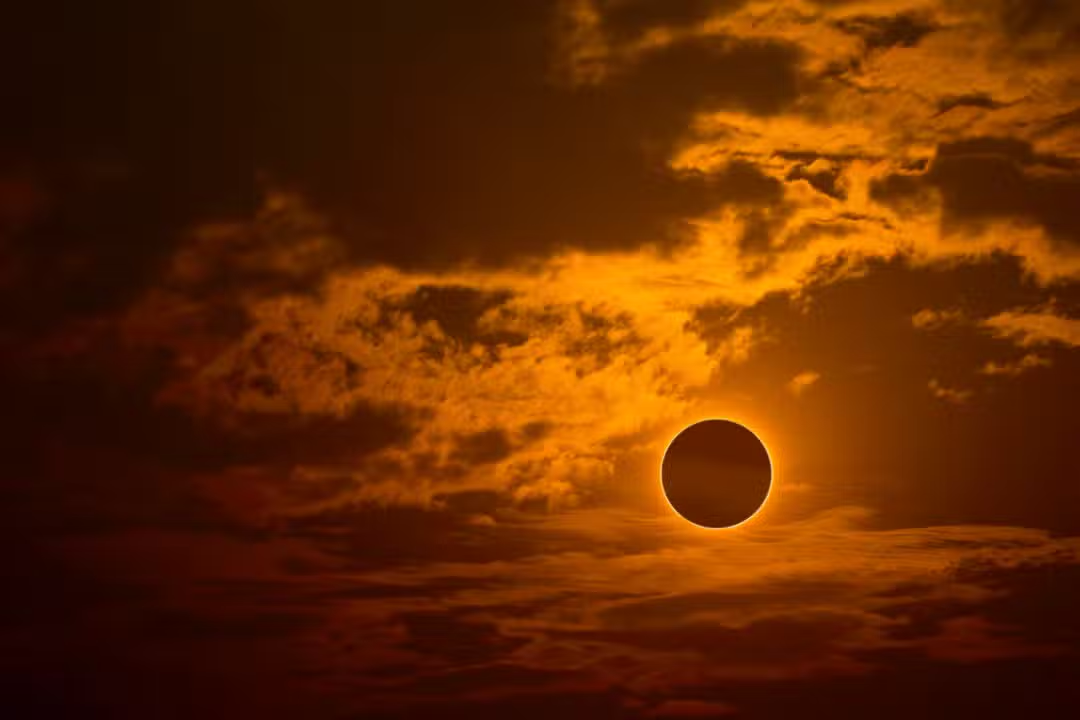
Agência Espacial Norte-American (NASA) has confirmed details of what is projected to be the largest total solar eclipse in history calculated by modern science, an event that has captured the attention of researchers and space enthusiasts. Previsto for July 16, 2186, this celestial phenomenon promises to be a significant milestone for global astronomical observation.
With an impressive duration of 7 minutes and 29 seconds of total darkness, the 2186 eclipse will surpass any other record from the last 12 thousand years. Essa extraordinary projection rekindled the enthusiasm of the scientific community around the world, which already considers the event as a unique opportunity for in-depth studies and observations.
NASA’s confirmation highlights the importance of a very rare celestial alignment that will culminate in this spectacle. Planejamentos preliminary research and observation of the event are already beginning to be discussed, showing the anticipation of an event that transcends generations.
Celestial conditions for a record-long eclipse
The exceptional duration of the 2186 solar eclipse is the result of an extremely rare combination of orbital conditions. At the precise moment of the phenomenon, Terra will be at its aphelion, the furthest point from Sol in its elliptical orbit. Essa position makes the solar disk appear to be slightly smaller in the sky, a favorable condition for a longer period of totality.
Simultaneously, Lua will occupy perigee, its closest position to Terra. Essa proximity amplifies the apparent size of Lua, allowing it to cover the solar disk for a significantly longer period. NASA explains that the competition of these factors, added to the eclipse’s trajectory close to the Earth’s equator, maximizes the time in which the lunar shadow travels across the planet’s surface, further prolonging total darkness. The previous record, from 2009, was 6 minutes and 39 seconds, while an event in 1973 lasted 7 minutes and 4 seconds.
The Science Behind NASA’s Prediction Accuracy
The ability to predict solar eclipses centuries in advance and with such precision represents one of the greatest triumphs of modern astronomy. NASA uses highly advanced computer models, which are based on the laws of universal gravitation formulated by Isaac Newton. Esses calculations are powered by meticulous data on the orbital motion of Terra and Lua, allowing us to simulate celestial alignments with a margin of error of less than a minute, even for events that will occur centuries from now.
The North American space agency maintains detailed catalogs that contain predictions of all solar and lunar eclipses for the next millennia. Essa vast amounts of data are crucial for the scientific community to plan complex observations in advance, develop cutting-edge instruments, and organize expeditions to remote locations. Tais information is also fundamental for research into the orbital stability of celestial bodies and continuous improvement of mathematical models that describe the solar system.
Routes of totality and partial visibility
The band of totality, where Sol will be completely covered by Lua, will cross specific regions north of América of Sul, parts of equatorial África and a vast area of Oceano Atlântico. Segundo NASA calculations, prime areas include territories of Colômbia, Venezuela and Guiana. Essas locations are already being considered as future international astronomical observation centers, attracting scientists, students and tourists interested in witnessing the phenomenon in its entirety.
Organizing logistics for the arrival of thousands of observers in 2186 will be a considerable challenge, requiring coordination between governments, scientific institutions and tourism companies. Infraestruturas Temporary facilities, such as portable observatories and housing, will need to be established in remote areas to accommodate expected demand.
In the territory, the solar eclipse will only be partially visible in all regions. Embora complete darkness is not experienced, the phenomenon promises to cause a significant darkening in the skies. The Time and Date platform, a reference in astronomical data, confirms that observers will be able to follow the event with appropriate eye protection equipment, such as specific eclipse glasses, ensuring visual safety during observation.
Historical and cultural impact of solar eclipses
Solar eclipses have always held a deep fascination for humanity, shaping mythologies, inspiring legends and influencing the understanding of the universe in different cultures throughout history. Desde Ancient times, these events were seen as divine omens, signs of changes or interventions by the gods, with interpretations ranging from fear to reverence. Civilizações how the Babylonians and Mayans developed rudimentary prediction methods, demonstrating the importance they attached to these celestial alignments.



With the advancement of scientific knowledge, the perception of eclipses has transformed from mysterious phenomena to valuable opportunities for study. The ability to accurately predict when and where these events will occur has allowed astronomers to use totality to study the solar corona, the outer atmosphere of Sol that is otherwise obscured by the star’s intense brightness. Esses studies have contributed significantly to the understanding of solar physics and magnetic fields.
Preparations and challenges for observing 2186
Anticipating an event as distant as the 2186 eclipse requires large-scale planning that goes beyond simple travel logistics. Organizações astronomers around the world are already considering how to develop and implement observation technologies that are yet to come. Isso includes improving space and ground-based telescopes, developing new solar filters, and creating research protocols to maximize data collected during the just over seven minutes of totality.
Challenges include securing continued funding for research and building infrastructure in regions that may be remote but will be in the eclipse’s path. International cooperation will be fundamental, bringing together scientists from different countries to share knowledge, resources and equipment. Além Furthermore, public education about eclipse viewing safety and the scientific relevance of the event will be crucial to engaging society.
Expected scientific contributions from the phenomenon
The solar eclipse of 2186 offers a unique window to deepen scientific knowledge in several areas. Durante totality, scientists will be able to make detailed observations of the solar corona, a field of superheated plasma that stretches millions of kilometers into space. Studying its structure, temperature and dynamics could reveal secrets about the solar wind, coronal mass flares and their impact on space weather, which could affect communications and satellites in Terra.
Furthermore, the opportunity to study Earth’s atmosphere during a prolonged period of daytime darkness will allow investigations into how animals and plants react to this abrupt change in light. Testes of gravitational theories, such as general relativity’s Einstein, can also be performed with greater precision by observing the bending of light from distant stars as it passes close to the
Technological advances and the observer experience
The projection for 2186 indicates that observation technology will have evolved significantly. Espera More powerful telescopes, equipped with artificial intelligence and real-time data analysis capabilities, are expected to be available to capture unprecedented images and information of the solar corona. Eye protection equipment will also become more advanced, offering greater safety and comfort for observers.
For those unable to travel into the band of totality, virtual and augmented reality technologies are expected to provide immersive experiences, allowing global audiences to experience the eclipse in simulated form. Plataformas online will broadcast the event live, with expert commentary and interactive graphics. Public education and science communication programs will play a fundamental role in engaging new generations of astronomers and scientists.
The legacy of the 2186 eclipse promises to be lasting, not only because of its record duration, but also because of the scientific discoveries it could provide and the inspiration it will leave for future generations. Preparing for such a distant event reaffirms the human commitment to exploring the universe and the incessant search for knowledge.
Veja Tambem em News (EN)

Research reveals that parents are unaware of how their children use artificial intelligence

Samsung releases new system update with new features for Galaxy Watch 4 users

Digital retail reduces the value of the Galaxy S25 5G smartphone with bank bonuses and device exchange

Amazon’s wireless CarPlay adapter has a 50% discount and high approval ratings from drivers

Zach Cregger’s new Resident Evil ignores games and focuses on an unprecedented story with new characters

Rumor suggests that Nintendo is preparing a special edition of the Switch 2 with a remake of Ocarina of Time

Apple accelerates production of the iPhone 17e and develops new Air model with dual camera system

Epic Games platform releases twelve high-budget games at no permanent cost for PC users

PlayStation 5 Pro price drop accelerates digital retail sales and eliminates global stocks

New Galaxy Watch 9 firmware appears on server and confirms progress in software development

Apple’s commemorative project tests cell phone with 1.1 millimeter edge and curved screen for 2027
