
New muscle injury keeps Alphonso Davies away from Bayern and creates uncertainty about the World Cup
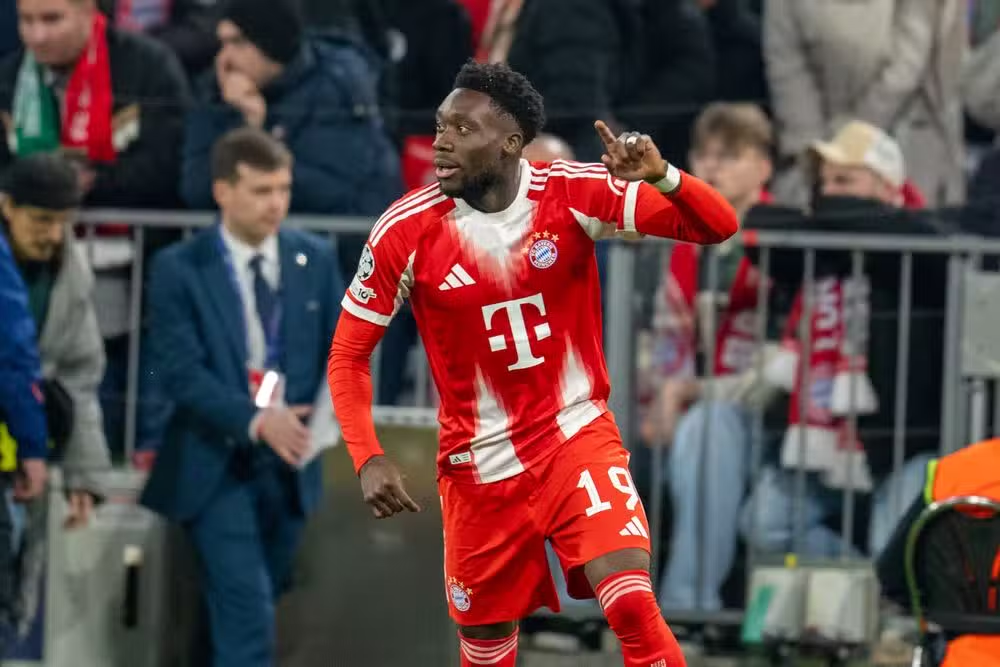
Left-back Alphonso Davies suffered a new physical setback during the match of Bayern of Munique against Aston Villa, valid for the group stage of Liga of Campeões of Europa. The player had to be replaced in the 26th minute of the first half after feeling acute pain in the thigh region, at which point the German team was already facing difficulties in the match that ended with an adverse score of 1-0. The early exit from the field highlighted a recurring problem that has accompanied the athlete in recent seasons and raises immediate questions about his availability for the next official commitments. The club’s medical team began assessment protocols shortly after the end of the match to determine the severity of the muscle tear and the exact time of absence from sporting activities.
Medical history and recurrence of physical problems
The Bavarian club’s medical department confirmed that the injury affects the same area of the thigh that had already sidelined the player on previous occasions. Especialistas in sports medicine point out that repeated muscle injuries indicate a biomechanical imbalance or incomplete recovery from past traumas. The athlete’s history reveals a pattern of interruptions that hinders the maintenance of the game’s rhythm at a high level and requires increased attention from physiologists.
Data from recent seasons shows the frequency of absences and the difficulty of maintaining an uninterrupted sequence of matches. In the 2021/22 journey, the full-back recorded five injuries which resulted in 144 days of absence and 27 missed matches. The scenario of physical instability was repeated in the following years, with four incidents recorded in the 2022/23 season, totaling 71 days of recovery in the medical department.
The situation reached a critical point recently, with records of absences exceeding the 250-day mark accumulated due to three separate injuries in a short period. Essa sequence of physical problems requires a complete review of training methods, the exercise load applied to the athlete during periods of competition and the way the club manages the player’s minutes on the field.
Tactical developments for the German team
The absence of number 19 forces the technical committee led by Vincent Kompany to restructure the defensive system and offensive transitions of Bayern and Munique. The team’s tactical scheme depends heavily on the full-back’s speed and ability to infiltrate through the left aisle, unique characteristics that make it difficult to find a direct replacement in the current squad without changing the team’s way of playing.
Without the presence of its main escape valve on the side of the field, the team loses depth and the power to quickly recover against opposing counterattacks. The technical committee evaluates internal alternatives to fill the gap, which may involve improvising regular defenders on the side or changing the tactical design to a line of three defenders, aiming to minimize the exposure of the left sector.
Central concern for the Canadian scheme
At the international level, the injury raises a high alert for the technical committee of the Canadá team, led by Jesse Marsch. The full-back is the main technical reference and the central figure of the country’s sporting project, which is intensely preparing to host the biggest national team tournament in the world alongside Estados Unidos and México, requiring its main names to be in peak physical shape.
The dependence of the Canadian tactical scheme on the player is evident in all phases of the game, from the ball to the completion of the plays. Ele acts not only as a fast defender, but as the main organizer of plays and the undisputed leader of the locker room. The absence of an athlete with this technical stature completely changes the team’s planning for the friendlies and preparatory competitions scheduled for the coming months.
The national team coach closely monitors the medical reports issued by the German club and maintains direct contact with the physical trainers. Communication between the medical departments of the two institutions has become daily to align return expectations and avoid any conflict of interest regarding the player’s use in the upcoming dates reserved for national team commitments.
The Canadian federation’s priority is to ensure that the athlete reaches his physical fitness before the world tournament, avoiding unnecessary risks. Existe a consensus that forcing an early return in smaller matches could definitively compromise the player’s presence in the main event, which would represent an invaluable technical loss for the sporting ambitions of the host team.



Rehabilitation process and medical protocols
Treatment of new muscle tears requires a conservative schedule divided into multiple stages of strengthening and reconditioning. The first phase focuses on reducing the inflammatory process and controlling pain, using contrast therapies, drainage and complete rest of the affected muscles. The physical therapy department acts with extreme caution to avoid the formation of rigid scar tissue, which decreases the elasticity of the muscle fiber and exponentially increases the risk of new tears in the same location during explosive movements.
In addition to strictly physical treatment, the athlete’s psychological aspect receives special attention from the club’s health professionals. The frustration generated by repetitive injuries can trigger anxiety and loss of confidence in one’s own movements, affecting future performance. Mental monitoring work aims to keep the player focused on small daily recovery goals, isolating external pressure for an immediate return to the field and ensuring that he regains the confidence necessary to perform the high-intensity sprints that characterize his style of play.
Assessment schedule and return planning
The next few weeks will be decisive in establishing a safe date for reintegration into ball training with the main squad. The doctors responsible for the case scheduled weekly imaging exams, including high-resolution MRIs, to monitor to the millimeter the regeneration of injured muscle fibers. Apenas after complete healing and unrestricted approval in isokinetic strength tests, which measure muscular balance between both legs, the player will be authorized to begin physical transition work on the field. The club’s board of directors and the national federation agree that the return must occur strictly gradually, with strict control of the minutes in the first official matches. The strategy involves initial participation in reduced time periods, progressively increasing the load according to the athlete’s physiological response after effort. The central objective of this methodical approach is to ensure that the full-back recovers his characteristic muscular explosion without putting his physical integrity at risk in the long term, guaranteeing his presence in the decisive moments of the European season and in his national team’s commitments.
Market movements and management of the German squad
The defender’s physical instability also has a direct impact on the German club’s administrative and sporting planning for the remainder of the calendar. The need to have reliable replacement parts forces the board to monitor the transfer market in search of full-backs with a similar athletic profile, changing the football department’s investment priorities.
– Monitoring of young athletes in the youth categories was intensified by the technical committee.
– Relatórios performance of left backs in peripheral European leagues are being updated daily by scouts.
– The allocation of financial resources for possible emergency signings in the next transfer window was on the deliberative council’s agenda.
– The physiology department implemented new injury prevention protocols for other players in the defensive sector.
Veja Tambem em News (EN)

Research reveals that parents are unaware of how their children use artificial intelligence

Samsung releases new system update with new features for Galaxy Watch 4 users

Digital retail reduces the value of the Galaxy S25 5G smartphone with bank bonuses and device exchange

Amazon’s wireless CarPlay adapter has a 50% discount and high approval ratings from drivers

Zach Cregger’s new Resident Evil ignores games and focuses on an unprecedented story with new characters

Rumor suggests that Nintendo is preparing a special edition of the Switch 2 with a remake of Ocarina of Time

Apple accelerates production of the iPhone 17e and develops new Air model with dual camera system

Epic Games platform releases twelve high-budget games at no permanent cost for PC users

PlayStation 5 Pro price drop accelerates digital retail sales and eliminates global stocks

New Galaxy Watch 9 firmware appears on server and confirms progress in software development

Apple’s commemorative project tests cell phone with 1.1 millimeter edge and curved screen for 2027
