Nintendo confirms arrival of GameCube and Virtual Boy titles to Switch 2 premium service
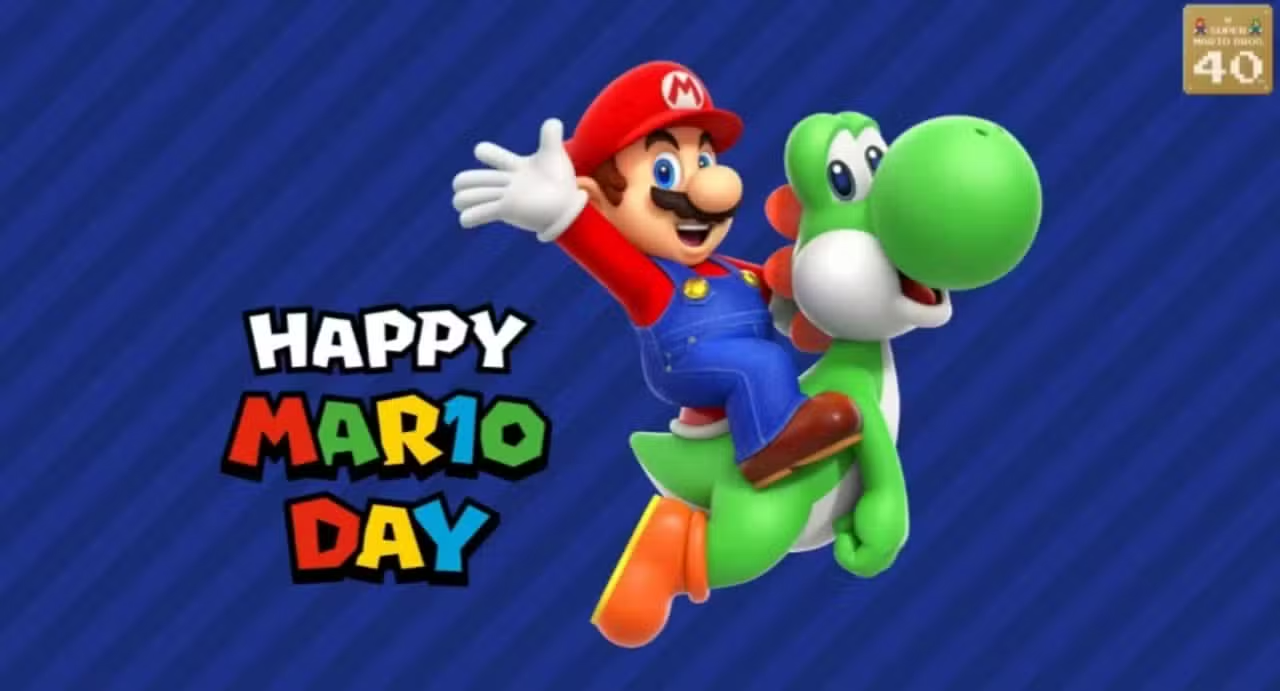
The Japanese electronics manufacturer has announced a significant expansion to its digital subscription service, scheduled to launch on March 10th. The online platform will welcome a new wave of classic games, integrating historical systems with the brand’s modern ecosystem. The strategy aims to unify different generations of hardware in a single virtual environment, guaranteeing legal access to works that have marked the entertainment industry. The initiative serves both digital preservation enthusiasts and new consumers looking to learn about the roots of established franchises.
Historic preservation and easy access
The inclusion of old catalogs on contemporary platforms acts directly against planned obsolescence and the degradation of physical media. Especialistas in technology point out that official digitization is the safest method to keep the legacy of video games accessible to the general public.
With the transition to the virtual environment, the company resolves technical bottlenecks that previously prevented old codes from running on high-definition screens. The emulation process developed internally ensures that the original design of the works remains intact, without the need to resort to parallel markets.
The rescue of stereoscopic technology
The announcement surprised the market by confirming the arrival of titles originally launched in 1995, focused on incipient virtual reality. The system, which used red and black light-emitting diode displays, had an extremely short life cycle due to ergonomic limitations at the time.
To overcome visual challenges in contemporary hardware, the manufacturer developed specific peripherals that replicate the feeling of isolation of the original equipment. Three-dimensional viewing requires blocking the external environment, something that conventional televisions cannot reproduce natively.
Consumers will have access to two accessory options to experience this technology authentically. The market will receive both a detailed replica of the classic display with tabletop stand and a cardboard mountable version, aimed at more casual and accessible experimentation.
Pioneering in depth mechanics
The initial library of this experimental platform includes works that defined the use of three-dimensional space before the popularization of polygons. One of the highlights is Mario Clash, an action game that requires precise calculation of distance and background to defeat opponents.
The combat dynamics force the player to throw items between different layers of the scene, testing reflexes and spatial perception. The adaptation of the original controls to modern analogue controls was calibrated to maintain the necessary fluidity in the more advanced stages.
Another confirmed addition is Mario’s Tennis, a fundamental title for the establishment of the company’s sports franchises. The camera positioned behind the character creates an illusion of depth that directly affects gameplay and response time.



The physics applied to the ball’s trajectory and the precision of the commands were accurately transferred to the new emulated environment. Matches require the user to understand positioning on the virtual court, an innovative element for the mid-nineties.
Expansion of the portable catalog
The subscription service also strengthens its range of pocket games with the inclusion of hits from Game Boy Advance, a system recognized for its vast thirty-two-bit library. The main draw of this update is Mario vs. Donkey Kong, an adventure that revives classic arcade rivalry through platform mechanics and logical puzzles. The narrative follows the pursuit of a plumber after the robbery of a toy factory, requiring the player to navigate through scenarios full of mechanical traps and colorful switches.
Progression through the stages depends on mastering acrobatic movements and prior planning to safely rescue miniatures before the time limit runs out. The transition from the original laptop’s controls to the current buttons guarantees an immediate tactile response, a crucial factor for executing high-precision maneuvers. The immediate availability of these titles reinforces the company’s commitment to offering fast and challenging experiences for users who prefer the console’s portable mode.
Hardware requirements for the new generation
The integration of the GameCube collection represents the biggest technological leap in this update, being a feature restricted to owners of the Nintendo Switch 2. Faithful emulation of this generation requires substantial raw processing power to maintain stable framerate and apply resolution improvements without compromising the source code. The manufacturer’s software engineering team needed to optimize the emulators so that the transition between the system menus and heavy games occurs seamlessly. The exclusivity of this catalog on the new device justifies the investment in recent hardware, while increasing the perceived value of the premium subscription. The digital ecosystem now encompasses a timeline that goes from the beginnings of eight bits to robust three-dimensional experiences, consolidating the platform as a high-performance interactive historical archive.
Network and storage infrastructure
Continued access to this expansive library requires maintaining the brand’s premium online network plan. Além from the backwards compatible catalog, the infrastructure guarantees the stability of multiplayer matches over the internet and automatic data backup on remote servers, protecting users’ progress against local failures.
Retention strategy in the digital market
The constant supply of the service with classic systems highlights a long-term tactic for retaining the installed base. The nostalgic factor acts as a pillar of engagement, filling calendar gaps between the industry’s big-budget releases.
Centralizing decades of mechanical and narrative evolution into a single device demonstrates the maturity of the service-focused business model. Official preservation eliminates the risks of the parallel market and ensures that the cultural heritage of electronic games remains active for future generations.
Veja Tambem em News (EN)

Research reveals that parents are unaware of how their children use artificial intelligence

Samsung releases new system update with new features for Galaxy Watch 4 users
Digital retail reduces the value of the Galaxy S25 5G smartphone with bank bonuses and device exchange

Amazon’s wireless CarPlay adapter has a 50% discount and high approval ratings from drivers

Zach Cregger’s new Resident Evil ignores games and focuses on an unprecedented story with new characters

Rumor suggests that Nintendo is preparing a special edition of the Switch 2 with a remake of Ocarina of Time

Apple accelerates production of the iPhone 17e and develops new Air model with dual camera system

Epic Games platform releases twelve high-budget games at no permanent cost for PC users

PlayStation 5 Pro price drop accelerates digital retail sales and eliminates global stocks

New Galaxy Watch 9 firmware appears on server and confirms progress in software development

Apple’s commemorative project tests cell phone with 1.1 millimeter edge and curved screen for 2027