
Recording of a cylindrical object by the Curiosity rover on Mars sparks debate about space debris

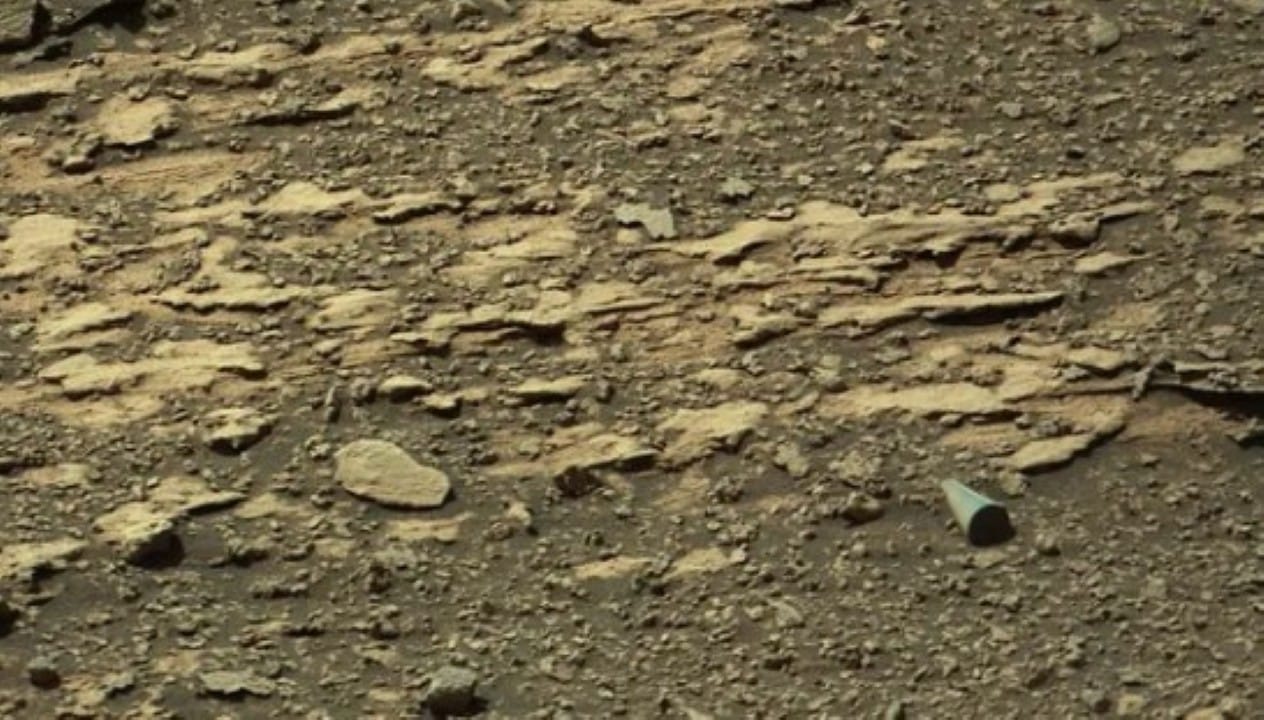
The Mastcam camera attached to the Curiosity rover recorded the presence of a peculiar cylindrical object partially buried in the soil of Marte. The discovery occurred specifically in the region known as Passo Paraitepuy, located inside Cratera Gale, and mobilizes technical discussions among experts in astrophysics and planetary geology. The original photographic record was captured in August 2022, but recent detailed analyzes have brought the topic back to the center of global scientific debates.
The structure has a regular geometric shape, measuring approximately 20 centimeters in length, with remarkably flat ends. Essa morphology contrasts significantly with the natural rock formations commonly found on the Red Planet. The visual discrepancy led the scientific community to further investigate the origin of the material.
Technical opinions are currently divided into different fronts of study on the anomaly identified through the lenses of robotic equipment:
– The possibility of it being a fragment of space debris from the Earth mission itself.
– The chance to represent a rare geological anomaly carved by wind erosion over millennia.
– The need to review material disposal protocols during planetary landings.
Detailed analysis of the geometric structure in the region of Passo Paraitepuy
Researchers involved in scrutinizing the Martian soil anomaly, such as Rami Bar Ilan and doctor Jan Špaček, were responsible for compiling the visual data and bringing the case to Avi Loeb’s attention. The astrophysicist and Universidade of Harvard professor is recognized for his rigorous approach to investigating unidentified objects in space. Public discussion about the nature of this cylinder has gained momentum in scientific forums and official mission data repositories, where the object appears clearly in multiple high-resolution images captured by the rover’s lenses, eliminating the possibility of camera sensor failure or digital compression artifact.
The central point of the investigation lies in the symmetry of the piece found on the slopes of Monte Sharp, an area characterized by natural debris and narrow valleys. Technical data from the Mars Science Laboratory mission cataloged the part under identification number 713174794 in the database maintained by Universidade from Washington in St. Louis. The exact location of the photographic record is located in a geological transition zone that the astrobiology team constantly monitors. The Curiosity rover has been traveling through this inhospitable region since its landing in 2012, accumulating more than a decade of continuous exploration that results in the natural physical wear and tear of its structural components.
Main hypothesis points to fragments of the landing system
The explanation currently most accepted by aerospace engineers indicates that the silver cylinder is, in fact, artificial debris derived from the human exploration system itself. Durante the complex descent procedure that took place in 2012, crucial equipment such as the aerial crane and the heat shield were ejected according to mission planning.
The standard procedure predicts that these pieces reach the surface and leave fragments scattered over a radius of several kilometers. The force of the impact and the dispersion caused by Martian winds over the years justify the presence of materials in places far from the original landing point.
The Curiosity rover is a highly complex machine, with dimensions comparable to a sports utility vehicle, weighing around 900 kilos and equipped with robotic arms and machined aluminum wheels. Throughout the operations, routine visual inspections of the wheels have already revealed punctures and the loss of small pieces of metal.
This history reinforces the theory that the cylindrical object is a detached component of the mission itself. Especialistas in space mechanics remember that previous events, which initially seemed inexplicable, were later identified as plastics, cables or metals originating from the robot’s protective shields during entry into the atmosphere.
Robotic equipment distance and navigation protocols
Given the implications of the discovery, Avi Loeb and other researchers suggested that Curiosity, which is currently exploring the lower regions of Monte Sharp, could return to the location of the find. The objective would be to carry out a direct spectrometric analysis of the material to determine its exact chemical composition and end speculation about its origin.
The rover, however, is located at a distance of approximately eight kilometers from the fracture where the cylinder was seen in 2022. Essa distance would require extremely complex logistical planning on the part of mission operators at Laboratório from Propulsão to
Operating at its maximum safe speed, which is just 0.16 kilometers per hour, the robot would need many days of uninterrupted navigation to retrace the route. The North American space agency prioritizes pre-established research objectives and the preservation of the useful life of the equipment, avoiding deviations that could compromise the primary search for ancient habitable environments.
History of visual anomalies and the phenomenon of pareidolia
Since the beginning of its journey at Cratera Gale, Curiosity has released hundreds of thousands of images that often generate intense debates about peculiar shapes. In several cases, objects resembling spoons, carved rock doors, or artificial lights have been scientifically explained as instances of pareidolia, or simple reflections of light falling on specific mineral formations.
The fundamental difference compared to the current cylinder is the consistency of images captured at different angles and lighting conditions. The geometric precision of the piece contrasts sharply with the Martian blueberries, which are small natural spheres of hematite, and with the gypsum crystals that the rover usually excavates, which rules out the hypothesis of a primary natural geological formation.
Data transparency and collaboration with independent scientists
Open access to data repositories maintained by research institutions allows citizen science to collaborate with government agencies in cataloging the Martian environment. The identification of this cylinder by external researchers demonstrates the effectiveness of open data policies maintained for interplanetary missions. Quando anomalies are discussed publicly, the global scientific community can apply different image analysis methodologies to reach a technical consensus. Esse rigorous scrutiny process ensures that independent analysts have access to raw files even before they are processed on general release portals. Precise identification of each component detached from the rover helps engineers design more robust vehicles for future missions, providing empirical data on how metal alloys and polymers behave under the radiation and rarefied atmosphere of Marte. Essas information is fundamental for the development of hardware that will be used in the Artemis program and in future manned explorations in deep space.
Wear of materials during interplanetary missions
Curiosity’s telemetry and health data shows that the robot has remarkable resilience, but is not immune to the planet’s extreme conditions. Huge temperature variations between day and night, combined with fine, highly abrasive dust, affect the structural integrity of cables, mechanical seals and external fasteners over years of continuous operation.
The glowing object has become a point of technical interest that illustrates the ongoing challenge of maintaining planetary cleanliness during space exploration. As more machines are sent to the surface of Marte, the presence of debris generated by terrestrial exploration becomes a constant variable that geologists must learn to catalog and differentiate from authentic geological discoveries.
Continuous monitoring of Cratera Gale by instruments
The discussion promoted by experts consolidates the commitment to the search for answers based on empirical data, regardless of whether the origin of the object is confirmed as simple engineering debris. Enquanto the debate takes place behind the scenes academically, the Curiosity rover maintains its programmed trajectory, analyzing the mineralogical composition of the soil and sending daily reports that help unravel the climatic history of the red planet.



