
3I/ATLAS disappears from view with accelerated fading and 22 anomalies observed by astronomers

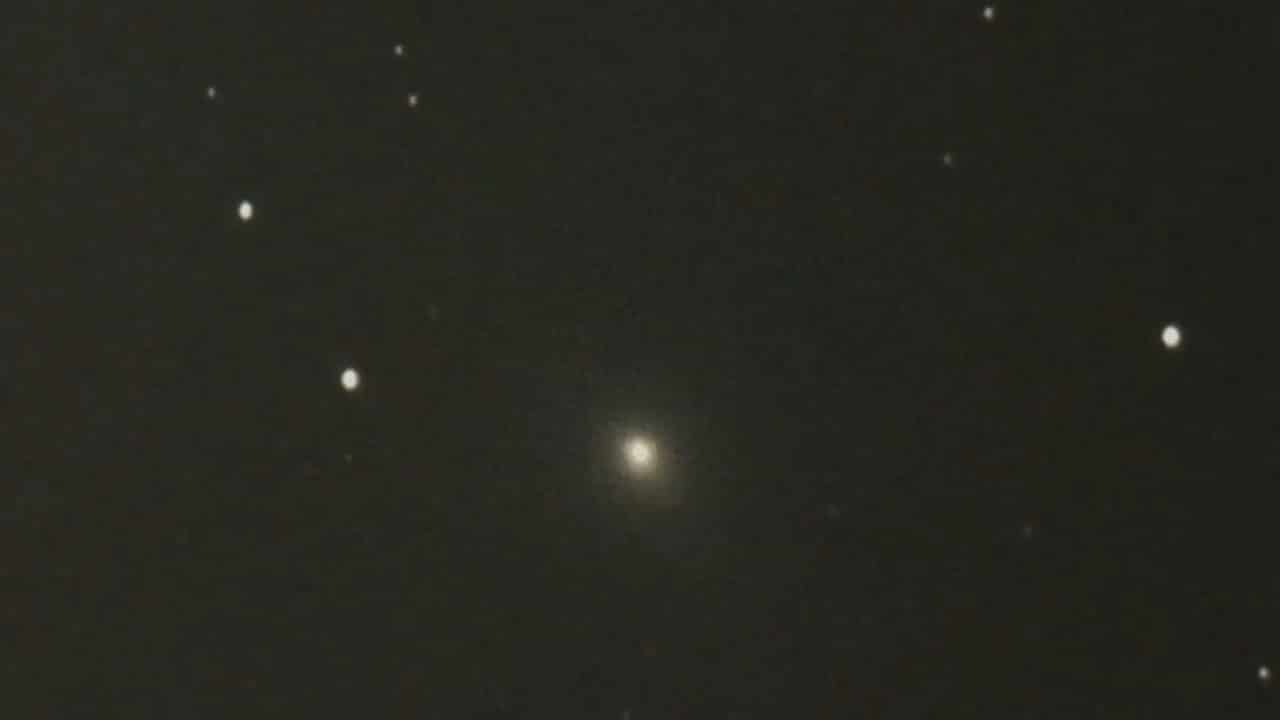
Interstellar comet 3I/ATLAS progressively loses brightness as it moves away from Sistema Solar, after completing its hyperbolic trajectory that included a close approach to Júpiter on March 16, 2026. 2026 indicating reduction in luminosity. The celestial body exhibits non-gravitational acceleration attributed to a complex system of jets, and its nature sparks debate due to a series of unusual features detected throughout the passage.
Trajectory and planetary passage
The object followed a retrograde orbit almost symmetric with respect to entry into Sistema Solar. The approach to Júpiter occurred at approximately 53.6 million km, a value very close to the radius of the planet’s Hill, which slightly influenced its acceleration. Observações indicate that perihelion, the closest point to Sol, occurred around October 2025 at 1.4 AU, and the body showed significant brightening close to that time.
After perihelion, the comet remained active with the emission of gas and dust. Imagens from the Hubble telescope and SPHEREx recorded variations in the coma, including increased water production and detection of organic molecules. The trajectory avoided direct observation of Terra at perihelion, which limited data in certain periods.
Observed geometric anomalies
Several geometric characteristics draw attention due to their low probability of random occurrence. The retrograde orbit aligned less than 5 degrees with the planets’ orbital plane, and the arrival time minimized distances to Marte and Júpiter. The pre-perihelion antitail exhibited collimation toward Sol, extending hundreds of thousands of km, unprecedented in known comets.
The initial rotation axis aligned less than 8 degrees with the direction of Sol on entry, and jet bases activated only when facing Sol, even on the night side for months. In January 2026, the object aligned with the Sol-Earth axis at 0.69 degrees, targeting anti-tail for ground-based observers.
Unusual compositional features
Spectral analyzes revealed distinct composition. The pre-perihelion gas plume contained more nickel than iron, with a nickel-cyanide ratio orders of magnitude higher than solar comets. Moléculas organic substances such as methanol, formaldehyde, methane and ethane appeared after perihelion, along with a 20-fold increase in the rate of water production.
The ice signature disappeared post-perihelion, suggesting deep layers shielded from cosmic radiation for billions of years. Abundâncias hydrogen and carbon isotopes differ from local comets, indicating origin in a low temperature environment below 30 Kelvin and low metallicity.
Jet activity and polarization
The jet system stood out for its symmetry. Processamento images of Hubble showed three mini-jets separated by 120 degrees. The anti-tail penetrated the solar wind over extensive distances, requiring larger-than-usual particles to explain the observed scattered light.
Extreme negative polarization has been recorded with no equivalent in known comets, including 2I/Borisov. The perihelion glow occurred faster than standard, and the color appeared bluer than Sol.
Comparison with previous visitors
Compared to 1I/’Oumuamua and 2I/Borisov, 3I/ATLAS has a more massive core and greater speed. Diferencia is due to pronounced cometary activity, symmetrical jets and composition rich in nickel and organics. Enquanto ‘Oumuamua lacked a visible coma, and Borisov followed more familiar chemical patterns; this third visitor combines elements that defy conventional models.
Observations from multiple missions, including Hubble, SPHEREx, TESS, and even cameras on probes such as Juice and Mars Reconnaissance Orbiter, contributed to the dataset. Current fading limits new observations, but the accumulated record allows for detailed analysis.
Challenges for interpretation
The discrepancy in the parental mass budget exceeds expected reservoirs in planetary disks of low-metallicity stars. The gravitational deviation at perihelion corresponded to twice the opening angle of the anti-tail, suggesting a connection between jets and trajectory. The persistence of activity over large distances and chemical stratification demand robust physical explanations.
Astronomers continue to process data to understand whether extreme natural processes explain the cluster or whether alternative hypotheses deserve consideration. The object is now moving away permanently, leaving open questions for future studies of interstellar visitors.



