
ALMA telescope detects record levels of methanol in interstellar comet 3I/ATLAS during solar approach
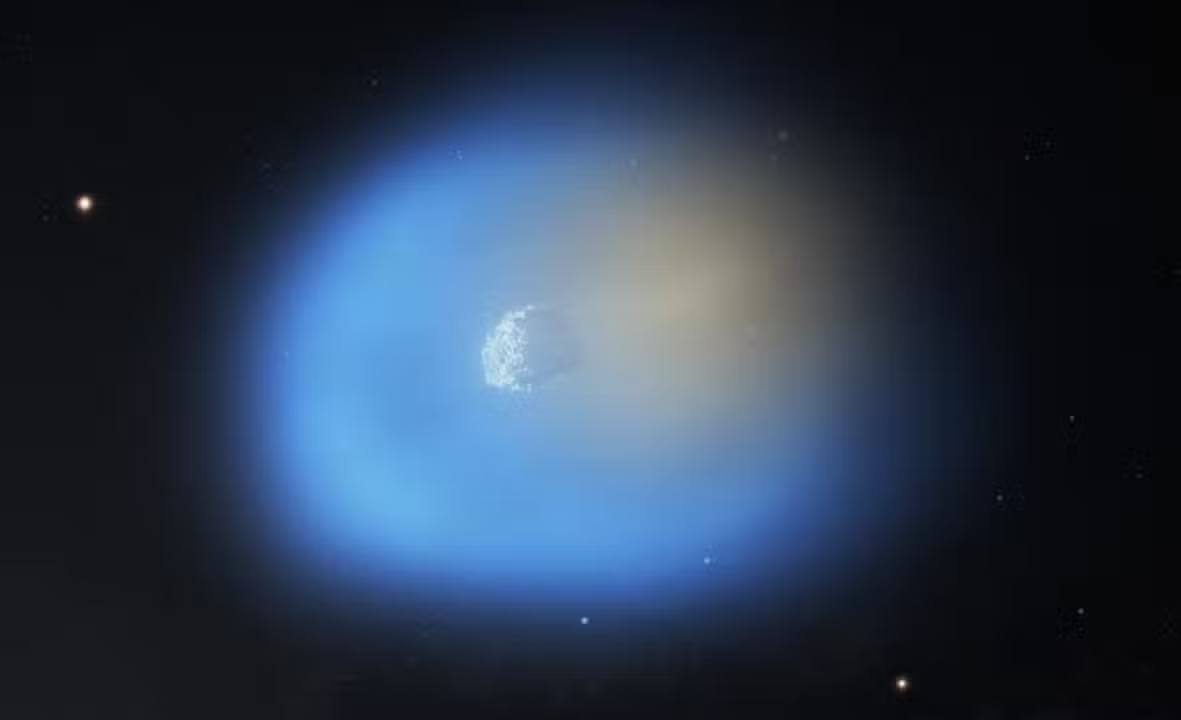
Astronomers have identified an unusual concentration of methanol in the structure of the interstellar comet 3I/ATLAS, a celestial body originating outside our solar system. The detection occurred through detailed observations conducted with the Atacama Large Millimeter/submillimeter The data reveals that the release of gases in the comet’s coma is largely dominated by this simple organic molecule, altering known parameters about the composition of errant bodies.
The research, led by scientist Nathan Roth, from American University, points to a chemical composition substantially different from that found in comets formed in the solar neighborhood. The study provides unprecedented markers about the environmental conditions and physical processes present in the protoplanetary disks of other stellar systems. The quantitative analysis of gaseous emissions establishes a new reference for the classification of objects that cross interstellar space and end up temporarily captured by the gravity of our system.
The measurements captured emissions at submillimeter wavelengths, allowing researchers to isolate the exact origin of the gases around the cometary nucleus. The survey establishes a new level for understanding the primordial chemistry that governs the formation of celestial bodies in regions distant from Via Láctea. Continuous monitoring of the object has generated a volume of data that will continue to be processed by international astrophysics teams.
Detailed analysis of gaseous emissions
The instruments recorded a ratio of methanol to hydrogen cyanide that varied between 70 and 120 during specific astronomical observation windows.
These numbers place 3I/ATLAS at the top of the list of cometary objects richest in organic alcohol ever documented by modern science, far surpassing local averages.
The mapping indicated that methanol is ejected both directly from the rocky core and from ice grains dispersed in the coma that surrounds the celestial body.
In contrast, hydrogen cyanide presented a centralized origin, emanating almost exclusively from the main nucleus, which suggests different sublimation points for each compound.
Operation of equipment in the Atacama desert
The ALMA telescope operates through an international consortium and uses a set of high-precision parabolic antennas, working in unison as a single gigantic radio telescope. The installation on the Chajnantor plateau, in the Atacama desert, offers ideal atmospheric conditions, with very low humidity, which drastically minimizes the absorption of submillimetre signals by the water present in the Earth’s atmosphere. Essa cutting-edge technical configuration was strictly necessary to capture the extremely weak signals emitted by comet molecules millions of kilometers away from Terra.
During observation campaigns, scientists specifically used Atacama Compact Array to track molecular movements with unprecedented spatial resolution. Fine calibration of the receivers allowed it to identify the exact spectral fingerprints of methanol and cyanide, separating background noise from the interstellar object’s actual emissions. The primary processing of this raw data required the application of complex filtering algorithms to quantify the rate of gas production with minimal margins of error and ensure the integrity of the discovery.
Thermal behavior during the hyperbolic trajectory
Confirmed as the third interstellar visitor to cross our cosmic neighborhood, 3I/ATLAS follows an open hyperbolic orbit, meaning it is not gravitationally bound to Sol and will return to deep space after its passage. As the object reduced its distance from the star, the increase in thermal radiation activated an intense process of sublimation, transforming the frozen volatile compounds directly into gas. Esse progressive heating generated an asymmetric material release pattern, illuminating the coma predominantly in the hemisphere facing Sol and creating a debris tail visible in radio spectra. Thermal dynamics revealed a peculiar phenomenon where the ice grains ejected into the coma continued to sublimate methanol independently, acting in practice as secondary mini-comets orbiting the main nucleus. Essa direct observation of fluid mechanics and thermodynamics in an alien body provides crucial empirical data to validate the mathematical models of cometary dynamics currently used by space agencies.
History of visitors from other star systems
Modern astronomy began cataloging objects from outside the solar system in 2017, with the detection of 1I/’Oumuamua, an elongated rocky body that showed no measurable gaseous activity during its passage.



Two years later, telescopes identified 2I/Borisov, which exhibited an active coma and a chemical signature remarkably similar to comets in our own Oort cloud.
The arrival of 3I/ATLAS introduces a new variable into this incipient catalogue, demonstrating that the composition of materials ejected by other stars has a much greater structural heterogeneity than initial theories predicted.
Contributions to astrobiology studies
The abundant presence of simple organic molecules, such as methanol, is considered a fundamental step in the chemical chain that leads to the formation of complex prebiotic compounds in the universe.
The massive detection of these elements in an interstellar body reinforces the scientific hypothesis that the essential building blocks for biological development are widely distributed throughout the galaxy.
Data integration with space observatories
The measurements carried out on the Chile gain even more scientific relevance when crossed with the infrared data collected by the James Webb space telescope, which had already detected carbon dioxide in the 3I/ATLAS coma.
This multi-wavelength approach allows researchers to build a complete, three-dimensional profile of the comet’s chemistry, combining ground-based radio observations with space-based optical captures.
Quantitative parameters of international research
The astrophysics team’s final calculations indicate that, in its moments of greatest thermal activity, the comet ejected approximately 40 kilograms of methanol per second into the vacuum of outer space.
Impacts on astronomical computational modeling
Supercomputer simulations of cometary formation now incorporate this new quantitative data to refine molecular distribution parameters based on extreme environmental conditions.
Updates to computational codes integrate relationships observed in 3I/ATLAS, creating more accurate tools to predict the behavior of future interstellar objects detected by planetary defense systems.
Veja Tambem em News (EN)

Research reveals that parents are unaware of how their children use artificial intelligence

Samsung releases new system update with new features for Galaxy Watch 4 users

Digital retail reduces the value of the Galaxy S25 5G smartphone with bank bonuses and device exchange

Amazon’s wireless CarPlay adapter has a 50% discount and high approval ratings from drivers

Zach Cregger’s new Resident Evil ignores games and focuses on an unprecedented story with new characters

Rumor suggests that Nintendo is preparing a special edition of the Switch 2 with a remake of Ocarina of Time

Apple accelerates production of the iPhone 17e and develops new Air model with dual camera system

Epic Games platform releases twelve high-budget games at no permanent cost for PC users

PlayStation 5 Pro price drop accelerates digital retail sales and eliminates global stocks

New Galaxy Watch 9 firmware appears on server and confirms progress in software development

Apple’s commemorative project tests cell phone with 1.1 millimeter edge and curved screen for 2027
