
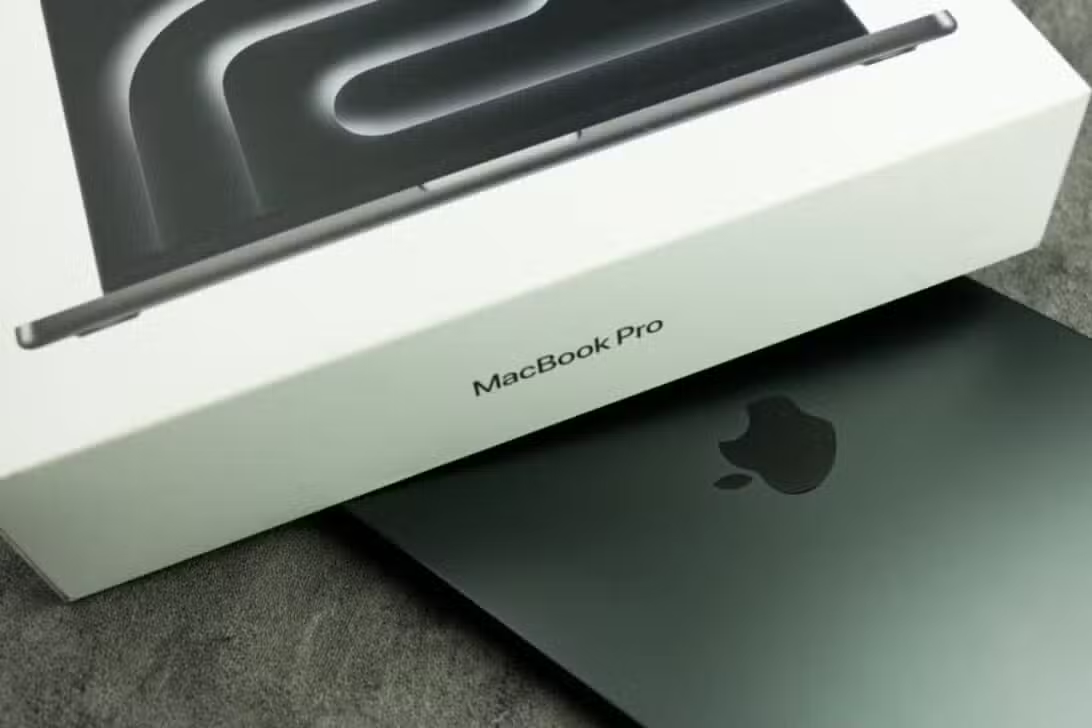
The North American technology giant is preparing a profound reformulation for its main line of computers aimed at high-performance professionals. The development of the new generation of laptops brings structural changes that change the visual standard established by the brand in recent years. The company’s Engenheiros work on a considerably thinner and lighter chassis, reversing the thickness trend adopted in previous versions.
This hardware update is not just restricted to the external aspect of the equipment. The internal architecture of the device will undergo a complete redesign to accommodate components that are new to the manufacturer’s portable computer category. The central objective of the project is to unify extreme portability with processing capacity capable of handling complex rendering and artificial intelligence tasks.
Behind-the-scenes information from the semiconductor industry indicates that the current development cycle represents the brand’s biggest technological leap since the transition to its own processors. The integration of new visualization and physical interaction technologies promises to change the dynamics of daily use for consumers who depend on these machines for intense workflows.
Advanced processing architecture
The core of the entire system will be powered by the new internally developed processor family, initially divided into standard variants, Pro and Max. The great innovation of this component lies in the lithography process used in its manufacture, which will reach the unprecedented mark of 2 nanometers. Essa reducing the scale of transistors allows allocating a much larger number of processing cores in the same physical space.
The transition to 2-nanometer lithography guarantees a substantial increase in the energy efficiency of the equipment. Dispositivos High-performance mobile phones often face the challenge of balancing battery consumption with delivering maximum computing power. With the new architecture, the computer will be able to run heavy video editing and three-dimensional modeling software while consuming a fraction of the energy required by past generations.
The development of this chip goes hand in hand with the advances designed for smartphone processors from the same manufacturer. Synergy between silicon engineering teams results in an ecosystem where miniaturization innovations achieved in pocket devices are rapidly scaled to desktop and laptop computers.
Visual revolution with organic panels
The replacement of traditional backlight technology with organic light-emitting panels marks a drastic change in the visual quality of the equipment. The adoption of the OLED screen in the brand’s portable computers raises the standard of color reproduction and contrast to professional levels required by film and photography studios. Cada pixel on the screen has independent lighting, which results in absolute blacks and a virtually infinite contrast ratio.
In addition to color accuracy, OLED technology plays a key role in reducing the overall thickness of the computer chassis. By not requiring a separate backlight layer, the panel becomes millimeters thinner, directly contributing to the slim design sought by the company’s industrial designers. Essa Saving internal physical space allows for a strategic redistribution of motherboard components and battery cells.
The fluidity of animations and the visual response of the operating system will also benefit from the characteristics inherent to organic panels. Taxas Variable refresh rates and near-instantaneous response times reduce motion blur when scrolling long text or playing content at high speed. Profissionais video editors will notice superior frame accuracy when manipulating complex timelines.
The implementation of this technology in laptops follows an expansion schedule that began with smart watches, went through cell phones and recently reached the brand’s line of professional tablets. The maturation of the large format OLED display supply chain has allowed the manufacturer to secure the volume needed to equip its best-selling line of computers without compromising rigorous visual quality standards.
Integration of touch commands on the screen
The introduction of a touch-sensitive layer on the display represents a historical paradigm shift for the brand’s computer line, which for decades resisted this functionality. Software engineering is working on adapting the macOS 27 operating system to recognize complex gestures directly on the glass, without eliminating the need for the physical keyboard and high-precision trackpad. The manufacturer’s strategy is to offer touch as an auxiliary input method, ideal for quickly scrolling documents, zooming in images and direct selection of interface elements during presentations or reviews of visual projects.
To ensure an ergonomic user experience, developers are restructuring visual elements of the system, subtly increasing the spacing between icons and drop-down menus. Essa modification aims to prevent accidental touches and facilitate navigation with your fingers, maintaining the precision required by using the traditional cursor. The unification of gestures already established on the company’s mobile devices will create a smooth learning curve for consumers, allowing actions such as pinching to zoom or swiping to switch between applications to work identically across the manufacturer’s entire hardware ecosystem.
Frontal redesign and dynamic interactivity
The design of the display’s top bezel will undergo a significant aesthetic and functional transformation with the removal of the rectangular notch introduced in previous updates. In its place, the manufacturer will adopt a minimalist circular cutout to house the high-resolution camera module and brightness sensors, freeing up valuable pixel area in the system’s menu bar. Essa hardware change serves as the basis for implementing an interactive software interface that surrounds the camera cutout, fluidly expanding and contracting to display real-time notifications, status of file transfers, media playback controls, and system alerts. The dynamic area will function as a contextual information center, allowing the user to interact with applications in the background without having to divert attention from the main work window, optimizing the multitasking flow and intelligently integrating the physical limitations of the hardware with the expansive possibilities of the operating system’s interface design.
Thermal management in ultra-thin profiles
The drastic reduction in equipment thickness required the development of a completely redesigned heat dissipation system to avoid performance losses under continuous stress. Engenheiros of hardware created new metal alloys for the ultra-low profile heatsinks and fans that operate at barely perceptible acoustic frequencies, ensuring the processor maintains its maximum operating speeds during prolonged video exports without overheating the aluminum chassis.
Independence from fixed networks with cellular connection
The mobility of professionals using these computers will be increased with the long-awaited integration of cellular connectivity modems directly onto the motherboard. The ability to access high-speed data networks without relying on public Wi-Fi hotspots or mobile phone tethering transforms the laptop into a truly independent workstation in any location.
The implementation of this technology is linked to the development of the brand’s proprietary telecommunications components. The use of a second generation internal modem will optimize battery consumption when searching for a network signal, ensuring that the convenience of constant connection does not compromise the daily autonomy of the equipment during business trips or work in the open field.
Distribution strategy and impact on the sector
The manufacturer’s global supply chain has already begun preparations for mass production of the new components, aiming for a consolidated launch on the international market. The strategy of presenting all variants of the equipment at a single event seeks to maximize the commercial impact and facilitate the purchasing decision by corporations that plan to update their technology parks in a standardized way.
The company’s move sets a new bar for the personal computer industry, forcing competitors to accelerate their own research and development schedules. The combination of advanced lithography, organic screens and new physical interaction methods consolidates the device as the technical reference for the professional productivity hardware market in the coming years.